
US Dollar Breaks Through Rp17,000, Rupiah Hits All-Time Low
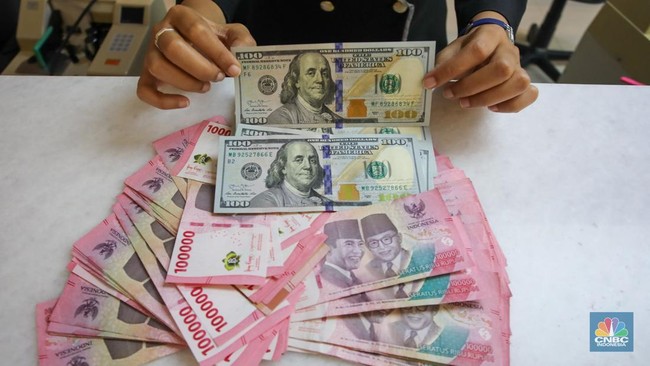
The rupiah exchange rate has once again set a dismal record against the US dollar on Wednesday’s trading (1/4/2026). The Garuda currency has officially broken through the Rp17,000/US$ level, marking the weakest intraday position for the rupiah in spot market history. According to Refinitiv data, at 09:31 WIB, the rupiah weakened by 0.06% to Rp17,000/US.Thislevelrepresentsanewmilestoneintherupiah′sdepreciation, followingthecurrency′srecordclosinglowthepreviousday.OnTuesday′strading(31/3/2026), therupiahcloseddownaslight0.03. Although still below the psychological Rp17,000/US$ level, that figure became the all-time weakest closing position for the rupiah. In fact, looking at intraday movements, pressure on the rupiah had already been evident since the previous day’s trading. The rupiah briefly touched Rp16,998/US, whichwasthentheweakestintradaylevel.However, adaylater, thatlevelwassurpassed, andtherupiahofficiallyfelltoRp17, 000/US. Thus, over two consecutive days, the rupiah has continuously set new depreciation records, from the weakest closing to the all-time weakest intraday. Actually, Bank Indonesia (BI) had just implemented foreign exchange repo with underlying SVBI and SUVBI at the start of this week, which was expected to strengthen domestic foreign exchange liquidity and support rupiah stability. This movement indicates that pressure on the rupiah remains very significant amid high global uncertainty and strong market demand for the US dollar. Looking back, this rupiah weakening adds to a long list of extreme pressure episodes experienced by the Garuda currency. There have been several crucial periods recorded as the most challenging phases for the rupiah, from monetary crises, domestic political turmoil, to global shocks that trigger capital flight to safe-haven assets. (1) August-October 1997 The rupiah’s weakening from August to October 1997 marked the initial phase of the Monetary Crisis in Indonesia. During this period, the exchange rate plunged from around Rp2,500/US$ to the Rp3,000s/US.IntensespeculativepressureforcedBankIndonesiatoabandonthemanagedfloatingsystemandswitchtoafree − floatingexchangerate.Thisstepwastakenbecauseforeignexchangereserveswerenolongersufficienttosustainrupiahsupportthroughmarketinterventions.TheworseningdepreciationthenpromptedthegovernmenttoseekassistancefromtheInternationalMonetaryFund(IMF).Thefirstaidagreementwassignedon31October1997, withonekeyconditionbeingtheclosureof16nationalprivatebanks.(2)May − June1998Afterthe1997pressures, therupiahentereditsdarkestphaseinMaytoJune1998.Refinitivdatashowsthaton16June1998, therupiahcollapsedtoitsall − timelowestclosinglevelof15, 200/US. However, intraday, it briefly reached 16,800/US.Thisextremepressureoccurredastheeconomiccrisisexpandedintoapoliticalandsocialcrisis.TheshootingofTrisaktiUniversitystudentson12May1998triggeredmassiveriots, looting, andarsoninJakartaandseveralothercities, causinginvestorstowithdrawfundsenmasse.UncertaintypeakedwhenPresidentSoehartoresignedon21May1998, whilethemarketremaineddoubtfulaboutthestabilityofthenewgovernmentunderB.J.Habibie.(3)April2001Enteringthereformera, therupiahfacedrenewedpressureinApril2001, tradingbetweenRp10, 500andRp12, 000/US. The main trigger was rising political uncertainty, as tensions between President Abdurrahman Wahid (Gus Dur) and the DPR and MPR culminated in plans for a special session to impeach the president. At the same time, relations with the IMF deteriorated due to delayed loan disbursements, as economic reforms were deemed to be progressing slowly, worsening foreign exchange market sentiment. (4) October-November 2008 One of the rupiah’s dark periods also occurred in 2008. From October to November that year, pressure on the rupiah came from abroad through the Global Financial Crisis, which began with the collapse of the US housing market and peaked with Lehman Brothers’ bankruptcy in September 2008. Panic led global investors to pull funds from emerging markets and shift them to safe assets like the US dollar and US government bonds. The rupiah, which had been stable around Rp9,000/US$ in August 2008, then fell to Rp12,100 to Rp12,600/US$ in November 2008. (5) September 2015 Significant pressure on the rupiah re-emerged in 2015. Up to 14 September 2015, the rupiah had weakened by 15.87% for the year, closing at Rp14,645/US$ that month. The depreciation was triggered by reduced foreign capital inflows due to global sentiment, particularly the US Federal Reserve’s monetary policy normalisation and China’s yuan devaluation. With high foreign exchange needs not matched by supply in the market, excess demand for foreign currency caused the rupiah to remain under pressure throughout the first half of 2015. (6) September-October 2018 From September to October 2018, the rupiah weakened amid turmoil in several emerging markets. The rupiah closed at Rp15,230/US$ on 11 October 2018. Externally, the weakening of the Turkish lira, Argentine peso, and other currencies led investors to chase safe-haven assets like the US dollar, yen, and US Treasury bonds. (7) March 2020 One of the deeper rupiah weakening moments occurred in March 2020. The exchange rate briefly touched Rp16,550/US$ and plunged 13.67% throughout March 2020, even breaching the psychological Rp16,000/US$ level, the weakest since the 1998 crisis. The main trigger was global panic due to the Covid-19 pandemic. The announcement of Indonesia’s first case in early March and plans for activity restrictions fu