
US Deploys Destroyer and Aircraft Carrier to Hormuz: How Formidable Is Its Power?
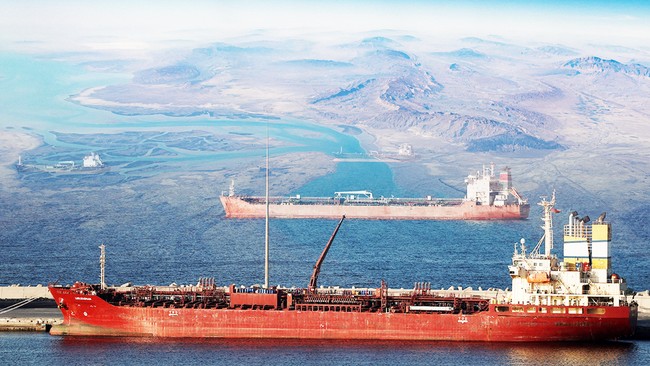
The United States has begun raising tensions in the Middle East after deciding to blockade all ship traffic entering and exiting Iranian ports starting Monday (13 April 2026) local time.
This step was taken after weekend negotiations between Washington and Tehran failed to produce an agreement to end the war that has been ongoing for about six weeks.
Nevertheless, the US military stated that ships belonging to countries other than Iran will not be obstructed, meaning they are permitted to cross the strait.
At the same time, Washington also announced it will begin destroying naval mines sown by Iran along the Strait of Hormuz.
This mission is quite noble to undertake as it will reopen shipping lanes, particularly for those carrying energy. However, in practice, securing and clearing the Strait of Hormuz is not an easy military operation. This operation certainly raises concerns about potential attacks from Iranian military forces.
This strait is one of the most important chokepoints in the world and falls within the operational area of the US 5th Fleet, headquartered in Bahrain.
The area of responsibility of this fleet covers the Arabian Gulf, Gulf of Oman, Red Sea, and parts of the Indian Ocean.
So, which fleets is the US most likely to use to secure this route?
Destroyers
According to the US Central Command (CENTCOM), which oversees the Middle East, the US military has currently deployed two warships of the destroyer type. The two ships are USS Frank E. Petersen Jr (DDG-121) and USS Michael Murphy (DDG-112).
Both are Arleigh Burke-class guided-missile destroyers, which are US Navy destroyers designed to carry missiles, escort fleets, and carry out various combat missions at sea.
CENTCOM reported that both ships crossed the Strait of Hormuz on 11 April and have begun initial operations to open lanes for shipping in the area.
CENTCOM also explained that the two ships are also being used to secure the situation there before the naval mine clearance team is deployed in the strait.
Underwater Drones from Task Force 59
One of the most important assets is not a large ship, but rather underwater drones or unmanned underwater vehicles (UUVs).
CENTCOM has already stated that additional elements, including underwater drones, will join the mine clearance operation in the coming days. This is important because the main threat in Hormuz currently is not just open confrontation, but also the danger of naval mines that could cripple passing ship traffic.
This step aligns with the direction of developing US naval power in the Middle East. The US Navy previously formed Task Group 59.1 under Task Force 59, which focuses on using unmanned systems combined with human operators to strengthen maritime security in the Middle East region.
This means that in the mission to clear the Strait of Hormuz, the US will likely not only rely on conventional warships.
They will also integrate unmanned technology to detect, map, and help remove subsurface threats.
Nevertheless, as of now, CENTCOM has not publicly detailed the type of underwater drones that will be used in the Hormuz mine clearance operation.
Abraham Lincoln Aircraft Carrier
Behind the two destroyers, the US also has the USS Abraham Lincoln, which is currently operating in the Arabian Sea in support of US military operations in the Middle East. This aircraft carrier serves as an umbrella due to its significant air power, from fighter jets and early warning aircraft (AWACS) to helicopters.
The USS Abraham Lincoln is a US aircraft carrier belonging to the Nimitz class, a group of large nuclear-powered carriers.
This ship is the fifth unit in that class and was built by Newport News Shipbuilding. Construction began on 3 November 1984, and it officially entered service on 11 November 1989. Since then, the USS Abraham Lincoln has been one of the key strengths of the US Navy for more than 30 years.
The main strength of this carrier is not just its hull, but its air capabilities. The USS Abraham Lincoln can carry up to about 90 aircraft and helicopters. In combat operations, the composition can be adjusted according to mission needs.
Its current battle group carries more than 60 fixed-wing aircraft and helicopters, including fighter aircraft, early warning aircraft, electronic warfare aircraft, and anti-submarine helicopters as well as search-and-rescue helicopters.