
US Breaches Ceasefire, Peace Talks with Iran Collapsing Again?
Jakarta, CNBC Indonesia - Tensions between Iran and the United States (US) have escalated after Tehran accused Washington of breaching the ceasefire with military strikes near the Strait of Hormuz. The accusation emerged as both nations were attempting to finalise an initial agreement to end a conflict that has lasted over three months.
Iran’s Foreign Ministry stated on Tuesday (27 May 2026) that the US attack in Hormozgan Province, southern Iran, was a ‘major breach’ of the fragile ceasefire that had been in place for nearly seven weeks.
Iranian media previously reported explosions heard in the area early Tuesday.
The US government defended its military operation, stating the attack was defensive. Washington claimed the targets were Iranian missile sites and vessels allegedly attempting to lay sea mines near the Strait of Hormuz.
US Secretary of State Marco Rubio said negotiations to halt the conflict may take several more days. Rubio stated the Strait of Hormuz must be reopened ‘by any means necessary’ during his visit to India, according to Reuters.
The US-Iran conflict erupted after a joint US-Israel attack on Iran on 28 February. The war triggered unprecedented global oil supply shocks, driving up prices for fuel, fertiliser, and food worldwide.
During the conflict, ship traffic through the Strait of Hormuz plummeted. The narrow passage typically handles about one-fifth of global oil and liquefied natural gas trade.
Iran’s Revolutionary Guard stated that 25 oil tankers and other vessels had transited the Strait of Hormuz in the past 24 hours with Iran’s permission.
Amid this, global Brent crude oil prices surged by around 3.5% on Tuesday, nearing $100 per barrel.
Iran’s Revolutionary Guard also warned they retain the right to retaliate against the latest US attack.
The elite Iranian forces claimed their air defence units shot down a US drone and engaged another drone and fighter jet alleged to have entered Iran’s airspace in the Gulf.
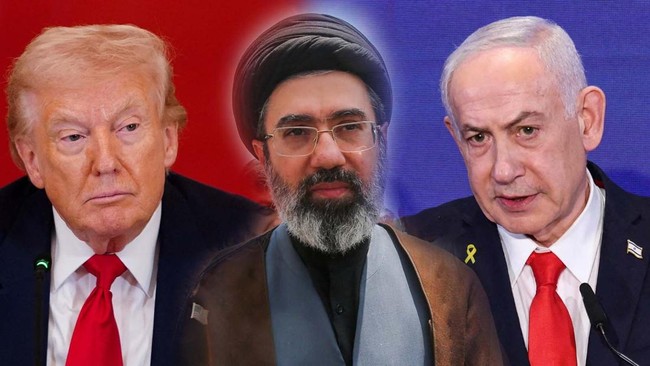
Meanwhile, Iran’s Supreme Leader Ayatollah Mojtaba Khamenei again issued harsh rhetoric against the US and Israel.
In a message posted on his official Telegram channel coinciding with the annual Hajj season, Khamenei said: ‘From now on, the slogans ’Death to America’ and ‘Death to Israel’ will be the slogans of the Islamic nation and the oppressed people of the world.’
US President Donald Trump had previously used these slogans to justify military actions against Iran.
Amid ongoing tensions, Iranian and US officials indicated progress in indirect talks on a preliminary memorandum of understanding intended to pave the way for broader peace negotiations.
Iranian media reported that Tehran’s chief negotiator, Mohammad Baqer Qalibaf, recently returned from Qatar after requesting the release of around $24 billion in frozen Iranian funds as part of the initial agreement.
Fars News Agency stated that the fund release is now the final obstacle in negotiations.
Iran also demanded an end to the conflict in Lebanon, where a ceasefire since mid-April has failed to stop clashes between Israel and Iran-backed Hezbollah.
Meanwhile, Israeli Prime Minister Benjamin Netanyahu said on Tuesday his country was expanding military operations in Lebanon.
‘Israel is deepening its operations in Lebanon,’ Netanyahu stated, adding his forces were moving with ‘significant strength on the ground’.
According to Iranian sources, the preliminary agreement would include a cessation of hostilities on all war fronts, restoration of shipping traffic in the Strait of Hormuz for 30 days, and possible financial assistance for Iran.
More complex issues, including Iran’s nuclear programme, would be negotiated in a second phase.
Reuters previously reported Iran has started allowing some ships to transit the Strait of Hormuz, prioritising vessels linked to Tehran’s friendly nations.
Trump himself stated his primary goal in the war is to prevent Iran from developing nuclear weapons through its stockpile of highly enriched uranium. However, Tehran continues to deny any plans to build a nuclear bomb.
At the same time, Trump is leveraging the crisis to push more Arab and Muslim nations, including Saudi Arabia, to join the Abraham Accords aimed at normalising relations with Israel.
Saudi Arabia has rejected the move without a clear roadmap towards establishing a Palestinian state.
The widening regional conflict has killed thousands, mainly in Lebanon and Iran. Meanwhile, in Iran, internet monitoring group Netblocks reported partial restoration of connectivity after nearly 90 days of outages.