
US Attacks 7 Iranian Vessels, 'Project Freedom' in Strait of Hormuz Begins
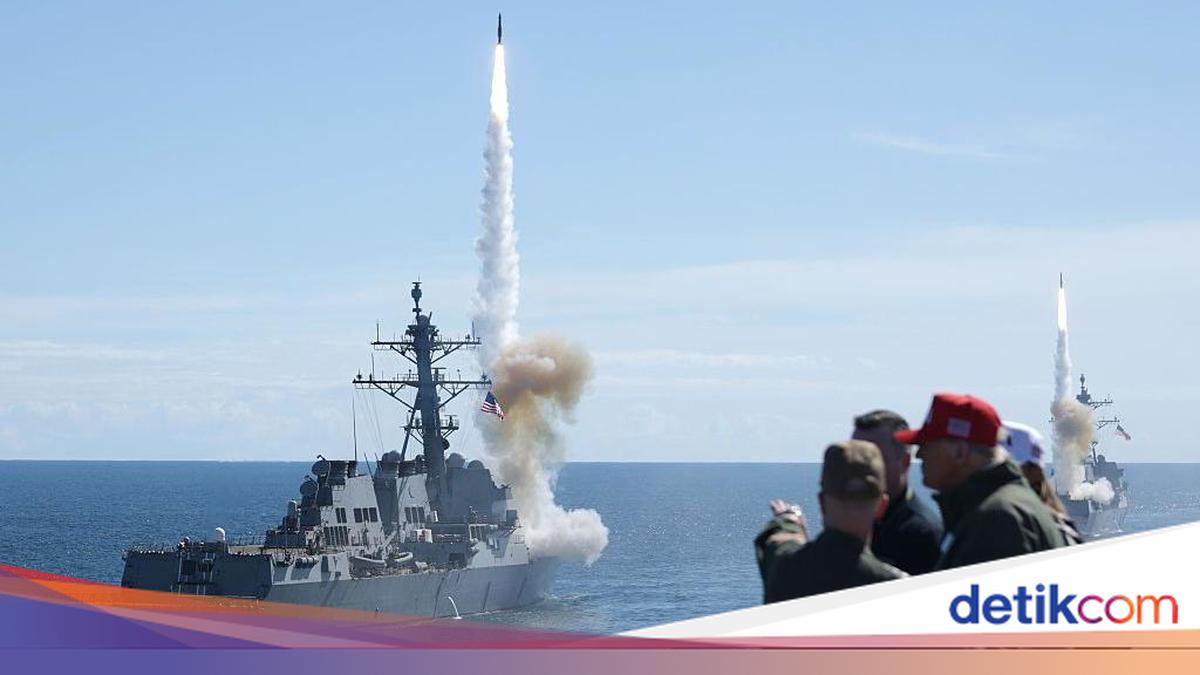
US President Donald Trump stated that the United States has attacked seven Iranian speedboats in the Strait of Hormuz. The attack was carried out as part of ‘Project Freedom’, Washington’s effort to guide ships out of the Gulf through the Strait of Hormuz.
Trump said: “We have shot seven small boats or, as they call them, ‘speedboats’. That’s all they have.”
The US military said helicopters were used to attack the vessels.
Iranian state media later denied Trump’s announcement. Citing military sources, the Tasnim news agency reported that two small cargo ships were hit in the attack, killing five civilians.
Previously, Trump stated that the US Navy would begin escorting stranded ships in Gulf waters to exit through the Strait of Hormuz on Monday (04/05). The ships have been stranded since Iran blocked the waterway route at the start of the conflict in February.
On Monday (04/05), shipping company Maersk said the US-flagged vessel Alliance Fairfax, stranded in the Gulf since late February, had exited the Strait of Hormuz.
The company said it had been contacted by US authorities who “offered the vessel the opportunity to exit the Gulf under US military protection”.
Maersk added: “The vessel then exited the Persian Gulf accompanied by US military assets without incident, and all crew members are safe and uninjured”.
However, not all ships in Gulf waters are safe from threats.
The United Arab Emirates’ Foreign Ministry reported that an oil tanker owned by Adnoc, the state oil company, was attacked in the Strait of Hormuz.
South Korea also reported an explosion on one of their ships anchored near the UAE.
Iranian Foreign Minister Abbas Araghchi said the events in the strait “clearly show that there is no military solution to the political crisis”.
He added: “Project Freedom is a Project of Deadlock.”
The Iranian military said it would attack US forces if they entered the Strait of Hormuz.
Why is this operation being carried out?
The US operation will involve 15,000 personnel, missile-armed destroyers, and more than 100 aircraft, according to Centcom.
In a social media post, Trump said “countries from all over the world” have asked the US if they can help free the ships, which he described as “simply innocent neutral parties”.
Trump also said US representatives are holding “very positive” talks with Iran, and that the talks “could lead to something very positive for all parties”.
Iran’s blockade of the strait has caused global fuel prices to rise because most of the world’s oil can no longer pass through the route.
Around 20% of the world’s oil and liquefied natural gas usually passes through the strait.
It is estimated that 20,000 seafarers have been trapped in the Gulf since the war with Iran began. The impact of the war is feared to have a severe effect on the physical and mental health of the seafarers. Moreover, their logistics supplies are increasingly thin.
On Sunday (03/05), the United Kingdom Maritime Transportation Operation (UKMTO) reported that a tanker had been hit by an “unknown projectile” in the strait, adding that the crew were safe.
How is Iran reacting?
In a statement, the head of Iran’s central command stated that they would attack “any foreign armed force” attempting to approach or enter the strait, “especially aggressive US troops”.
Major General Ali Abdollahi said Iran has “repeatedly” emphasised that the strait is “under the control” of Iran’s armed forces. As for shipping through the Strait of Hormuz, he added, it must be coordinated with Iran “in all circumstances”.
The “Project Freedom” operation is being undertaken while both countries are still under a temporary ceasefire that began on 8 April, and as they attempt to agree on a permanent peace plan.
Senior Iranian parliament member Ebrahim Azizi, a former commander of the Islamic Revolutionary Guard Corps, wrote on social media that “any American intervention” would be “considered a violation of the ceasefire”.
Iran has previously accused the US of violating the ceasefire by blockading its ports.
Iran’s chief negotiator, Mohammad Bagher Ghalibaf, said at the end of April that the blockade was tantamount to holding the global economy hostage.
What is in the 14-point peace plan proposed by Iran?
Trump’s announcement came after Iranian media reported that Tehran had received a US response regarding the 14-point peace plan.
Iranian state media said the 14-point peace plan contains demands for Washington to withdraw its troops from near Iran’s borders and end the sea blockade of Iranian ports, as well as halt all hostilities including Israel’s offensive in Lebanon.
The plan also calls for an agreement between the two countries to be reached within 30 days.
Spokesman for Iran’s foreign ministry, Esmaeil Baghaei, said that “at this stage, we do not have nuclear negotiations”, a key demand of Washington.
Iran has repeatedly denied pursuing nuclear bombs and says its programme is for peaceful purposes, although the country has enriched uranium to a level sufficient to make weapons.
What is Trump’s response to Iran’s proposal?
On Saturday (02/05), Trump confirmed that Washington had received Iran’s latest peace proposal.
In a post on Truth Social, he wrote that he would review the plan. However, Trump stated he “can hardly imagine that it can be accepted because they have not paid a heavy enough price for what they have done to Humanity, and the World, over the years”.