
US and Israel Coordinate "Assault" on Iran, But Tehran Harbours Surprises
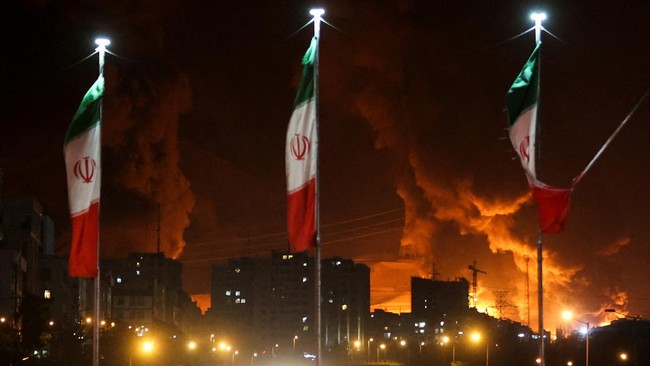
A combined US-Israeli military assault on Iran has reportedly crippled much of Tehran’s military capability, particularly in missile and drone launches. However, experts assess that Iran retains sufficient capacity to continue inflicting serious damage across the region.
The US Government, through the White House, stated that Iran’s military capability has been severely impacted. “Iran’s ballistic missile capability has been functionally destroyed. Their naval forces are deemed ineffective in combat. Complete and total air dominance over Iran,” the White House stated, according to Al Jazeera.
The statement also confirmed that the military operation designated “Operation Epic Fury” had yielded significant results since the war launched jointly with Israel on 28 February. A day later, President Donald Trump stated that US forces had destroyed Iran’s drone production capacity.
However, the situation on the ground reveals a more complex picture.
On Monday afternoon, Qatar announced it had successfully intercepted the latest missiles fired by Iran. Other Gulf states including Saudi Arabia, the United Arab Emirates, and Bahrain also issued warnings.
One missile was reportedly reported to have landed near a vehicle in Abu Dhabi, killing one person, indicating that the threat has not been entirely eliminated.
Attack Intensity Drops Sharply
Nevertheless, the volume of Iranian counter-attacks has indeed declined sharply since the conflict began.
In the first 24 hours of the war, Iran launched 167 missiles and 541 drones towards UAE territory. However, based on data compiled by Al Jazeera from the UAE Ministry of Defence, by the 15th day of the conflict, this number had dropped dramatically to just four missiles and six drones.
Attacks on Israel also declined, from nearly 100 projectiles in the first two days to just single digits in recent days, according to the Institute for National Security Studies.
The Pentagon also reported that missile launches had fallen by up to 90% from the first day, whilst drone attacks had decreased by 86%.
Iran is known to possess one of the largest supplies of ballistic missiles in the region. In 2022, the US Office of the Director of National Intelligence assessed that Iran held the largest inventory in the Middle East.
Although there are no official figures, Israeli intelligence reports estimate Iran possesses approximately 3,000 missiles, declining to 2,500 after the 12-day war in June.
The primary US-Israeli strategy has been to destroy Iran’s missile launchers. Each launch generates a signature detectable by satellite and radar, making tracking easier.
According to Israeli military officials cited by the Institute for the Study of War, approximately 290 launchers have been disabled out of a total of 410 to 440 units. However, the vastness of Iranian territory makes complete destruction difficult.
A professor at the National Defense University, David Des Roches, stated that intelligence limitations on the ground represent the main obstacle.
“It is not easy to identify the launchers. What we see are missiles positioned in hidden locations or places unconnected with the military before the war, when surveillance was minimal,” he said.
According to him, the reduction in attacks has occurred because Iran has lost the ability to launch large-scale simultaneous strikes.
Instead, Iran now fires one or two missiles at civilian and commercial targets, particularly in Gulf states, although Tehran maintains it only targets US interests.
“Militarily, [Iran’s actions] are not significant. These are what one calls provocative shots intended to weaken warning systems in neighbouring countries and to intimidate people,” said Des Roches.
Long-Term Warfare
Experts assess that Iran has now shifted strategy towards prolonged conflict. A researcher at the German Institute for International and Security Affairs, Hamidreza Azizi, stated that Iran is attempting to exhaust its opponents’ defensive capabilities first.
“There may be interest in making this a war of attrition,” he said.
Iran has also decentralised its launch systems by relying on mobile launchers that are harder to detect. “This is a race against time,” said Azizi.
Similarly, an academic from the Doha Institute for Graduate Studies, Muhanad Seloom, stated that Iran’s threat does not depend on the volume of attacks.
“It does not matter how much you launch as long as you maintain a credible threat,” he said. “It only takes one drone to succeed in destroying a sense of security,” he added.
Cheap Drones, Major Impact
Iran is known for its ability to produce cheap drones in large quantities, such as the Shahed 136. These drones can be produced rapidly and launched without complex systems, making them difficult to stop entirely.
Although they operate at relatively low speeds and can be shot down, a number of drones have managed to penetrate US and Gulf state air defence systems.
On Monday, a drone-related incident caused fires near Dubai International Airport and the Fujairah industrial zone in the UAE. Sirens also sounded in central Israel due to Iranian missile strikes.
In the Strait of Hormuz, hundreds of vessels were reported stranded due to concerns about attacks, although the number of direct attacks on shipping has been relatively limited. Since the war began, approximately 20 shipping-related incidents have been recorded.
Global Economic Impact
Iran’s strategy is assessed as part of an asymmetric warfare doctrine, designed to weaken a militarily superior opponent by attacking critical infrastructure and inflicting economic pressure.
Global oil prices have surged above US$100 per barrel, triggering market panic.
Qatar, the world’s second-largest gas exporter, has kept production shut down, whilst Bahrain’s national oil company has declared force majeure. Oil production from major oilfields in southern Iraq has also fallen by up to 70%.
A professor at Johns Hopkins University, Vali Nasr, assessed that economic pressure could become Iran’s primary weapon. Economic pressure could prove to be Iran’s main tool in this conflict.