
Urban Land Becoming Increasingly Scarce, BTN to Boost Financing for Vertical Housing
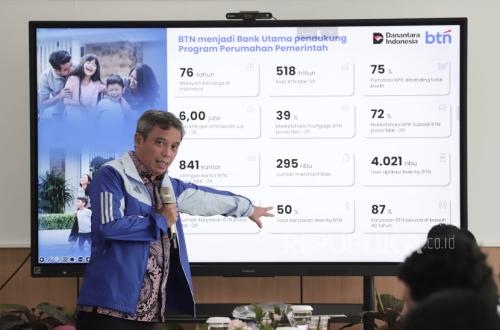
Land limitations in urban areas are increasingly pressing the need for vertical housing development. Bank Tabungan Negara (BTN) views the pattern of low-rise housing construction as no longer able to keep up with the growing housing needs of the population in major cities. BTN’s President Director Nixon LP Napitupulu stated that urbanisation pressures and high land prices are forcing housing development to shift towards vertical structures.
” Housing in big cities must indeed move towards vertical housing; low-rise houses are no longer feasible. The land is already very limited,” Nixon said during a media briefing in Bandung, West Java, on Thursday (9/4/2026).
According to him, if development is forced horizontally, the impact would not only be on housing shortages but also potentially erode productive land.
“If everything is forced into low-rise houses, productive land will run out. Meanwhile, needs continue to increase, but land does not,” he said.
BTN assesses that vertical housing integrated with public transport is the most realistic solution. Projects located near transport hubs are considered more attractive due to cost and time efficiency.
“Those that don’t sell well are usually far from transport. But if close to transport, people will be more interested because it’s more efficient,” Nixon said.
Besides location, housing quality is also a concern. He noted that unit sizes that are too small have so far been one of the barriers to public acceptance of vertical housing.
“The problem in Indonesia is that studio types are too small. Ideally, they should be larger so that people feel comfortable,” he said.
Amid these challenges, BTN reaffirms its role in national housing financing. As of April 2026, the company has disbursed around 6 million Home Ownership Credit (KPR) units since 1976, with a total value of Rp 530 trillion.
Nixon stated that this achievement reflects BTN’s role in expanding home ownership access while strengthening the housing ecosystem.
“For nearly five decades, BTN has not only disbursed financing but built a sustainable housing ecosystem,” he said.
He added that going forward, BTN will not only focus on housing financing but also expand services to overall family financial needs.
“We are strengthening the transformation towards beyond mortgage, where BTN not only serves housing financing but also comprehensive family financial needs,” he said.
This step is being taken through innovations in bundled financing, including home furnishing financing in one credit scheme.
“We are introducing financing innovations through bundling KPR with home furnishing needs, so customers get a more integrated solution,” Nixon said.
BTN’s Consumer Banking Director Hirwandi Gafar added that current housing sector challenges do not only come from the demand side but also from the supply side, particularly regarding land availability and permitting.
“Demand for decent housing continues to rise, while current challenges are more from the supply side, such as land availability and permitting,” Hirwandi said.
He stated that BTN is striving to address these challenges through a more integrated approach, including strengthening financing for developers and the public.
In addition, BTN’s debtor profile shows that the majority of KPR recipients come from low-income communities, with an average income of around Rp 4.9 million per month. Most come from the informal sector such as small traders and freelancers.
This condition shows that housing needs remain high, even amid economic pressures. BTN assesses that housing is a basic need that is not easily postponed.
“Housing is a basic need. Unlike investment purchases, people will still strive to own a home,” Nixon said.
With land limitations becoming increasingly apparent, BTN views vertical housing development as no longer a choice but a necessity.
“If land is becoming more limited, like it or not, we have to go upwards. That’s the reality we must face,” Nixon said.