
Untar Doctoral Dissertation Develops New Integration-Based Model for Megaproject Management
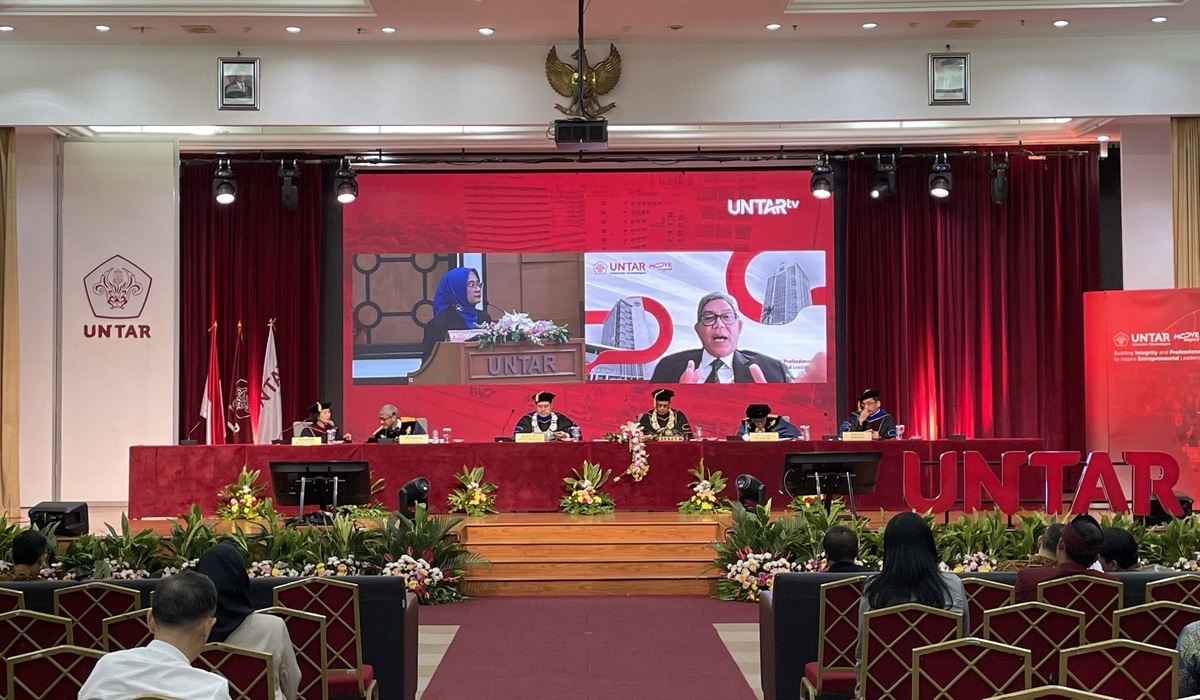
Rafama Dewi, a student in the Doctoral Programme in Civil Engineering at Tarumanagara University (Untar), presented her dissertation titled “Megaproject Program Management Model: A Case Study of Development Projects within the Ministry of PU-PKP in the Nusantara Capital City (IKN)” during an open dissertation examination in Jakarta on Tuesday.
The research was prompted by Dewi’s involvement in preparing the Basic Design Package for one of the zones in IKN. This experience raised various questions regarding the effectiveness of construction management in large-scale and complex projects.
“From that, we explored the common thread that needs improvement to enhance the performance of IKN projects as a national-scale regional project. Through literature and existing theory reviews, the research objective was formulated to create an adaptive program management model for megaproject,” said Rafama Dewi.
According to her, the novelty of the developed model is not intended to replace the currently implemented program management systems, but rather to strengthen existing functions and mechanisms to ensure they operate more effectively.
Dewi explained that although the research uses IKN as an empirical context, the resulting model is general in nature and can be applied to various development sectors, both public and private.
“IKN in this research serves as an empirical representation. However, the resulting model can be generalised and implemented in other sectors, certainly with adjustments to their respective contexts,” she stated.
She noted that one of the primary challenges in large-scale projects is ensuring integration between work packages running simultaneously. Currently, success is often measured only on individual work packages without considering the impact on interconnected packages.
“If construction activities are carried out simultaneously, integration between those work packages is required. The integration function already exists, but its implementation mechanism has not been maximised,” she explained.
Furthermore, she explained that while project planning is generally well-structured, the greatest challenge lies in the synchronisation between the planning stage and field execution.
“Sometimes in development, each work package operates in isolation. In reality, the success of one package must be followed by the success of adjacent and interdependent packages. When a package does not perform well, it indicates that the integration mechanism is not functioning optimally,” she said.
Through the developed model, Dewi offers an approach based on an adaptive mechanism that functions as an ‘adaptive connector’ to manage project dynamics and reduce risks arising during megaproject execution.
“This model assists through the strengthening of adaptive mechanisms. Everything that is dynamic can be controlled and managed based on priority scales without ignoring other aspects that must be accommodated. Therefore, this adaptive function must be meticulously designed,” she said.
The research findings are expected to serve as a reference for the management of national strategic projects and other megaprojects in Indonesia, ensuring that coordination, integration, and risk control can proceed more effectively to support successful development.