
Untangling the "Tangled Threads" of Indonesia's Fibre Optic Infrastructure
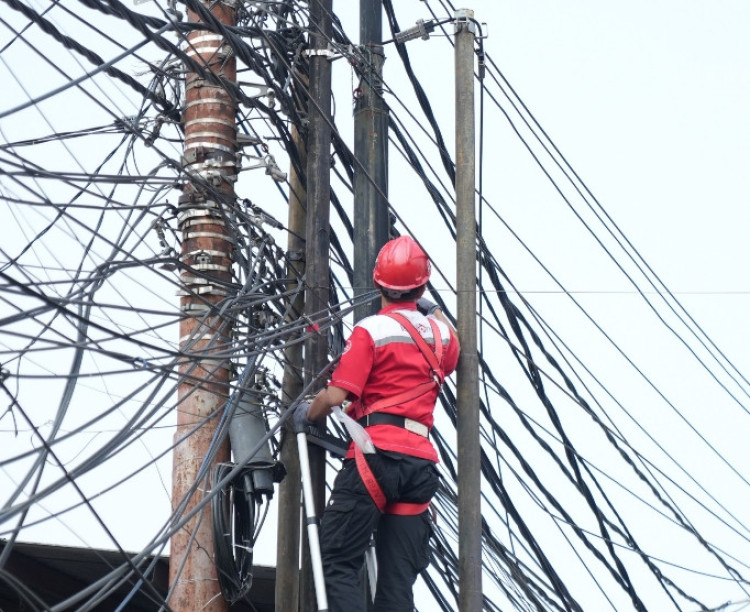
In the digital economy landscape, fibre optic infrastructure is no longer merely a supplementary utility; it is the backbone of digital sovereignty. Digital sovereignty refers to a nation’s ability to determine strategies, implementation, and operations of digital infrastructure to maximise benefits for the nation. This includes (but is not limited to) protecting citizens’ data, securing critical infrastructure, and ensuring technological independence.
In the digital infrastructure ecosystem, fibre optics play a crucial role as the “central nervous system” that connects digital communications. Advances in fibre optic technology enable high-speed digital connectivity, bridging cloud computing and facilitating the processing speed of artificial intelligence (AI). Currently, fibre optics is a medium capable of carrying massive data capacity with low latency, essential for driving the future economy.
However, significant challenges are being faced in the development of telecommunications infrastructure. Amid exponentially increasing data demand, the industry still encounters potential inefficiencies due to high market fragmentation. With more than 1,000 licensed internet service providers (ISPs) by 2025, intensifying competition could drive asset duplication and impact service quality. Additionally, infrastructure development must consider urban planning aspects, particularly the integration of poles and cable networks that are not yet optimally organised.
Stakeholders must consider whether capital investments will continue to be absorbed in potentially redundant network builds, or if consolidation steps are needed to support industry sustainability.
Industry Diagnosis: Structural Inefficiencies
Data reveals gaps that need attention. Data from the APJII 2025 Internet Survey shows that internet user penetration has reached 229 million people, yet fixed broadband (FBB) penetration remains in the low teens percent of total households.
The main challenge does not lie in the availability of investment, but in overlapping and uneven allocation. In several business districts and premium residential areas like SCBD, around 5 to 10 service providers build parallel fibre optic networks on the same routes. This creates multiple burdens:
CAPEX Allocation Efficiency: Significant capital investments are still concentrated on building similar assets in the same locations (overbuilt), while some tier-3 districts remain underserved.
Infrastructure Planning & Safety Aspects: The presence of sub-optimally organised cable networks not only affects urban aesthetics but also potentially impacts public safety and poses challenges in supporting Smart City implementations that require orderly underground infrastructure.
Industry Imperative: Why Consolidation is Essential
Infrastructure consolidation offers concrete solutions. In long-term business calculations, this step provides significant industry value creation through:
Cost Rationalisation: By sharing passive infrastructure (poles, ducting, manholes), operators can cut construction costs by 30-40%. These funds can be reallocated for service layer innovations or expansion to remote areas.
Enabler for 5G & IoT: 5G rollout demands massive network density to support small cells. Without consolidation, 5G backhaul costs would make service prices uncompetitive for consumers.
Better Asset Valuation: Separating infrastructure assets (NetCo) from service businesses (ServCo) has proven to increase company valuations due to lower risk profiles and more stable (predictable) cash flows.
Separating “Roads” and “Vehicles”
The world has moved towards Open Access and Neutral Carrier models. This model separates ownership of “roads” (cables/pipes) from “vehicles” (internet services). In Singapore, through NetLink Trust, the government mandates a single entity to build and manage the national fibre network’s passive layer. The result? Capital efficiency through optimised infrastructure development without duplicating work in the same locations. Fibre penetration reaches nearly 100% at very affordable prices, as ISPs like Singtel or StarHub can focus on competing on service quality and pricing without being burdened by massive physical construction costs.
Meanwhile, in the UK, Openreach was formed through functional separation from British Telecom (BT). Openreach is obligated to provide equal and non-discriminatory access to all service providers (including BT’s competitors). This creates a fair level playing field, accelerates innovation, and ensures that network builds in rural areas remain economically viable through cost-sharing schemes.
Telkom’s Strategic Steps
Indonesia is not entirely idle. PT Telkom Indonesia (Persero) Tbk (Telkom) has read the winds of change through a fundamental transformation strategy by separating business focuses, including:
ServCo Focus (FMC): Integrating IndiHome into Telkomsel allows the service entity to focus 100% on customer experience and service convergence without being burdened by physical network complexities.
Formation of InfraCo: Consolidating fibre optic and access network assets into a dedicated entity to create network excellence.
Unlocking Value: Transforming fibre assets from a cost centre into a revenue generator. InfraCo is prepared to operate neutrally, opening wholesale opportunities for operators.