
'Unrealistic' for Southeast Asia to meet Hegseth's defence spending demand amid Sino-US rivalry
analysis Asia
‘Unrealistic’ for Southeast Asia to meet Hegseth’s defence spending demand amid Sino-US rivalry
Washington’s call for Asian allies to spend 3.5 per cent of GDP on defence is untenable given competing needs in infrastructure, healthcare and education, analysts say.
KUALA LUMPUR: It is “completely unrealistic” for Southeast Asian countries to heed the United States’ call of boosting defence spending to counter China’s growing power, analysts say, as the region prioritises domestic development while balancing ties with the two superpowers.
Economic pressures from the Iran war have tightened governments’ purse strings, the experts say, adding that Southeast Asian states could instead improve defence cooperation with middle powers and use multilateral platforms like the Association of Southeast Asian Nations (ASEAN) to navigate great power competition in the region.
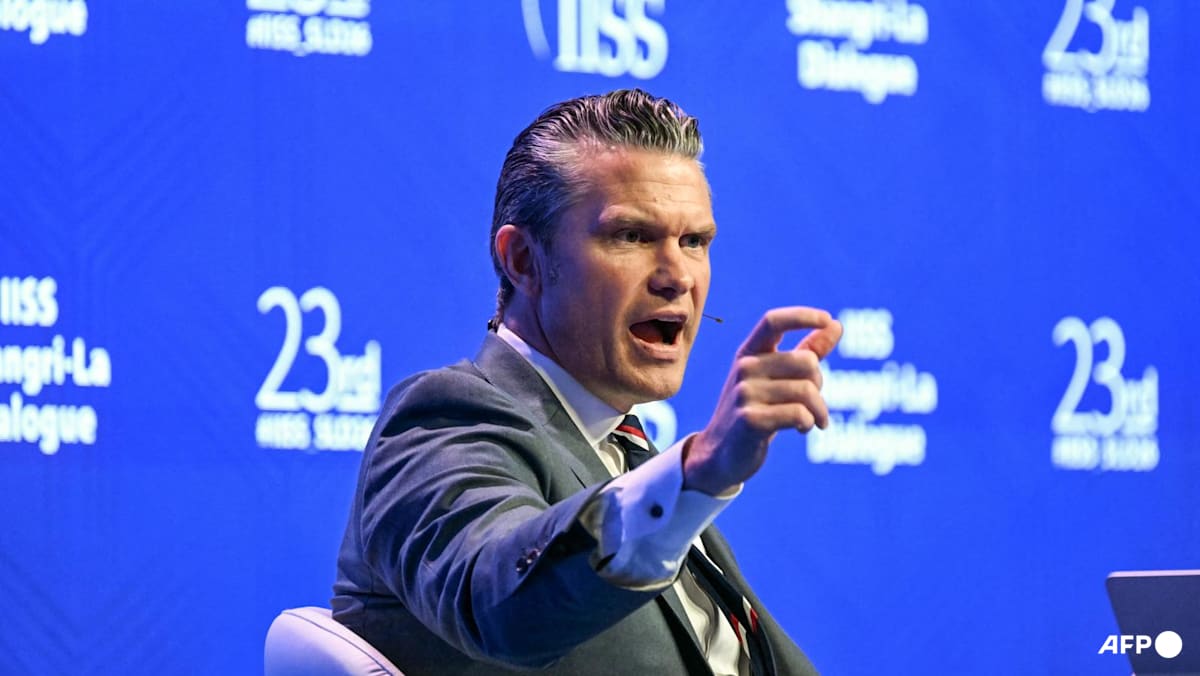
Last Saturday (May 30), US Secretary of Defense Pete Hegseth urged Asian allies to ramp up military spending to prevent China’s dominance in the region, warning of “rightful alarm” over its rapid military build-up.
The US expects its Asian allies and partners to increase defence spending to 3.5 per cent of gross domestic product (GDP), Hegseth said at the Shangri-La Dialogue in Singapore, known as Asia’s premier forum for defence leaders, militaries and diplomats.
“Less Shangri-La, more ships, more subs,” Hegseth said, stressing that the region needed greater defence capability than conferences.
Analysts told CNA that while the US could punish allies that fail to commit to higher defence spending by downgrading defence cooperation or complicating trade negotiations, Washington is unlikely to abandon the region given its need for critical minerals and military access.
Consistent US demands on defence spending could also produce an unintended effect of pushing some Southeast Asian states closer to China at a time when US presence in the region is already perceived as waning, the observers warned.
But they also said other ASEAN members will be wary of tilting towards Beijing given the latter’s military build-up in the South China Sea.
China claims most of the strategic South China Sea, overlapping with claims by other ASEAN states including Brunei, Malaysia, the Philippines and Vietnam.
Joshua Kurlantzick, senior fellow for Southeast Asia and South Asia at Council on Foreign Relations - a US think tank - said US President Donald Trump’s administration has “turned burden-sharing into the defining test of any alliance worth keeping”.
“Delivering the same demand at the region’s most important annual security forum was Washington’s way of saying it isn’t blinking - Asia is now facing the same issue that the White House is asking of Europe,” he told CNA.
Trump has a long-standing demand that allies shoulder more defence costs and burden, singling out European and North Atlantic Treaty Organization (NATO) partners as needing to reduce their reliance on Washington.
But while some Asian states have increased defence spending, this is due to their “own desire” to improve defence capabilities in an increasingly contested region, said Kurlantzick, “not because the US is demanding it”.
WHY 3.5 PER CENT IS UNREALISTIC
Among the 11 ASEAN members, Myanmar and Brunei have the largest defence spending proportions of GDP, at 6.6 per cent and 3.65 per cent respectively as of 2024, according to the Stockholm International Peace Research Institute.
Singapore’s defence expenditure was 3.05 per cent of its GDP in 2025.
Indonesia, which spent 1.04 per cent of its GDP on defence in 2025, has a long-term target of hitting 1.5 per cent, still far short of what the US is asking.
The Philippines has consistently increased defence spending since 2023, reaching 1.3 per cent of GDP in 2025, but has admitted it would be difficult to comply with the US demand.
Kurlantzick stressed that across much of Southeast Asia, defence spending competes directly with infrastructure, healthcare, education and poverty reduction.
“From those baselines, the distance to 3.5 per cent isn’t just large - for most countries it represents a generational shift in national priorities,” he said.
“In countries like Indonesia, Cambodia and Laos, where per-capita incomes remain modest and development needs are still acute, a dramatic jump in military budgets is genuinely difficult to sell to the public.”
Abdul Rahman Yaacob, a senior fellow at Verve Research, an independent think tank covering Southeast Asian foreign policy and security affairs, said Trump’s threat of fresh tariffs and the Iran war will impact how countries spend.
“The current economic uncertainty will likely affect how regional governments allocate budget to defence,” he told CNA.
It is “completely unrealistic” for Southeast Asian countries to meet the US’ 3.5 per cent target, said Hunter Marston, director of the Southeast Asia Program at the Lowy Institute, an Australian think tank.
He argued that Washington has not been consistent in this policy across the region, pointing to how although the Philippines - a US treaty ally that is very concerned about China’s increasing assertiveness in the region - spends among the lowest on defence in ASEAN, Washington has not exactly put pressure on Manila.
“While Southeast Asian countries are anxious about US-China rivalry and China’s growing military power, what they spend on defence is reflective of their current perceptions of external threats as well as their own priorities at home,” Marston said.
THE CHINA FACTOR
And when it comes to China, not all Southeast Asian states might believe Beijing is a force that needs to be contained, said Muhammad Faizal Abdul Rahman, a research fellow at Singapore’s S Rajaratnam School of International Studies (RSIS).
“There is also the question of whether Asian countries fully share the US worldview, in which military spending primarily serves to counter China and maintain a balance of power advantageous to the US,” he told CNA.
“This a