
Unpad to Soon Implement WFH for Staff and Students
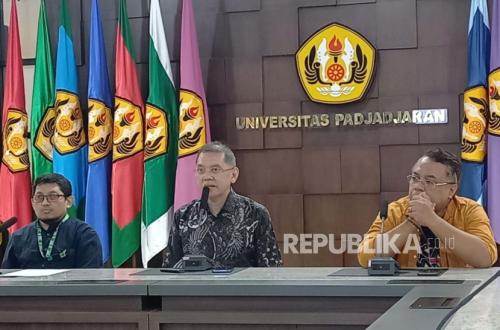
Universitas Padjadjaran (Unpad) will soon implement work from home (WFH) for staff and students in line with the central government’s circular. WFH is expected to contribute to energy savings amid the crisis unfolding in the Middle East.
Unpad Rector Prof Arief Kartasasmita welcomed the central government’s policy to implement the WFH programme, including on campus. The policy is hoped to anticipate any potential energy crisis or other crises arising from external geopolitical conditions.
“Unpad will take steps; we will encourage partial implementation, or lectures not related to practicals, to be conducted via WFH by Unpad in line with that circular,” he said on the sidelines of a workshop and benchmarking event on enhancing policy analysis competency in higher education with 51 participating universities, Tuesday (7/4/2026).
He explained that those working from home for one day will be in the administrative sector. Then, lectures that do not require direct skills or practicals and fieldwork can be done via WFH.
“We urge academic staff and lecturers to work from home. So, not working in cafes or elsewhere,” he said.
He stated that working in cafes or other places would not solve the problem of reducing energy needs. His side will soon implement the policy.
“We will now implement it; the principle is that this WFH should not disrupt the essence of education. So, if there are students who truly cannot do WFH, they will continue as usual,” he explained.
He said lectures that can be done via WFH will be implemented to ensure energy resilience. His side has not yet calculated the efficiency achieved, but it will certainly have an impact.
“I haven’t calculated the details of how much, because there are so many variables. But there will definitely be an impact, even if I don’t know the percentage,” he said.
Because, he explained, first they must calculate how many students are absent and those studying from home or their dorms.
He added that higher education institutions today must issue policies based on data and evidence. Thus, it is hoped that in the future, higher education bureaucratic management will improve.
Prof Arief said the challenges facing higher education today are technological disruption, climate change, and other global issues. Therefore, universities must have agility and the will to change.
“For example, the latest is the geopolitical changes happening internationally now; it requires us to immediately implement quick solutions. For instance, energy issues due to the war in the Middle East; that is also one way we can make quick, measurable policy changes,” he said.
He stated that if they do not have the experts or policy analysis, there is a risk of misguided policies.