
Unpacking the Provisions of the Newly Ratified PPRT Law by Puan: Is Oversight Difficult?
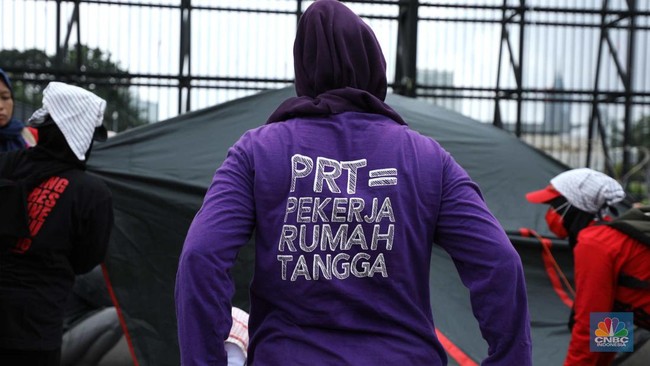
Jakarta, CNBC Indonesia - The ratification of the Domestic Workers Protection Law (UU PPRT) represents a major advancement in protecting domestic labour. However, the real work lies in the field: ensuring that these regulations are effectively implemented.
Given the private nature of the work environment, implementing this law is considered not as straightforward as in other formal sectors that are easier to monitor.
As is known, the Domestic Workers Protection Bill (RUU PPRT) was officially enacted into law during the 17th Plenary Session of the IV Session Period of the 2025-2026 DPR RI in Jakarta on Tuesday (21/4/2026). The ratification was marked by the unanimous approval of all session participants, led by DPR RI Speaker Puan Maharani.
“We will ask again to all honourable session participants, whether the Domestic Workers Protection Bill can be approved to be enacted into law?” Puan asked.
“Agreed!” the session participants responded in unison.
“Thank you,” Puan said, followed by the gavel strike and applause in the chamber.
Data on Domestic Workers Remains a Challenge
One of the main challenges is data collection. Article 30 states that oversight includes an integrated data system.
“Data collection and reporting of P3RT, domestic workers (PRT), and employers… in one integrated electronic data system.”
The problem is that many domestic workers have worked informally without official records. Without a strong data foundation, oversight could be suboptimal.
Oversight Limited in Private Spaces
Unlike factories or offices, the workplace of domestic workers is the household. This makes direct oversight difficult.
Although the central and regional governments are mandated to provide guidance and oversight, the scope is vast.
“The Central Government and Regional Governments provide guidance and oversight on the implementation of Domestic Workers Protection.”
With millions of households as employers, the limitation of supervisory resources becomes a real challenge.
The Role of RT/RW Not Necessarily Effective
This law does involve RT/RW as part of the oversight and conflict resolution mechanism. However, its effectiveness remains questionable.
On one hand, RT/RW are seen as closest to the community. On the other hand, not all local officials have the capacity or courage to handle labour conflicts.
Article 32 states that mediation can be carried out by the RT/RW head if a dispute arises.
However, in practice, conflicts between domestic workers and employers can be sensitive and not easily intervened in.
Potential for Non-Compliant Agreements
The law requires a clear employment contract between domestic workers and employers. Article 11 stipulates that the agreement must include rights, obligations, and wages.
The challenge is that not all parties understand how to create a fair and detailed employment contract. The risk of superficial or unbalanced agreements remains wide open. This could lead to conflicts in the future.
Transition from Informal to Formal
To date, the domestic workers sector has been dominated by trust-based and familial work relationships. The shift to a more formal system requires adaptation from both parties.
This change is not just about rules, but also culture. If not accompanied by massive socialization, the regulations could potentially not be implemented optimally.
Ultimately, the success of this law is not only determined by the content of the regulations, but also by the readiness of the ecosystem in the field. Without strong oversight, neat data collection, and widespread understanding, these rules risk becoming merely a legal umbrella without real reach.