
University of Indonesia Partners with International Bodies to Launch Unmanned Vessel for Coral Reef Protection in Karimunjawa
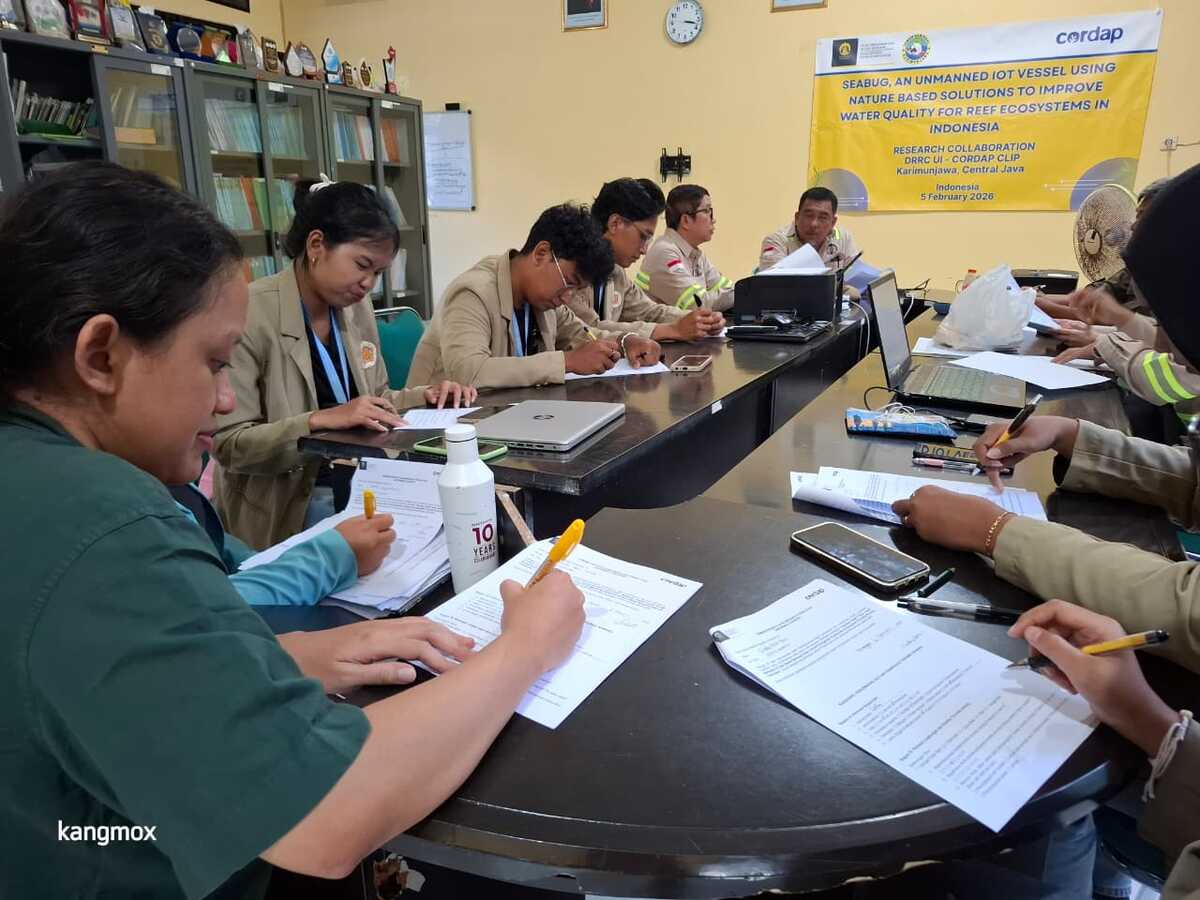
The Disaster Risk Reduction Center of the University of Indonesia (DRRC UI) has initiated an ambitious marine conservation project through the innovation of “Seabug”, an unmanned vessel based on Internet of Things (IoT) technology. The project, supported by international funding from the Coral Research & Development Accelerator Platform (CORDAP), is designed to monitor and protect the water quality of the coral reef ecosystem in the Karimunjawa Islands, Central Java.
As an initial step, a team of experts from DRRC UI completed field surveys and location mapping between 4 and 8 February 2026. This technology represents a response to marine ecosystem degradation triggered by sedimentation and uncontrolled tourism activities.
Project Manager of DRRC UI, Adonis Muzanni, explained that “Seabug” will function as a digital guardian that transmits water quality data in real-time. “We ensure that the placement of this infrastructure will not disturb the natural aesthetic or local navigation routes, but will serve as a ‘digital guardian’ for the underwater ecosystem,” said Adonis in a statement on Monday (2 March 2026).
The UI team used Remotely Operated Vehicle (ROV) technology, or underwater drones, to map the visual condition of coral reefs. Based on technical considerations regarding equipment safety and water currents, the team recommended two placement points for the Seabug units, namely in the waters around Naraya Resort and Floating Paradise.
Following the completion of laboratory data processing, the installation of Seabug units and floating decks is planned to take place in April 2026, shortly after the celebration of Eid al-Fitr 1447 H.
A representative of the Karimunjawa BTN, Agus Roma Purnomo, revealed that the greatest current challenge is snorkelling activity by unskilled tourists, who often damage coral structures unintentionally. “Research data from the past five years indicates significant degradation. The presence of this IoT technology is expected to help us monitor physical water parameters such as pH and salinity more accurately,” said Agus.
Karimunjawa Village Head, Aris Setiawan, added that data from this technology will be very helpful for the village government in making decisions on area protection policies, particularly when facing coral bleaching phenomena resulting from extreme temperatures.
The collaboration between academia, government, and global funding is expected to serve as a pilot model for technology-based coral reef restoration in other coastal regions in Indonesia to address climate change threats.