
Unhas MBG Kitchen Deemed a Model for Integrating Research and National Nutrition Programmes
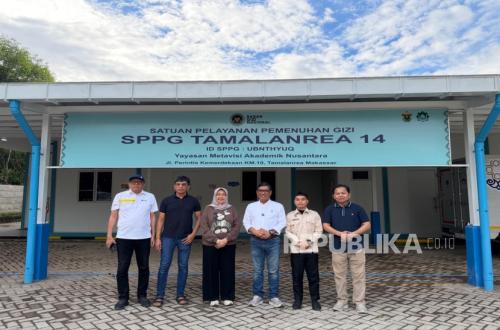
REPUBLIKA.CO.ID, JAKARTA – The Indonesian Association of Free Nutritious Meal Kitchen Entrepreneurs and Managers (APPMBGI) views the operation of the Free Nutritious Meal Kitchen (MBG) at Hasanuddin University as an example of integration between academic research and public programme implementation. This model is deemed capable of strengthening the execution of science-based nutrition fulfilment programmes.
APPMBGI General Chairman Abdul Rivai Ras stated that the MBG kitchen on campus introduces a new approach to managing the Free Nutritious Meals programme through collaboration between the academic world and field practice. This assessment was conveyed following a visit to the Hasanuddin University MBG kitchen, accompanied by APPMBGI Expert Council Member Prof. Sukri Palutturi and South Sulawesi APPMBGI Provincial Board Chair Sri Asri Wulandari Aksa Mahmud.
“We directly observed how the university is taking a strategic role in supporting the national priority programme in meeting community nutrition needs,” said Abdul in his statement on Monday (4/5/2026).
Abdul assessed that the presence of the MBG kitchen on campus is not merely a food service facility but serves as a space for integrating knowledge, innovation, and public policy practice.
“This is not just a kitchen in the operational sense. This is a living laboratory. Here, knowledge, research, innovation, and practice meet in a complete ecosystem,” said Abdul.
According to Abdul, the approach taken by Hasanuddin University reflects an ideal development model that can bridge the gap between academic research and field implementation. Students, researchers, and practitioners are involved in a single cycle from concept formulation, testing, to direct programme evaluation.
“So far, we have often seen research stopping at the academic desk, while practice runs without a strong scientific basis. A model like this breaks that chain. What is researched is directly tested, and what is implemented can be scientifically improved,” said Abdul.
Abdul added that this integration pattern has long been applied in various advanced countries through the closeness of higher education institutions with production and innovation centres. According to him, this model enables accelerated technology validation, process efficiency, and sustainable improvement in output quality.
“When a learning centre stands side by side with a production centre, the innovation process becomes much faster, adaptive, and measurable. This is what we see beginning to be built at Unhas through the MBG kitchen,” said Abdul.
The Hasanuddin University MBG kitchen is also assessed as functioning as a teaching factory that can serve as a centre for developing operational standards and MBG management models to be replicated in various regions.
“This is an example of how public policy meets academic excellence. And when both run together, we are not just executing a programme, but building a strong system,” said Abdul.