
Understanding the D-8 and Indonesia's Chairmanship
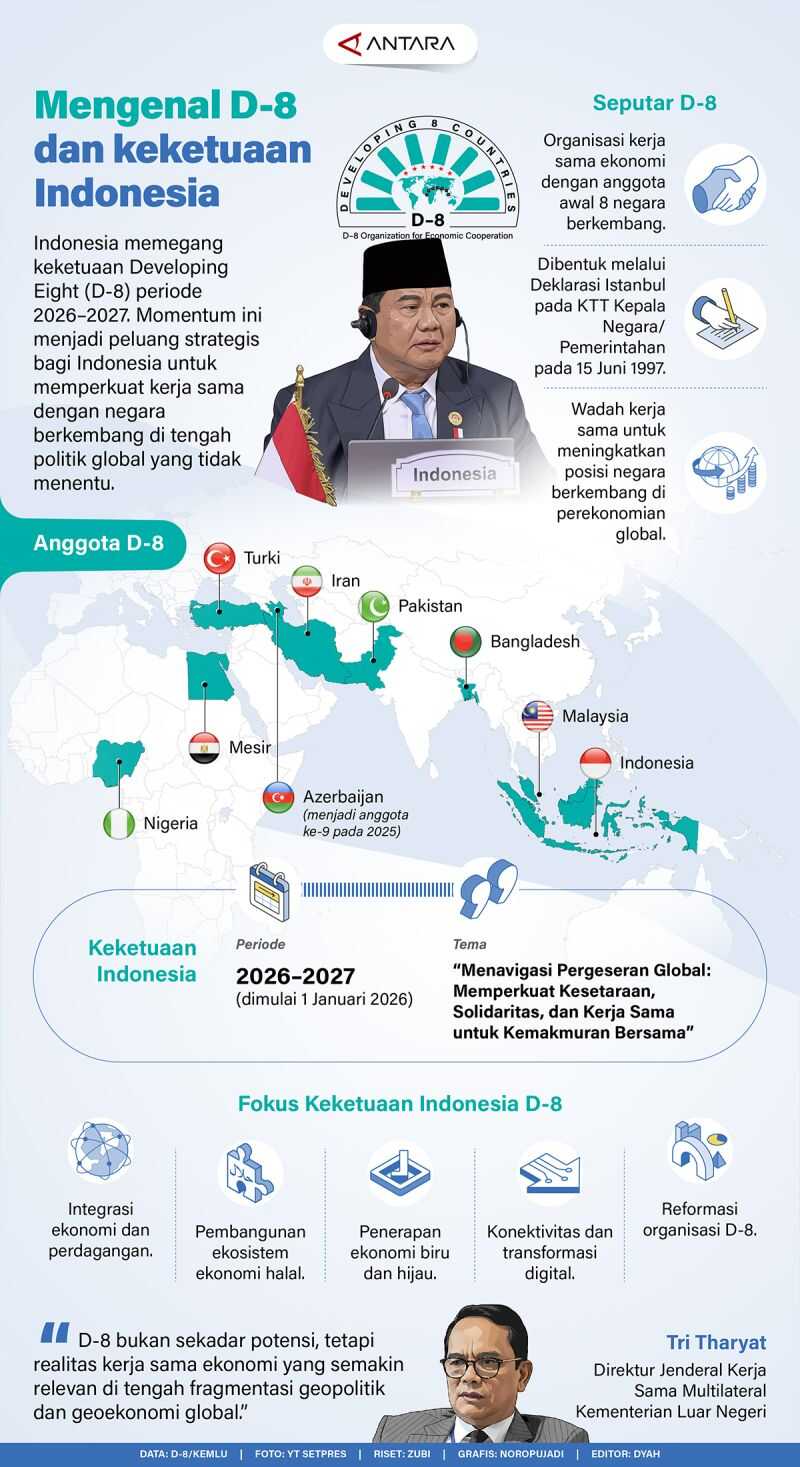
Indonesia holds the chairmanship of the Developing Eight (D-8) for the 2026-2027 period. This momentum represents a strategic opportunity for Indonesia to strengthen cooperation with developing nations amid uncertain global politics.
What is D-8?
D-8 is an economic cooperation group established in 1997 by eight developing countries: Indonesia, Bangladesh, Egypt, Iran, Malaysia, Nigeria, Pakistan, and Turkey. Azerbaijan became the ninth member in 2025.
Indonesia’s Assumption of the Chairmanship
President Prabowo Subianto attended the D-8 Summit to represent Indonesia in receiving the D-8 chairmanship baton for the 2026-2027 period from Egypt, which previously held the position. The President assessed that D-8, as an economic and development cooperation organisation among eight developing countries founded in 1997, constitutes an important forum.
Indonesia’s Chairmanship Theme
Indonesia’s chairmanship carries the theme “Navigating Global Shifts: Strengthening Equality, Solidarity and Cooperation for Shared Prosperity,” reflecting Indonesia’s commitment to leading D-8 in facing global geopolitical and geo-economic dynamics through strengthened cooperation and Global South solidarity.
Official Chairmanship Logo
The Government of the Republic of Indonesia launched the official logo for Indonesia’s chairmanship of the D-8 for the 2026-2027 period, as part of preparations for the 12th D-8 Summit to be held in Jakarta in April 2026. Visually, the logo combines the Nusantara compass symbol and a guiding light (jyoti), representing direction, hope, and strategic orientation.
Five Priority Agendas
Indonesia’s D-8 chairmanship focuses on five priority agendas for cooperation among member states. These five priorities encompass four economic cooperation agendas and one organisational reform agenda, including:
- Trade cooperation – The trade potential is considerable given the demographics of D-8 member countries’ populations, and this potential is to be enhanced through D-8 cooperation.
- Halal economy – The second agenda relates to the halal economy, given that the majority of D-8 member countries’ populations are Muslim.
- Blue and green economy – The third priority agenda covers the development of blue and green economies, as Indonesia wishes to emphasise the potential for maritime sector cooperation.
- A fourth economic agenda and organisational reform.
Strengthening the Economic Role of Muslim Nations
Deputy Foreign Minister Arrmanatha Nasir stated that Indonesia’s D-8 chairmanship is directed towards strengthening the role of Muslim countries in the economic sector amid ongoing global uncertainty.
12th D-8 Summit in Jakarta
The Ministry of Foreign Affairs stated that all summit preparations are proceeding smoothly and in a coordinated manner, ensuring that the summit on 12-15 April 2026 can proceed as planned. In addition to the main summit, Jakarta will also host various senior officials’ meetings, foreign ministers’ meetings, and the D-8 Halal Expo 2026.
Special Session on Palestine
The Ministry of Foreign Affairs confirmed that there will be a special session on Palestine at the D-8 Summit to be held in Jakarta in April 2026. The special Palestine session will serve as the closing session of the D-8 Summit in Jakarta on 15 April 2026.
Trade Targets
The intra-D-8 trade volume target is projected to reach USD 500 billion by 2030, which will require intensive cooperation and policy harmonisation among member states.
Chairmanship Orientation
As D-8 Chair for the 2026-2027 period, Indonesia will promote results-oriented cooperation with direct impact, emphasising the strengthening of economic interactions among member states, joint value creation, and increased business community engagement. Indonesia’s chairmanship also reinforces developing country solidarity in facing global challenges such as economic instability, climate change, and supply chain disruption.