
Under the Same Sky, Indonesia Prostrates
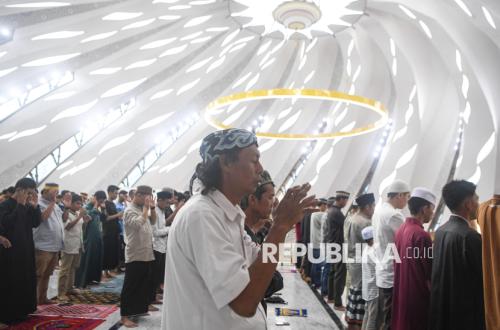
The Nusantara sky was not yet fully bright when the echoes of the takbir reached their peak. Allahu Akbar, Allahu Akbar, wa lillahil hamd. That majestic phrase resounded from millions of mosque loudspeakers, prayer rooms, and small mosques, echoing from Sabang to Merauke, from coastlines to mountains, from palaces to emergency tents standing on soil still damp from disaster.
Saturday, 21 March 2026. Indonesia celebrated Eid al-Fitr, 1 Syawal 1447 Hijriah.
However, this year’s Lebaran was not merely a recurring celebration on the calendar. It was a mirror reflecting the face of a nation with all its complexities: its strengths and vulnerabilities, its grandeur and simplicity, its differences celebrating themselves in unforced harmony.
Dawn had just broken when the grounds of the Jakarta Presidential Palace complex began to fill with citizens. They came from all corners, from various backgrounds, queuing orderly under the still pinkish sky. Not for bureaucratic matters or formal needs, but for something far warmer: maintaining ties of kinship.
President Prabowo Subianto welcomed them one by one. Handshakes, smiles, and greetings that were not mere protocol formalities. The palace doors, usually distant from the daily lives of the people, on this blessed morning, were flung wide open without barriers.
Notably, the President specifically instructed that ministers and state officials should not be burdened with formal attendance obligations. This policy was not without meaning. It was a signal that the palace’s main stage on this day was entirely dedicated to the people, while the state’s servants were given the opportunity to go home, embrace their families, and celebrate the day of victory in the most intimate circles.
For the President, this year’s Eid al-Fitr was a crucial and pressing moment to strengthen unity among all elements of the nation once again. Unity, he believes, is not just a beautifully spoken moral value, but a real strategic asset in facing the increasingly uncertain dynamics of the global economy.
Safer Roads
While greetings flowed at the Palace, on the toll roads and national highways, millions of vehicles moved in a flow that, this year, was more orderly than in previous years. The vehicle volume on the Trans-Java Toll Road reached around 270,000 units per day at the peak of the mudik exodus. An extraordinary figure.
However, behind those numbers lies even more heartening news: the traffic accident rate fell by about 3.23% compared to the same period last year, while the fatality rate, the death toll, dropped significantly by around 24.61%.
National Police Chief General Pol Listyo Sigit Prabowo stated that the 2026 Lebaran mudik flow generally proceeded smoothly and under control. The evaluation of Operation Ketupat 2026 recorded encouraging results, the fruit of more precise traffic engineering, intensive security at vulnerable points, and no less importantly: the growing maturity of public awareness in sharing road space.