
UMKM Minister Reveals Significant Discrepancy in Indonesia-China Export-Import Data
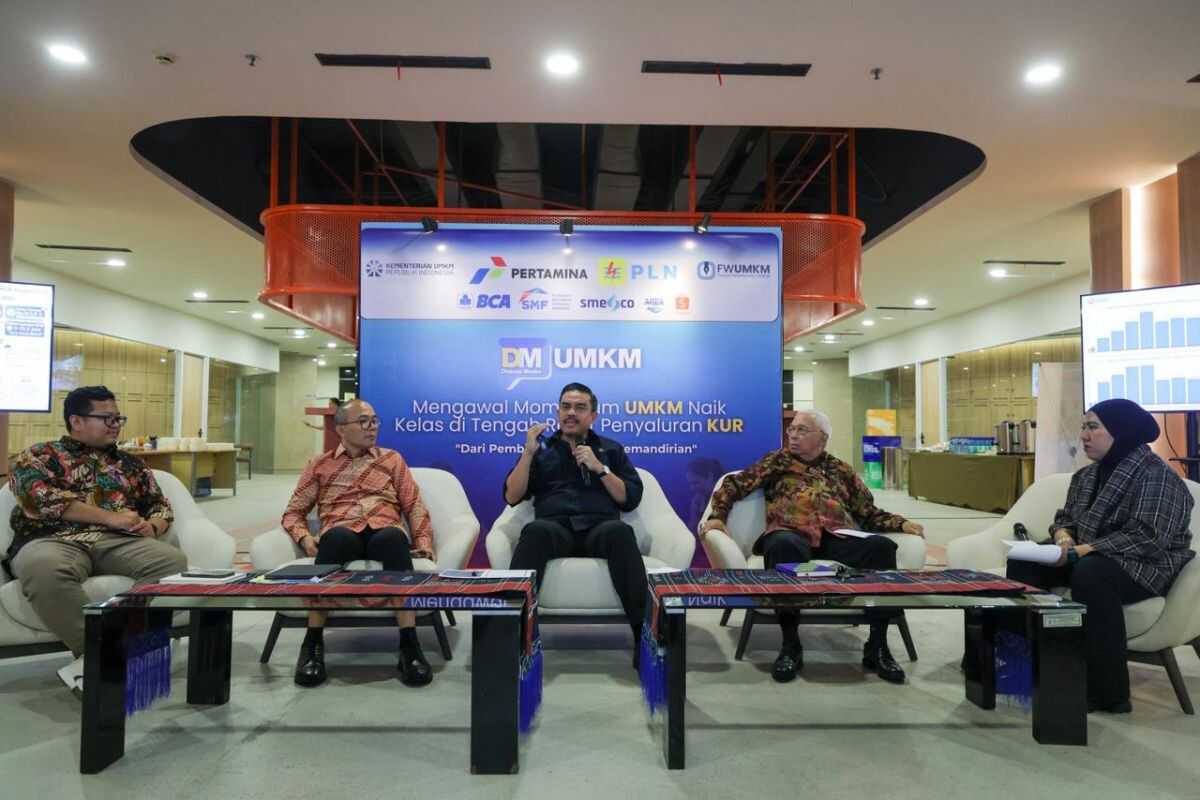
Jakarta — Indonesia’s Minister of Micro, Small, and Medium Enterprises (UMKM), Maman Abdurrahman, has revealed a significant discrepancy between China’s reported exports to Indonesia and Indonesia’s recorded imports from China, particularly in textiles, apparel, and footwear commodities.
According to Maman, the import data recorded in Indonesia is substantially lower than China’s export figures. “The problem is illegal imports entering the country that are not recorded. This is what the President refers to as under-invoicing. Our import data shows 100, but China’s exports show 900. That means 800 units are unrecorded, flooding our domestic market,” he stated during a media discussion organised by the UMKM Press Forum in Jakarta on Friday.
He emphasised that this practice not only erodes state revenue but also creates social problems by contaminating the domestic market and making it difficult for UMKM to compete.
Based on UNTrade 2025 data processed by the UMKM Ministry, significant discrepancies exist between China’s recorded exports to Indonesia and Indonesia’s recorded imports from China across several textile and apparel categories. For hijabs (HS 6214), China’s export value has consistently exceeded Indonesia’s recorded imports since 2013–2024. In 2024, China’s hijab and scarf exports were recorded at approximately $9 million USD, whilst Indonesian imports totalled only $0.6 million USD.
Maman also highlighted export-import data for baby clothing (HS 6111), where China’s 2024 exports reached $4.2 million USD, whilst Indonesia’s imports were only $2.7 million USD. Similar gaps appear in bras and corsets (HS 6212), with China exporting $83.2 million USD compared to Indonesian imports of $28.8 million USD.
For women’s underwear (HS 6108), China’s exports totalled $48.5 million USD whilst Indonesia’s imports were only $13.9 million USD. Men’s underwear (HS 6107) also showed a gap, with exports at $6.2 million USD and imports at $4.6 million USD. Canvas footwear (HS 6404) in 2024 saw China’s exports reach $157.2 million USD, whilst Indonesian imports totalled only $112.4 million USD.
Discrepancies also appear in t-shirts (HS 6109), with China exporting $61.7 million USD and Indonesia importing $20.4 million USD. Men’s trousers and jackets (HS 6203) recorded exports of $30 million USD, whilst Indonesian imports were only $8.2 million USD. For women’s dresses and skirts (HS 6204), China’s exports reached $74.2 million USD, whilst Indonesian imports totalled $16.8 million USD.
Maman described the current domestic market as “contaminated” due to being flooded with cheap imports, including those entering illegally. According to him, the prevalence of illegal imports renders government efforts to enhance UMKM capacity ineffective. Financing support through the People’s Business Credit (KUR) scheme, training programmes, and production facilitation are all undermined because UMKM products struggle to compete in markets saturated with imported goods.
“If we can already produce a product domestically, it should be restricted from import. But if we cannot yet produce it, importing is not a problem,” Maman stated firmly.