
Uluwatu Cliff Faces Dual Pressures from Above and Below
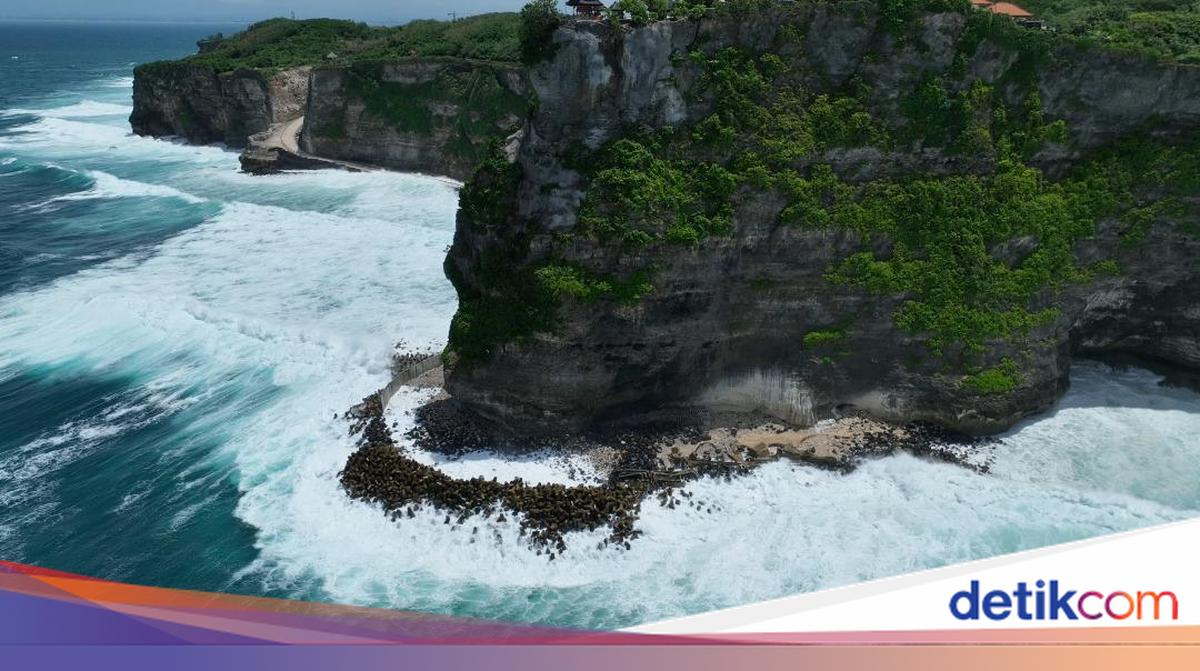
The project to address cracking cliffs in the area surrounding Pura Luhur Uluwatu in Pecatu Village, South Kuta, Badung, Bali is currently in the first phase of three planned phases. The project consultant has identified two pressures threatening the Uluwatu cliff: rainwater runoff from above the cliff and wave strikes at its base.
“Uluwatu is a limestone area. Limestone terrain has characteristics where it is easily dissolved by rainwater and easily damaged by sunlight,” said Arisandi Putra, the project planning consultant for the Uluwatu cliff stabilisation programme, on Thursday (12 March 2026).
Arisandi noted that the threat from above the cliff stems from poorly managed rainwater drainage channels. According to him, water flowing through drainage systems has the potential to erode and worsen cliff cracking.
“The main drainage flowing in this area must be properly organised, and its force must be dissipated. It is not possible to combine all channels into one, because large water flows could split the cliff,” he added.
Arisandi stated that cracks have been discovered at several points along the Uluwatu cliff. Based on investigation results, he said, one cause is poor drainage management and excessive visitor activity too close to the cliff edge.
Meanwhile, the threat from below the cliff comes from continuous wave strikes that gradually erode the cliff. To mitigate this impact, Badung Regency Government has constructed a wave-breaking structure beneath the cliff.
“If categorised as safe against direct wave strikes on the cliff, the answer is yes. The structure we built can reduce wave energy so that the cliff no longer receives direct pressure from waves,” he said.
Additionally, Arisandi believes that the ancestors’ placement of the sacred area at Pura Uluwatu was geologically sound. According to him, directly beneath the main mandala and madya mandala areas of Pura Uluwatu lies a layer of hard rock that functions like an ‘earth anchor’ supporting the cliff structure.
“There is an earth anchor here. It is a type of rock, but harder than rocks generally found. This is what has kept Uluwatu standing firm until now,” he explained.
First Phase of Uluwatu Cliff Stabilisation
As previously reported, the seawall construction project in the Pura Luhur Uluwatu area drew public attention. Based on narratives circulating on social media, the cliff stabilisation construction was damaged and scattered after being struck by waves.
Acting Head of Badung’s Public Works and Spatial Planning Department (PUPR), Anak Agung Rama Putra, commented on the situation. According to him, the seawall construction is currently in the first of three planned phases.
“This activity is actually in phase one. Phase one is meant to establish an inspection road and reduce and mitigate wave strikes,” said Rama Putra.
Rama Putra explained that phase one of the Uluwatu cliff stabilisation project focuses on creating an inspection road whilst mitigating wave strikes. He noted that the maximum wave height that can be withstood by the currently installed breakwater structure is approximately 4-6 metres.
“Since this is design and build, the design and implementation processes are running in parallel,” he added.
Rama explained that the scattered rocks visible on social media are part of the foundation layer of the inspection road used for mobilising materials and heavy equipment. He asserted that there is no revetment damage and the cliff stabilisation project at Uluwatu continues as planned.