
UKI says cross-sector collaboration in the health sector is key to economic growth
Jakarta (ANTARA) — The Christian University of Indonesia (UKI) Cawang, East Jakarta, says cross‑sector collaboration between health and the economy is one of the key levers for promoting sustainable economic growth.
Academic Jisman Lubis of the UKI Vocational Faculty says the health and economic sectors have a reciprocal relationship that reinforces each other.
“Good public health conditions will boost productivity, which ultimately has a positive impact on economic growth,” Jisman said in Jakarta on Friday.
He argued that transdisciplinary and cross-sector collaboration are crucial to reduce social disparities while improving societal welfare in a sustainable manner.
Transdisiciplinary collaboration is a collaborative approach that integrates various academic disciplines with non-academic knowledge (practitioners, communities) to solve real-world complex problems.
“Preventive approaches are the most efficient economic strategy. Therefore health literacy and economic literacy must run in tandem,” Jisman added.
Furthermore, he revealed that participation coverage of the National Health Insurance Programme (JKN) has reached more than 90 percent of the Indonesian population.
Meanwhile, national health spending is recorded at around three percent of Gross Domestic Product (GDP).
On the other hand, data from the Central Statistics Agency show that Indonesia’s Human Development Index (HDI) in 2025 reached 76, reflecting progress in improving living standards.
“Cross-sector collaboration is expected to improve access to primary health services and reduce the risk of poverty due to health costs,” Jisman said.
He also emphasised the role of students as future professionals who are expected to facilitate cross-sector collaboration and apply practical interdisciplinary skills in real life.
According to Jisman, students are not only learners but also agents of change who can contribute directly to addressing various social and public health challenges.
“Students are expected to directly go into communities, implement practical knowledge (applied science) to help people facing problems in an era of uncertainty,” Jisman said.
Moreover, he explained that current challenges are marked by a combined ‘VUCA’ situation, i.e. volatility, uncertainty, complexity, and ambiguity.
This condition, he said, describes a world that is rapidly changing and hard to predict. In fact, the current global condition is also considered to have entered the BANI era—Brittle, Anxious, Non-linear, Incomprehensible—where cause-and-effect relationships are no longer easy to understand.
“In such a situation, UKI’s Faculty of Vocational Studies students must be able to balance health and economy to confront ever-more complex dynamics,” Jisman asserted.
This approach allows integration of various disciplines to yield a more comprehensive understanding of a problem.
“Transdisciplinary approach has a concept of integration to enhance problem understanding. We also need to utilise technology to facilitate human life,” Maksimus said.
He also revealed that the transdisciplinary approach not only involves various disciplines but also a range of actors, including academics, practitioners, and policymakers.
Its aim is to generate knowledge that is critical, informative, and applicable in solving fundamental problems faced by society.
“Therefore, dialogue is needed to connect and enhance mutual understanding across disciplines,” Maksimus explained.
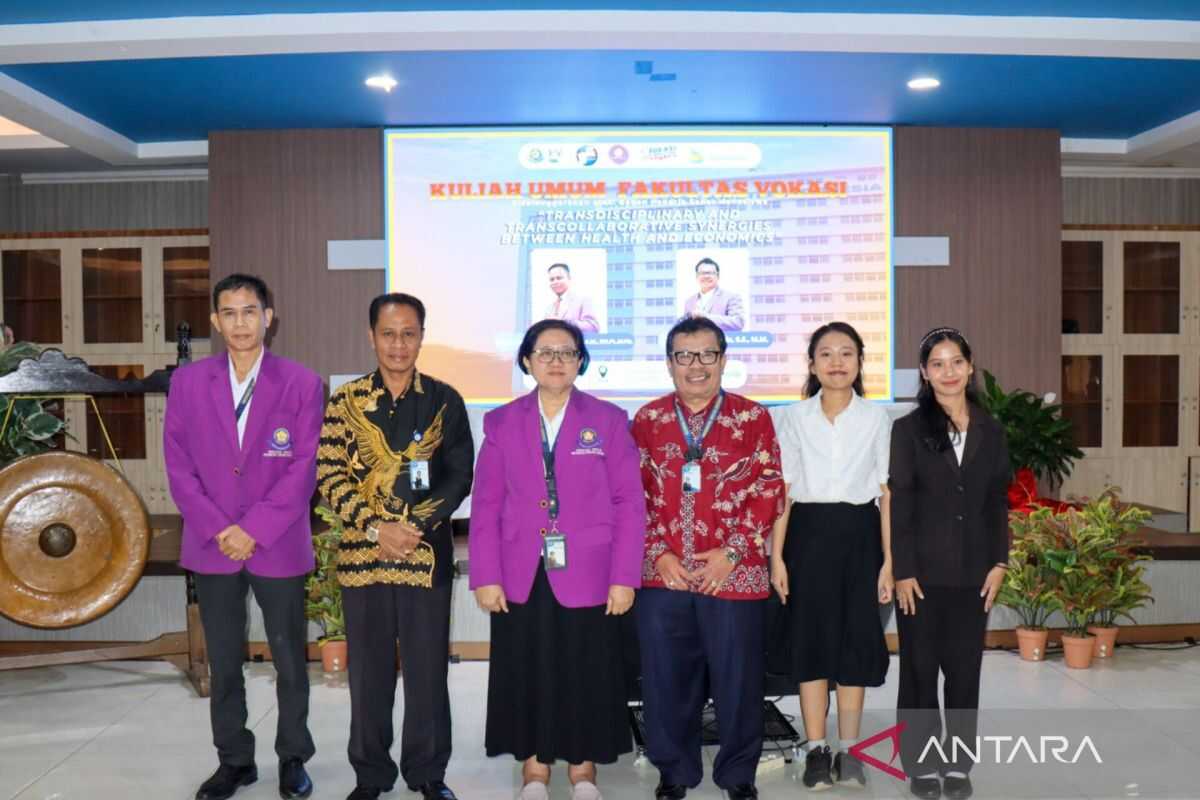
As is known, the Christian University of Indonesia held a public lecture by several academics organised by the Working Body of the Student Senate (BPSM) of the Faculty of Vocational Studies UKI on Thursday (5/3).
The event, held in the UKI Jakarta Seminar Room, was titled “Transdisciplinary and Transcollaborative Synergies Between Health and Economics”.