
UKEN 2026 Held Simultaneously Across Eight Regions, Strengthening Integrity and the Code of Ethics for Prospective Notaries
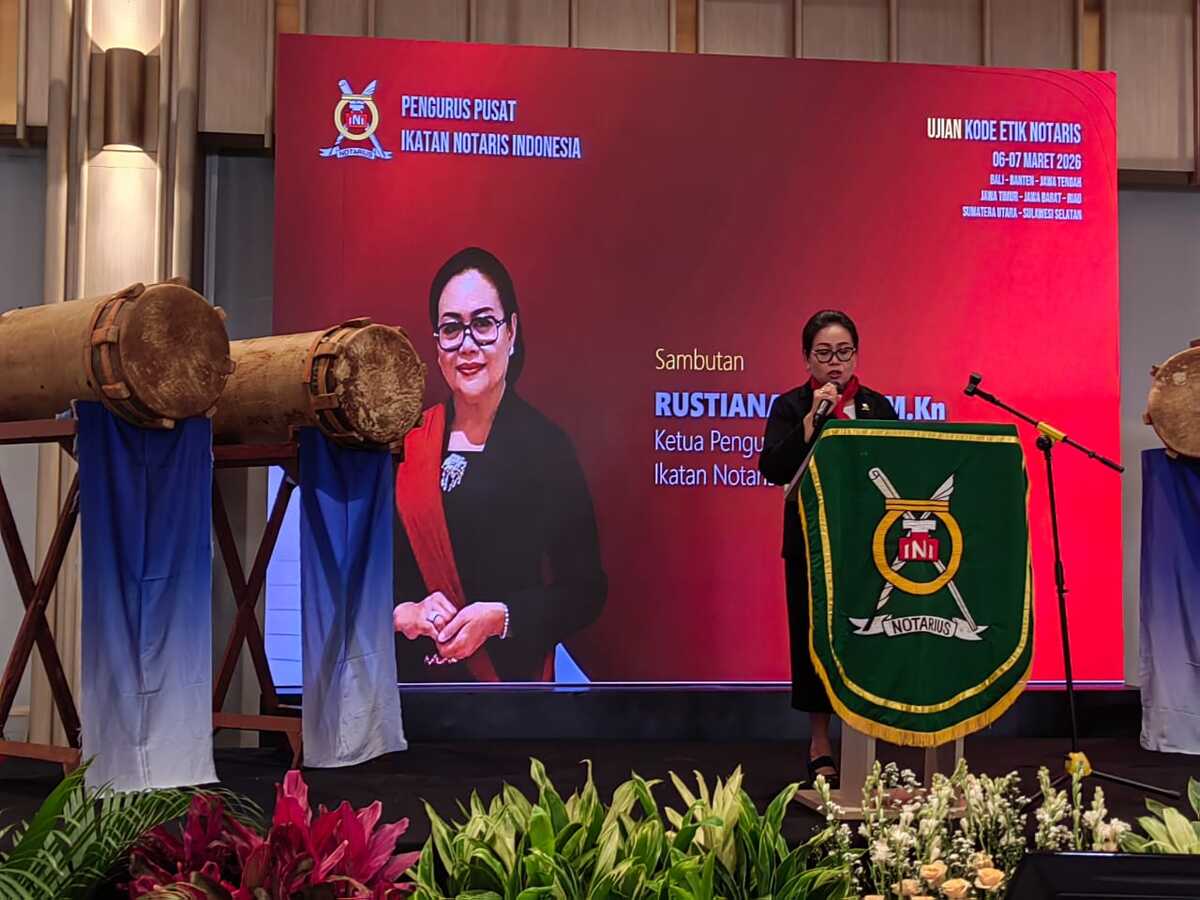
UKEN 2026 opening ceremony and held simultaneously across eight regions: North Sumatra, Riau, Banten, West Java, Central Java, East Java, Bali, and South Sulawesi. A total of 921 participants from across Indonesia took part in the examination as part of the development and strengthening of the ethics standards of the notary profession.
All regional organizers connected and broadcast the opening live via Zoom from the Banten Organising Region, with participants in each region joining.
The March 2026 UKEN is part of the organisation’s ongoing agenda and forms part of the series of Notary Code of Ethics Examinations under the leadership of the President of the Central Board of the Indonesian Notary Association (PP INI), Dr. H. Irfan Ardiansyah, S.H., Sp.N., LL.M. This reinforces continuity and consistency in the organisation’s strategic programme, particularly in the nurturing and strengthening of ethics in the notary profession nationally.
At the official opening of UKEN 2026, the Director General of General Legal Administration (AHU) of the Ministry of Law and Human Rights, Dr. Widodo SH, MH via Zoom stated that the ethics examination is an important stage for prospective notaries before they are officially appointed. Because the ethics examination is the final requirement that must be met after undergoing professional training.
“He hopes that through this examination, prospective notaries will be truly prepared to practise their profession with integrity, moral responsibility, and upholding legal certainty,” he said.
He also emphasised that notaries are a profession highly trusted by the public. Various important legal actions such as the formation of business entities, trade agreements, and other legal transactions often involve notaries. Therefore, a notary must be able to perform their duties professionally and in compliance with the applicable rules. In addition, the Ministry of Law and Human Rights continues to improve the quality and competence of prospective notaries through various stages, including the appointment examination and professional training. This step is taken to ensure that every notary has a good standard of competence.
Widodo also revealed that in recent times there have been a number of violations of notary appointments in several regions. These violations include handing over deed minutes to third parties without supervision, drafting deeds without the presence of the parties, and suspected signature forgery. He said such violations not only breach the code of ethics but can also lead to administrative, civil, or criminal sanctions.
Therefore, moral preparation and understanding of the code of ethics for prospective notaries are crucial before they practise. There are currently around 23,000 notaries in Indonesia, but around 3,000 of them remain not clearly identified. Therefore, Widodo reminded prospective notaries to truly prepare themselves and to have a strong commitment to practising the profession.
Meanwhile, Rustianah, SH, MKn, Chair of the Banten Regional Board in her address said that the strength of the notary profession lies not only in the authority granted by law but also in the honour and dignity of the profession itself. The code of ethics is the foundational core that protects the profession’s reputation. “Without ethics, the powers held by a notary would lose their meaning. Likewise, without integrity, public trust in the notary profession could collapse. Therefore, participants are expected to attend the examination with full seriousness, honesty, and a sense of responsibility,” she said.
She added that UKEN is not only seen as a pass requirement but also as a moment for prospective notaries to reaffirm their commitment to the noble values of the notary profession. She conveyed her commitment to conducting the examination professionally, transparently, and accountably in line with the provisions set by the central board and the ethics council. Through a well-structured and measured process, it is expected to produce notaries who not only possess strong legal capabilities but also have high ethics and integrity in carrying out their duties.
In the same vein, the President of PP INI, Dr. H. Irfan Ardiansyah, S.H., Sp.N., LL.M stressed the importance of maintaining integrity in the notary profession. Actions deviating from rules and ethics are not appropriate for a notary. “Behaviour that violates norms and ethics often happens beyond reason and does not reflect the professional stance of a public officer,” he asserted.
He reminded that in addition to legal competence, a notary must also maintain good relationships with various parties, including fellow professionals and partners. This is important to create a professional working environment and mutual support. Irfan also affirmed that the examinations and trainings conducted by the professional body aim to shape notaries who are not only legally competent but also possess strong integrity in carrying out their duties.
He stated that integrity is the core value a notary must hold. Without integrity, public trust in the notary profession may decline. Therefore, prospective notaries are expected to uphold ethics, professionalism, and healthy competition in their practice. He added that the notary profession indeed offers good earning potential, but every notary must uphold ethics and not disregard the rules for personal gain. With proper training and a commitment to integrity, prospective notaries are expected to practise