
UI unveils multidisciplinary innovation in Purwakarta's 'Knowledge Village'
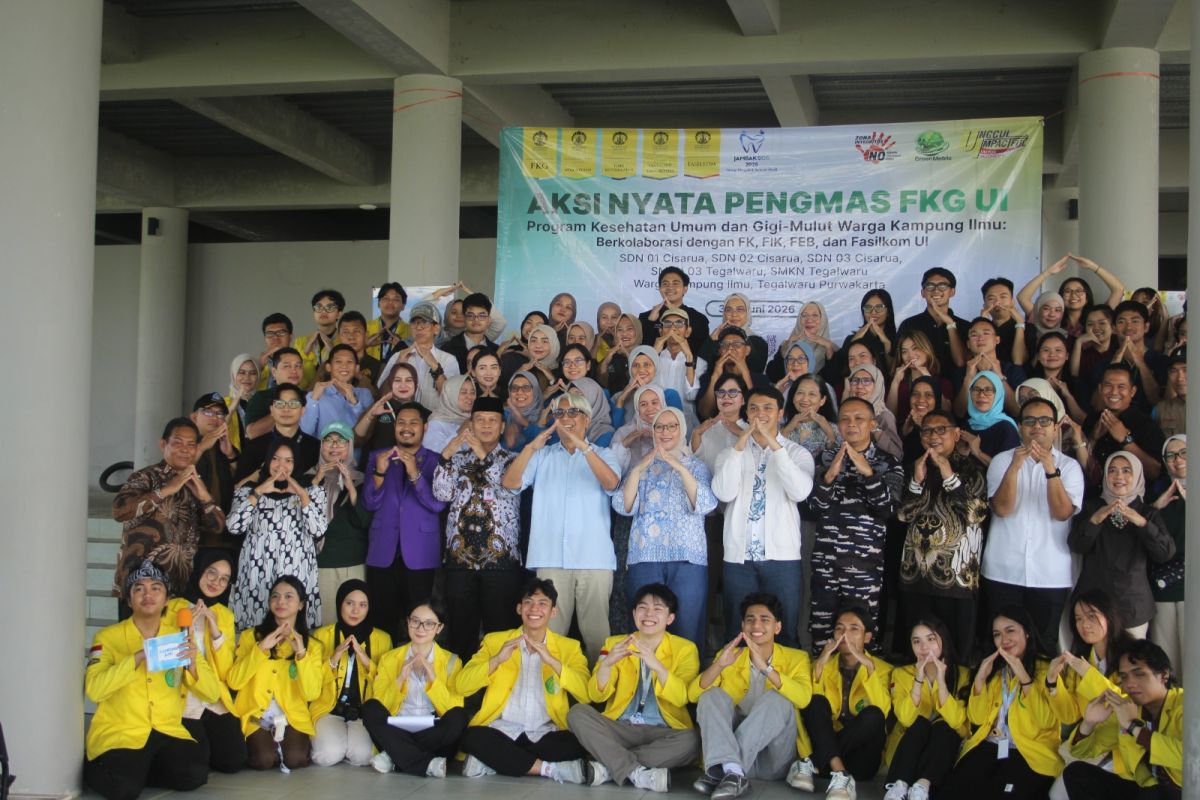
Through adaptive pentahelix synergy, UI and its partners have demonstrated that measurable community service can bring fundamental change to public health and welfare. The Faculty of Dentistry (FKG) at Universitas Indonesia (UI) has reaffirmed its commitment to community service through the “FKG UI Community Service Real Action” programme in Kampung Ilmu, Tegalwaru, Purwakarta, West Java. “This programme proves that community service does not stop at medical services alone, but must transform into a multidisciplinary movement that is data-based and rooted in the real needs of the community. Through cross-faculty synergy and community support, we want to ensure that stunting and oral health interventions can run sustainably, while producing a model for fostered villages that becomes a national exemplar,” said FKG UI Dean Prof. Lisa Rinanda Amir in Depok on Thursday. Five years of consistency in Kampung Ilmu Purwakarta has produced a new fostered village pilot model, proving that measured community service can bring fundamental change to public health and welfare. Entering its fifth year, this agenda is no longer merely an annual social service event but has evolved into a stage for data-based innovation and multidisciplinary collaboration to answer public health challenges, carrying the grand mission of meeting the Sustainable Development Goals (SDGs), particularly SDG number 2 (Zero Hunger), number 3 (Good Health and Well-being), and number 4 (Quality Education). In implementing this community service, FKG coordinated with the Directorate of Community Service and Social Innovation (DPIS) and collaborated with four other faculties: the Faculty of Medicine (FK), the Faculty of Nursing (FIK), the Faculty of Economics and Business (FEB), and the Faculty of Computer Science (Fasilkom). This cross-institutional and interdisciplinary synergy produced two programmes for implementation: the formulation of the “Stunting Intervention Triangle” and a “Strategy for Responding to Fluctuations in Oral Diseases.” Data from Tegalwaru Community Health Centre showed that oral diseases once ranked 6th among the top 10 diseases in 2023, with 876 cases. Intensive intervention by FKG UI succeeded in reducing this figure until it dropped out of the top 10 list in 2024. However, in 2025 cases reappeared in 8th place with 463 cases, nearly half the initial figure. “This fluctuation phenomenon prompted the UI team to reformulate a more precise, adaptive, and long-term oriented strategy so that cases do not spike again,” said Lisa. The formulation of the “Stunting Intervention Triangle” serves as the main driving force in this fifth year’s real action, advancing three approaches: health, economic, and community. The health approach is carried out through comprehensive screening of pregnant women and toddlers by a joint team from FKG, FK, and FIK UI. Oral and dental disorders that affect children’s nutritional intake are also treated alongside FK UI obstetrics specialists and the FIK UI family nursing team. Meanwhile, the economic approach is filled by FEB UI through food security and family financial management workshops, ensuring parents can maintain purchasing power for nutritious food. The community approach involves training local volunteers from Kampung Ilmu and Community Health Centre health cadres to conduct independent monitoring, ensuring early detection of stunting and dental health remains sustainable. The real community service action is driven by 130 personnel, consisting of undergraduate students, professional students, specialist residents, lecturers, and clinical teaching doctors from FKG UI, reinforced by FK UI PPDS students, FIK UI lecturers, 9 personnel from the R.E. Martadinata Dental Laboratory (LADOKGI), and 5 personnel from the FKG UI Alumni Association (ILUNI). The direct impact of this real action was felt by 1,403 beneficiaries, including students from SDN 01 Cisarua (155 students, 12 teachers), SDN 02 Cisarua (299 students, 15 teachers), SDN 03 Cisarua (69 students, 8 teachers), SMPN 03 Tegalwaru (287 students, 25 teachers), as well as hundreds of students from SMKN Tegalwaru, groups of pregnant women, Community Health Centre health workers, and local volunteers. Universitas Indonesia affirmed its commitment to continuously carry out community service as an embodiment of the Tri Dharma of Higher Education.