
UI Professor Transforms Indonesia's Approach to Earthquake Resilience
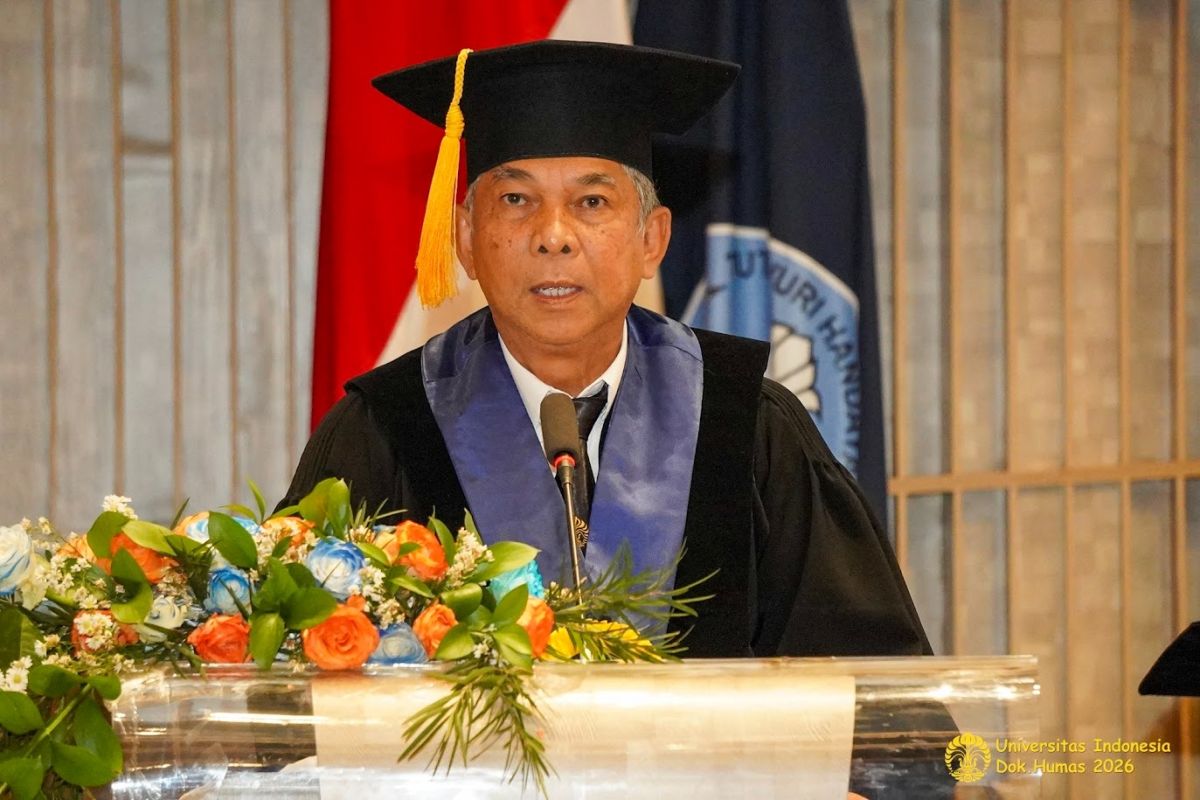
Depok (ANTARA) - Professor Yuskar Lase, a professor in the field of Building Construction Engineering Technology at the Faculty of Engineering, University of Indonesia (FTUI), is transforming Indonesia’s approach to facing earthquakes. “Earthquakes are an inevitability that cannot be avoided, but their impact on man-made structures is a choice,” emphasised Prof Yuskar Lase in his statement at the UI Depok campus on Friday. Yuskar stressed the need for a paradigm shift from the fixed base approach to the sliding base system. According to him, this system is not merely a technical innovation, but a form of reconciliation between modern engineering and the dynamics of nature. Yuskar’s research stems from the background that Indonesia, as a country on the Ring of Fire, faces recurring deadly seismic risks, from Sumatra (1833), Aceh (2004) to Cianjur (2022). Non-engineered buildings, particularly low- and mid-low rise structures, have proven most vulnerable. Ironically, the current Nusantara building construction philosophy is still dominated by the fixed base approach, with structures designed to resist and counter earthquake energy. The application of this approach to non-engineered, low-rise, and mid-low buildings has empirically and theoretically proven to be the most vulnerable to earthquake destructive forces. “The paradox of our development is building concrete jungles on active faults. That is why we must dare to change the construction paradigm,” he added. Yuskar highlights the traditional house from his birthplace, Nias Island, namely Omo Hada, as an important reference. Omo Hada uses a flexible structural system with stone supports, semi-rigid joints, and diagonal bracing, allowing earthquake energy dissipation through friction and controlled deformation. The cross-generational resilience of Omo Hada proves that adaptation principles have long been part of the Nusantara society’s DNA. Post-2005 Nias earthquake studies recorded that Omo Hada houses only shifted by approximately 10 cm without significant damage, despite being shaken by an earthquake with a moment magnitude (Mw) of 8.6. This fact shows that resilience is not an imported commodity from the West, but a local heritage that remains relevant to this day. Modern technology such as the Double Concave Friction Pendulum (DCFP) serves as an elaboration of the Omo Hada principles. This system allows buildings to move relative to the ground, reducing structural response, while having self-centering capabilities. Yuskar’s research on data centre buildings demonstrates the effectiveness of this system in controlling the level of structural damage as well as data centre equipment, which has very significant economic value, even exceeding the economic value of the building structure itself. With the paradigm transformation from fixed base to sliding base, Nusantara building construction can become more adaptive, efficient, and inclusive.