
UGM Team Scientifically Unveils Mysterious Fire Phenomenon in Sleman
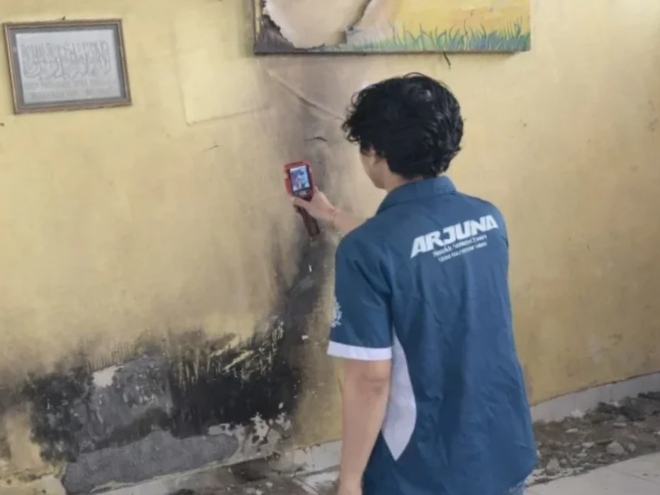
The phenomenon of dozens of mysterious fire spots appearing in a resident’s house in Seyegan, Sleman, Special Region of Yogyakarta, has begun to be unravelled. The phenomenon was not due to mystical reasons, but rather the result of a chemical reaction. This was evident after a research team from the Centre for Entropy Deceleration Studies (PKPE) at the Faculty of Engineering, Universitas Gadjah Mada (UGM), led by Prof. Ir. Alva Edy Tontowi, Ph.D., conducted three direct observations. The mystery began to unravel during the second observation on Monday (1/6/2026). It started with the PKPE team’s finding of a shirt that had spontaneously burnt in one corner of the house. “When the gas detector device was brought close, the hydrogen accumulation figure at that spot soared very high, reaching 0.40,” Alva revealed. Not only there, this highly flammable gas had also apparently infiltrated another area, namely the bathroom. The team recorded the gas there reached 0.11, which is considered quite high. These findings led to the conclusion that the gas was the result of the fermentation of organic waste from chicken slaughtering activities around the location. To prove this, the team tested water samples from various points, ranging from pipe flows, wells, to household wastewater. They even carried out shallow excavations at several points on the floor on Thursday (4/6/2026). This step was taken to measure the movement of the soil gases. From the field findings, Prof. Alva presented the theory that while hydrogen is indeed flammable, it needs an igniter. From this, suspicion fell on a gas called phosphine (PH₃). Phosphine gas can form from phosphate-rich materials, such as bones and the hard parts of chicken feathers leftover from slaughter. This gas is very sensitive and can ignite spontaneously upon contact with oxygen at room temperature. “Unfortunately, phosphine gas is not easily detectable and will burn up completely when it meets oxygen. It is highly likely that this phosphine gas triggered the combustion of the hydrogen gas when they appeared together,” Alva explained. In short, when phosphine gas emerges from the ground together with hydrogen, the phosphine immediately ignites upon contact with air, then ‘sets fire to’ the hydrogen that has accumulated in the room. That is what caused the mysterious fire spots to appear. Prof Alva explained that laboratory analysis of liquid waste samples is still ongoing. At the same time, the UGM team moved quickly to provide first aid for the homeowner so that a similar disaster does not recur. The most crucial first step is to open air circulation as wide as possible and install electric fans. With that, gas seepage coming out of the floor is immediately dispersed by the wind and does not have time to accumulate to levels that could trigger the appearance of fire. Secondly, the homeowner was also asked to remove flammable items. Thirdly, the UGM team will help saturate the soil and the house floor with an alkaline solution (limewater). This step of pouring limewater is carried out to change the soil’s acidity level. In this way, the Clostridium bacteria, which has been fermenting the chicken waste and producing hydrogen gas, will no longer be comfortable living there. With these findings, scientifically, the mysterious fire could finally be explained and also suppressed by science.