
UBSI 2026 Digital Learning Innovation Grant Promotes PjBL, Transforming Classrooms into Academic Workspaces
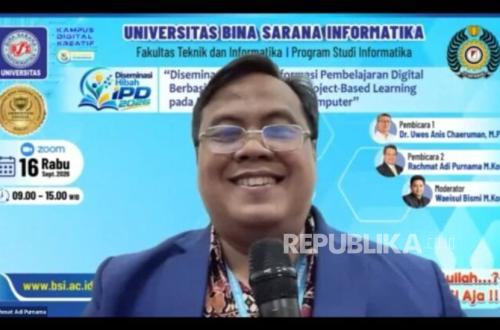
The 2026 Digital Learning Innovation Grant (IPD) programme at Universitas Bina Sarana Informatika (UBSI) is not only driving the use of technology in education but also strengthening the implementation of Project-Based Learning (PjBL) oriented towards learning outcomes and real-world issues. This approach positions students not merely as recipients of material, but as active participants in the process of discovering, developing, and resolving problems.
This was stated by the Dean of the Faculty of Engineering and Informatics (FTI) at UBSI, Rachmat Adi Purnama, during a session on the Dissemination of Digital Learning Transformation Results based on Case Method and Project-Based Learning for Computer Network courses, held at the Asyana Hotel Pemuda, Jakarta, on Wednesday (16/9).
According to Rachmat, learning must be designed based on the competencies students must achieve, rather than simply chasing the completion of all lecture materials. Therefore, the application of PjBL needs to guide students through a learning process that enables them to understand, explain, analyse, and ultimately produce solutions.
“The PjBL concept transforms the classroom into an academic workspace,” Rachmat stated in a press release received on Wednesday (16/9).
Under this concept, projects become an integral part of the student learning experience. The process does not stop at the assignment stage but begins with identifying problems that need to be understood and solved.
Rachmat explained that students can learn through projects derived from real-world issues, while lecturers act as designers of the learning experience and facilitators. With this pattern, learning interaction occurs not only when the lecturer delivers material but also when students conduct investigations, engage in discussions, collaborate, and develop solutions.
Learning Videos as Part of the PjBL Ecosystem
Rachmat also linked the implementation of this approach to the execution of the 2026 IPD Grant at UBSI. One of the innovations being developed through this programme is instructional videos designed to help students understand material before undergoing evaluation and discussion processes.
“That is why the Study Programmes, in this case, are receiving the IPD grant. One of the components is the creation of instructional videos,” he said.
According to him, the use of video provides a more flexible learning space for students. Material can be studied beforehand via video, after which student understanding is reinforced through evaluations, assignments, discussions, and other learning activities.
Thus, technology is not positioned as the ultimate goal of learning innovation. Videos and digital devices serve as part of a learning ecosystem that supports students in achieving established competencies.