
Two Blessings from First Quarter Investment: Job Creation and the Rise of Domestic Investors
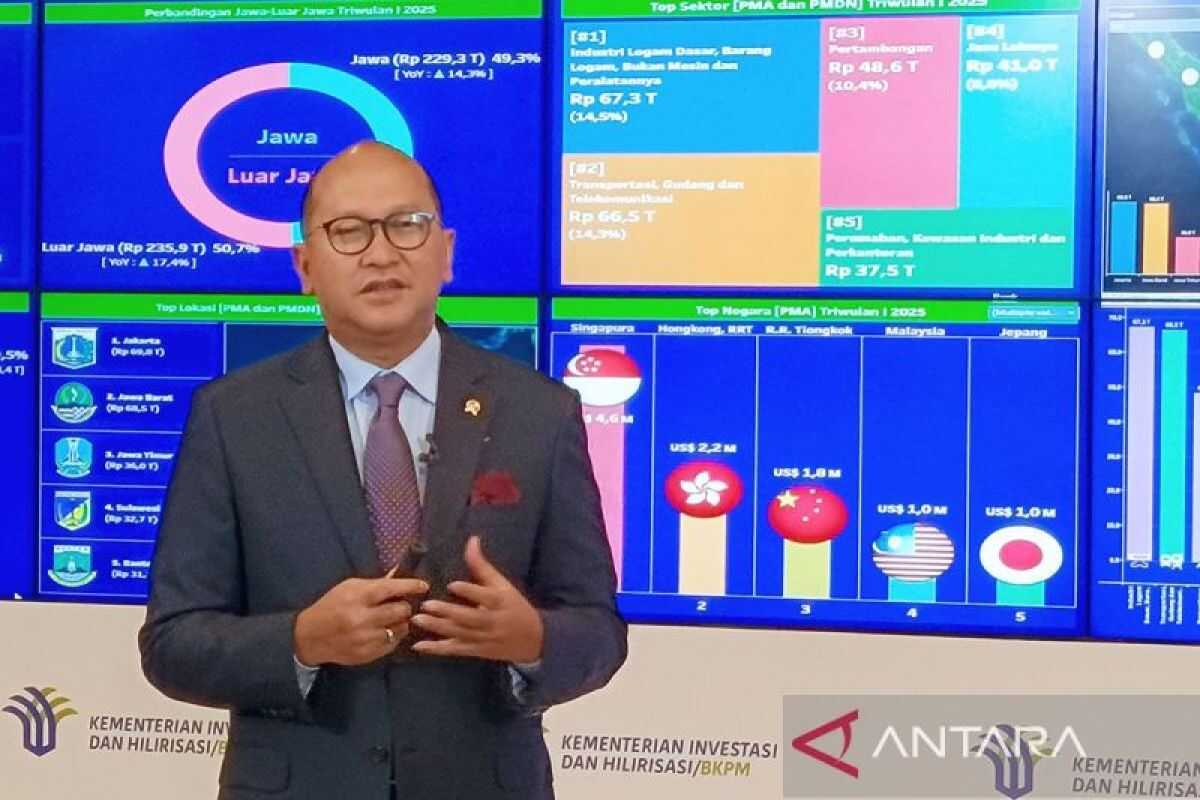
Jakarta (ANTARA) - The first quarter 2025 investment realisation data contains two major blessings worthy of deeper examination beyond mere macroeconomic figures: significant job absorption and the resurgence of domestic investor dominance. Both are not merely good news in statistical terms, but important indicators of the direction of growth and resilience of the national economy going forward.
Investment and Downstream Minister/BKPM Head Rosan Perkasa Roeslani’s statement regarding the absorption of more than 594,000 workers from new investments, along with the surge in domestic investment growth, marks two moments of momentum that, if properly leveraged, could bring structural transformation to Indonesia’s economy.
Amid the widespread reporting of layoffs in the manufacturing sector, particularly over the past six months, the fact that nearly 600,000 people were absorbed through investment activity represents a breath of fresh air that must not be overlooked. As noted by Christiantoko, Executive Director of NEXT Indonesia Center, this achievement carries strategic significance that often escapes public attention because the dominant narrative has been focused on the bleak side of industrial turbulence.
In this context, investment realisation is not merely a matter of capital and infrastructure, but also one of livelihoods and human dignity. When nearly 600,000 people gain employment opportunities, we are speaking of 600,000 households that can maintain their purchasing power, children’s education, and access to healthcare. Employment is the most concrete foundation of economic development oriented towards public welfare.
Furthermore, Christiantoko emphasised that household consumption accounts for approximately 54 per cent of national GDP. This means job absorption directly keeps the main engine of the economy running. In an economic system like Indonesia’s, where the majority of the population falls within the lower-middle class, the relationship between employment and economic resilience is extremely close. It is therefore not an exaggeration to say that successfully absorbing hundreds of thousands of workers through investment is a tangible form of inclusive development strategy.
President Prabowo has also established a Layoff Task Force as a demonstration of concern for national labour conditions, and this investment data could serve as both evaluation material and fuel for optimism in shaping future employment strategies.
Domestic Investors
Equally important is the second blessing from the investment report: the revival of domestic investor enthusiasm. For years, foreign direct investment (FDI) dominated Indonesia’s investment structure. In 2022, for instance, FDI contributed 54.2 per cent of total investment, and in 2024 it still stood at 52.5 per cent.
In an open economic system, the role of FDI is certainly important, particularly in terms of technology transfer and strengthening industrial capacity. However, there is a fundamental challenge when dependence on foreign investment becomes too great: vulnerability to global dynamics, geopolitical uncertainty, and capital flows that cannot always be controlled by national policy.
This is where the significance of the first quarter 2025 data becomes striking. With domestic investment growth of 19.1 per cent year-on-year, far outpacing FDI which grew only 12.7 per cent, the contribution of local investors has finally surpassed that of foreign investors — 50.5 per cent of total investment realisation now originates domestically. This is not merely a statistic, but a representation of a directional shift in the national economic strategy.
Economic self-reliance is not merely a political slogan; it becomes possible when local business players dare to invest their capital, see a future within the country, and build growth from internal strength. This phenomenon is widely seen as a sign of renewed enthusiasm among local entrepreneurs. Such optimism must be nurtured with precise policies — legal certainty, well-targeted fiscal incentives, and bureaucratic simplification must continue to be pursued so that this does not become a mere temporary anomaly.
Moreover, in President Prabowo’s narrative, economic self-reliance has always held a central place. If local business players become the primary drivers of investment, then the resulting money circulation will also revolve more within the domestic economy. The implications include strengthening domestic fiscal capacity, increasing regional revenues, and reducing dependence on volatile foreign capital flows.
This also opens new space for consolidation of nationally strategic sectors. When local capital is more dominant, opportunities to build interconnected industrial networks also grow, including forming robust ecosystems in renewable energy, modern agriculture, information technology, and manufacturing based on domestic resources.
In this context, investment becomes more than merely an instrument of economic growth; it becomes a tool for structural transformation. Investment’s contribution to GDP in 2024 reached 29 per cent, and there remains considerable room for increasing that contribution. However, such increases will only be meaningful if accompanied by a shift in investment quality: from capital-intensive to labour-intensive, from extractive to productive, from centralised to distributed, from short-term oriented to sustainable.
Both pieces of good news from this first quarter — high job absorption and domestic investment dominance — signal that Indonesia stands at a promising crossroads. What is needed now is the courage to make this the foundation of long-term policy, not merely a momentary achievement.
In other words, these two blessings from investment realisation are not just a success story, but a call to strengthen the national economic architecture. If investment continues to be directed towards absorbing labour and strengthening the role of domestic investors, then Indonesia’s economy will not only grow, but will stand upon a solid and sovereign foundation.