
Trump's Thirst for Weapons, America's "War Prophet" Smiles Contentedly
Lockheed Martin (NYSE: LMT) is undergoing a crucial structural transition in early 2026. The Q1 2026 financial report shows a decline in profits and a reversal to negative cash flow, triggering a 4.6% share price correction.
Nevertheless, this short-term pressure occurs amidst a surge in ammunition demand driven by the escalation of conflict between the United States and Iran.
This geopolitical dynamic not only accelerates weapons orders but also transforms the procurement cooperation framework between the company and the US Department of Defense into one more accommodating to corporate risks.
Here is a summary of Lockheed Martin’s Q1 2026 financial performance:
US-Iran Conflict Catalyst and Ammunition Production Acceleration
The United States’ military involvement in the conflict with Iran has directly depleted the Pentagon’s strategic ammunition reserves. This situation forces the US government to swiftly secure supplies of air defence systems and precision missiles.
In response, on 10 April 2026, Lockheed Martin received an undefinitized contract action (UCA) worth $4.7 billion. This massive contract focuses on accelerating the production of PAC-3 Missile Segment Enhancement (MSE) interceptors, whose combat effectiveness has been directly validated in the field, including through Operation Epic Fury.
The ongoing war is forcing a scaling change in the defence industry’s production. The latest agreement targets tripling the production capacity of PAC-3 MSE.
High demand is also seen in other product lines, where the US government requests that production capacity for Terminal High Altitude Area Defense (THAAD) and Precision Strike Missiles (PrSM) be increased up to fourfold.
To support this, the company has realised capital investments exceeding $7 billion since President Donald Trump’s first term, with $2 billion specifically allocated to accelerate ammunition production and build new facilities such as the Munitions Acceleration Center.
Transformation of Partnership with the US Department of Defense
The high urgency of weapons production amid the conflict has driven a total restructuring of how the Pentagon does business with defence contractors.
The US Department of Defense is beginning to adopt the Acquisition Transformation Strategy, a business model more akin to commercial practices. Under this framework, the Pentagon provides financial protection through recovery mechanisms to Lockheed Martin.
If the government changes production targets in the future, cuts budgets, or Congress alters funding allocation policies, Lockheed Martin will still receive appropriate financial compensation.
This risk mitigation model eliminates the main barriers that have previously made defence contractors reluctant to invest large capital in factory expansions.
Lockheed Martin CEO Jim Taiclet emphasised this situation as a fundamental opportunity, supported by the government’s willingness to share financial risks and proposals for a record $1.5 trillion defence budget from President Donald Trump’s administration.
Short-Term Operational Pressures in the Aeronautics Segment
Although the Missiles and Fire Control segment recorded an 8% increase in operating profit to $500 million, the company’s consolidated performance is still burdened by supply chain constraints.
The Aeronautics segment, the largest revenue contributor, recorded a 14% decline in operating profit to $619 million.
This decline is a direct impact of delays in development and production on the F-16 fighter jet programme, where the company delivered not a single unit in Q1 2026.
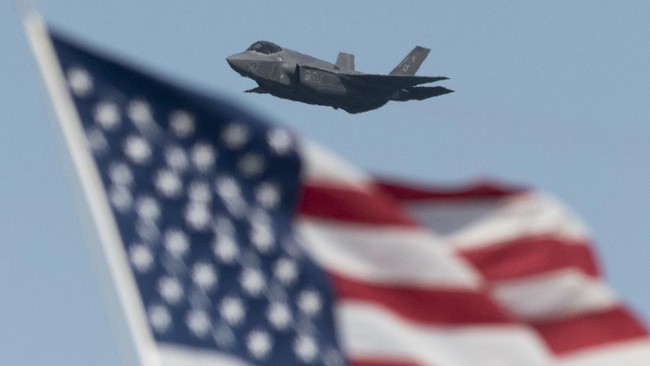
Additionally, issues with integrating parts from increasingly scarce manufacturing sources are hindering C-130 transport aircraft production, while F-35 fighter jet deliveries dropped from 47 units to 32 units.
Free cash flow (FCF) reaching negative $291 million reflects high working capital tied up due to billing timing issues and a surge in capital expenditures ($511 million) to boost factory capacity to meet Pentagon orders.
Future Business Prospects and Valuation
Looking ahead, Lockheed Martin is expected to face a transition phase at least until the second half of 2026. Analysts from Bank of America maintain a Neutral rating with an adjusted price target to $600 from the previous $660.
This projection underscores short-term cash flow pressures before new factories and production accelerations begin generating stable revenue.
However, the company’s long-term prospects appear protected by the stability of the new contract structure and high order visibility amid global geopolitical tensions.
Management consistently maintains full-year financial guidance targets, with expected revenue in the range of $77.5 billion to $80.0 billion, and free cash flow projected to recover to $6.5 billion to $6.8 billion.
The fundamental pressures in the first quarter more reflect initial capital sacrifices in the early phase of a defence spending cycle projected to be one of the largest in US history.
Lockheed is expected to reap significant profits ahead, as in its history whenever there is war.
As a note, Lockheed Martin is often nicknamed the “war prophet” or prophet of war. This nickname is not an official term but rather a political critique and metaphor that emerged from anti-war activists, academics, to parts of Western media.
The term refers to the view that the largest US weapons company almost always benefits when geopolitical conflicts heat up. When war breaks out or global tensions rise, demand for fighter jets, missiles, air defence systems, to advanced military technology usually surges.