
Trump Reveals Several Pieces of Good News from Iran
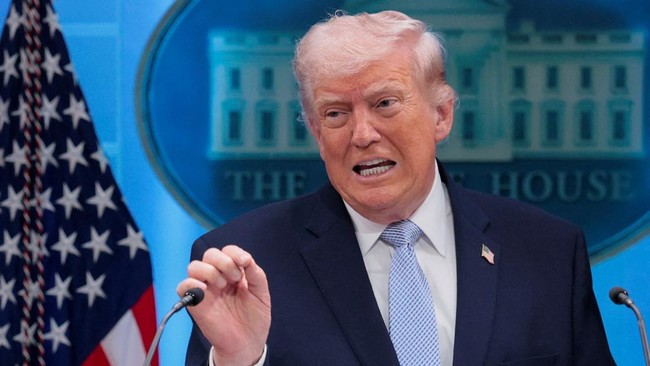
Following Iran’s announcement of reopening the Strait of Hormuz with certain conditions, US President Donald Trump has revealed additional “good news” from Tehran. This indicates optimism for ending the war in the Middle East.
Nevertheless, Trump did not specify what these pieces of good news entail. He also emphasised that the imminent ceasefire with Iran is unlikely to be extended without further agreements.
It is known that Iran has temporarily reopened the Strait of Hormuz after a US-mediated ceasefire was reached between Israel and Lebanon.
However, subsequent statements from both sides have raised uncertainty about how quickly shipments can return to normal through this global oil route.
“It seems everything is going very well in the Middle East with Iran,” Trump told reporters aboard Air Force One on Friday (17 April) evening local time, while returning to Washington from Phoenix, Arizona.
“We negotiated over the weekend. I hope everything goes well. Many of these things have been negotiated and agreed upon. The main thing is that Iran will not have nuclear weapons,” Trump claimed.
In contrast, Trump stated that his side might end the ceasefire with Iran unless a long-term agreement to end the war is approved by both parties. He also reaffirmed that the US blockade of Iranian ports will continue.
The US and Israel began the war with Iran on 28 February 2026. The seven-week conflict has killed thousands and caused a surge in oil prices due to the closure of the Strait of Hormuz.
Trump told Reuters that there is a possibility of more direct talks between Iran and the US this weekend.
There were no signs of preparations on Saturday (19 April 2026) morning local time for talks in Pakistan’s capital, where the highest-level US-Iran negotiations since the 1979 Islamic Revolution ended without agreement last weekend.
Pakistan’s main mediator, Army Chief Field Marshal Asim Munir, has been holding talks in Tehran since Wednesday.
A Pakistani source familiar with the mediation efforts said that a meeting between Iran and the US could result in an initial memorandum of understanding, followed by a comprehensive peace agreement within 60 days.
Among the complicating factors, Iran’s Parliament Speaker and senior negotiator Mohammad Baqer Qalibaf posted on social media that the Strait of Hormuz “will not remain open” if the US blockade continues.
Foreign Minister Abbas Araqchi has announced on social media that the strait is open to all commercial vessels for the remainder of the 10-day ceasefire agreed on Thursday by Israel and Lebanon, which Israel invaded after the Iran-allied Hezbollah militant group joined the fighting.
Ship traffic data shows about 20 vessels, including container ships, bulk carriers, and tankers, moving through the Gulf towards the Strait of Hormuz on Friday (17 April) evening, but most eventually turned back, though the reason is unclear. The group included three container ships operated by French shipping group CMA CGM, which declined to comment.
However, a cruise ship stranded in Dubai, Celestyal Discovery, successfully crossed the strait and headed to Oman on Saturday morning, according to Marine Traffic tracking data.
Iran stated that all vessels crossing the strait must coordinate with the Islamic Revolutionary Guard Corps, which was not the case before the war.
The Defence Ministry said in a statement quoted by state television that military vessels and those affiliated with “enemy forces” (US and Israel) are still not permitted to pass.
Shipping companies said they would need clarification, including on mine risks, before vessels move through the entry point to the area.
The US Navy warned sailors that mine threats in some parts of the waterway are not fully understood and advised them to consider avoiding the area.
Latest update: Iran has announced the reclosure of the Strait of Hormuz as disputes with the US continue.