
Trump in Pharaoh's Clothing
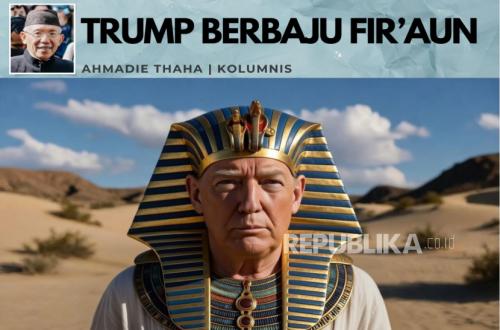
Throughout approximately three thousand years of ancient Egyptian history, roughly one hundred and eighty rulers carried the title “Pharaoh.” Thus “Pharaoh” was not a personal name but a political position—a kind of permanent president, albeit one with a golden crown, pyramids as national monuments, and forced labour as a development programme.
The Qur’an mentions the word “Pharaoh” approximately seventy-four times. This frequency is excessive if merely recounting ancient Egyptian history, without acknowledging how lengthy that history was—stretching across thirty centuries. Imagine: thirty centuries. The clear implication is that the scripture intended not merely to describe a historical figure, but to illustrate a pattern of power that transcends eras.
Sometimes the Pharaoh appeared wearing a golden crown. Sometimes in military uniform. And sometimes—in the modern political world—he appears in an expensive suit, at a campaign podium, and under television spotlights. In short: the Pharaoh does not always wear a crown. He merely changes his clothes, including metaphorically.
The Pharaoh is a symbol of power transformed into political narcissism. In the story of Moses recounted in the Qur’an, he is depicted as a ruler incapable of accepting limits. When Moses arrived bearing a message of truth, the Pharaoh’s response was not reflection but escalation. Criticism was deemed rebellion. Facts were deemed threats. Power had to be maintained by any means necessary.
This pattern, it turns out, did not end in antiquity. A writer named Richard Diamond attempted to reread the Pharaoh narrative in the context of modern politics. Diamond is a former technology executive who now writes about Jewish philosophy, public ethics, and political life.
In his article in the Times of Israel titled “This Week, as Pharaoh Reappears, It’s Worth Naming Trump’s Pathology,” he invites readers to see that the Pharaoh’s leadership pattern can re-emerge in more contemporary forms.
Diamond is not crafting religious interpretation or cheap political allegory. He is simply doing something straightforward: recognising psychological patterns of power, particularly what he calls Trump’s pathology—the psychological illness afflicting US President Donald Trump.
According to his analysis, Trump’s behaviour over many years demonstrates a leadership structure remarkably similar to what psychology terms “pathological narcissism.”
In everyday conversation, narcissism is often dismissed as mere excessive self-confidence. We sometimes use it to describe friends who enjoy posting photographs of themselves on social media.
However, in classical psychological study, narcissism is a personality structure incapable of accepting limits. Social philosopher Erich Fromm termed its extreme form “malignant narcissism”—a need always to be right, inability to accept authority outside oneself, and a tendency to destroy anything obstructing one’s dominance.
If this pattern of malignant narcissism is used to read Trump’s behaviour, many of his actions appear quite consistent. When he lost the 2020 election, for instance, he did not accept the result as a political fact but as an affront that must be overturned.
Dozens of courts across various states rejected his legal team’s lawsuits, finding no evidence of significant fraud. Yet in the narcissistic leadership pattern, defeat is not a political fact. Trump and his team viewed it as a wounded ego requiring retaliation as a healing mechanism.
Psychologist Heinz Kohut explained such reactions using the term “narcissistic rage.” When a narcissist’s enormous ego is wounded—whether by criticism, defeat, or mockery—the response is not introspection but counterattack. Anger becomes a mechanism to restore dominance, which Trump has frequently directed at his political opponents.
This explains why in Trump’s political life, many figures have suddenly become enemies. Critical media is called the “enemy of the people.” Judges making contrary decisions are attacked openly. Even government officials attempting to preserve constitutional procedures have often become targets of his assault.