
Trump "Falls For" Netanyahu's Talk, Now Headaches Alone in Iran War
US President Donald Trump is assessed to have adopted the narrative of Israeli Prime Minister Benjamin Netanyahu regarding the potential for an “easy” war against Iran. This comes amid a conflict that has instead widened and grown more complex.
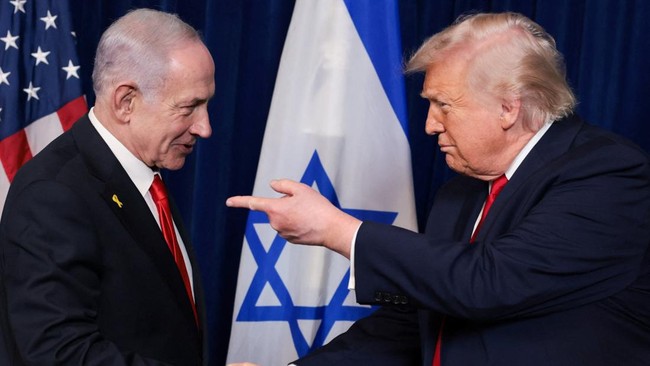
Citing analysis from The Guardian, during Netanyahu’s meeting with Trump at Mar-a-Lago on 29 December, he brought strong encouragement for Washington to re-engage in the conflict with Tehran. In that meeting, Trump repeated Israel’s claim that Iran is rebuilding its military strength.
“Now I hear that Iran is trying to rebuild its power. So we have to take them down. We will destroy them. But hopefully, that doesn’t happen,” Trump said in a press conference with Netanyahu.
Netanyahu is also said to have used a personal approach to convince Trump, including presenting high Israeli honours and offering strategic prospects: victory over Iran could reduce Israel’s dependence on US military aid.
This lobbying effort continued through subsequent intensive communications, with Israel seeking to secure full US involvement in a large-scale conflict against Iran. Israeli intelligence even assessed that the Tehran regime is fragile and potentially collapsible due to internal pressures.
However, the reality on the ground shows otherwise. Israel is said to have been overly optimistic about the duration and impact of the war. Israeli officials previously estimated that the Iranian threat could be neutralised in a matter of days, while military planners prepared for a maximum scenario of three weeks.
In fact, the war has entered its second month without signs of abating. This conflict has also become part of a broader regional escalation since the Hamas attack on Israel on 7 October 2023, which triggered war in Gaza, Lebanon, and involvement from Iran and the Hezbollah group.
Although several key Iranian figures, including Supreme Leader Ali Khamenei, have been reported killed, the “decapitation” strategy has not produced the promised regime change as Netanyahu assured. On the contrary, Iran’s forces have consolidated, particularly under the Revolutionary Guard.
Within the US, doubts have emerged over Netanyahu’s claims. Axios reported that a US official described Netanyahu, nicknamed “Bibi”, as having overly convinced Trump that the war would be easy and that the chances of regime change were very high.
“Bibi really convinced the president that it would be easy, that regime change was far more likely than it actually is,” the source said.
Meanwhile, former US diplomat Daniel C. Kurtzer and Aaron David Miller assess that Trump is not merely influenced, but a “willing and full partner” in the conflict.
The consequences of the war now extend to the global economy. The closure of the Strait of Hormuz has shaken energy and world trade markets. Analysts estimate that the conflict has cost billions of dollars and strained US advanced weaponry stocks.
This conflict demonstrates that Netanyahu’s promises of a quick and easy war have not only missed the mark but also brought widespread impacts, from regional instability to deepening economic and geopolitical pressures globally.