
Trump Continues to Rain Down Missiles on Iran as US Prepares Ground Invasion?
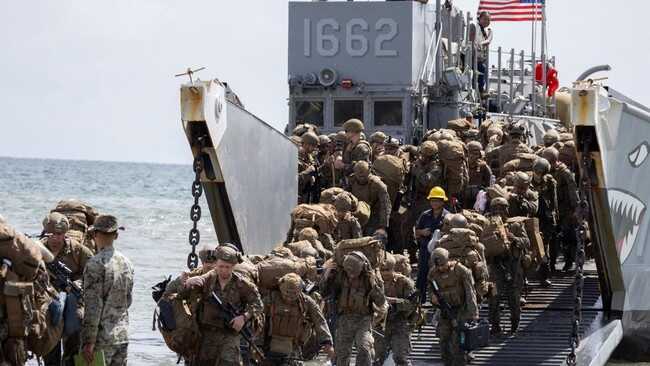
Jakarta, CNBC Indonesia — Military tensions between the United States and Iran have entered a critical phase after President Donald Trump’s administration launched ‘Operation Epic Fury’. Large-scale air and naval strikes targeting targets within Iran have now sparked global speculation about the possible deployment of ground troops or boots on the ground by Washington. As of Wednesday (4 March 2026), the impact of the strikes was reported to be massive. The Iranian Red Crescent recorded at least 787 killed, including the bombing incident at a girls’ primary school in Minab that killed 165 female students. On the other side, six US soldiers were killed and 18 others wounded as Iranian projectiles struck American assets in the Gulf region. US Secretary of Defence Pete Hegseth confirmed there were air-defence breaches that led to casualties on the American side. ‘You have air defences and many (projections) coming in, and we shoot down most of them. However occasionally, perhaps one—the one we call a ’squirter’—gets through, and in this particular case it struck a tactical operations centre,’ he said. Regarding the potential escalation to a ground invasion, President Donald Trump did not give a definite answer but remained open to all options. When asked whether he would send infantry troops to Iran, Trump said the option was open. ‘I will never say never. We will do whatever is necessary,’ he said. Legally, the move has sparked debate about the status of ‘war’ without a Congressional mandate. David Schultz, politics professor from Hamline University, told Al Jazeera that Article I of the U.S. Constitution gives Congress the power to declare war, but Article II gives the President the authority to respond to threats. ‘I would argue that if we look at U.S. history, most conflict has not been formally declared wars, but presidents have dragged us into them,’ Schultz said. Paul Quirk, a professor at the University of British Columbia, added that the status of the action depends on its duration. If it goes on for a very long time, the action will be classified as a war. ‘Americans will call it an attack if it is brief. But if it lasts for weeks or months, then in practice it becomes a war,’ Quirk said. The US government argues that the strikes aim to destroy Iran’s nuclear programme. Trump openly stated that the objective of the strikes is to obliterate Iran’s nuclear programme once and for all. Moreover, Trump called on the Iranian people to ‘take over the government’ and ‘seize control of your destiny.’ US Secretary of State Marco Rubio claimed the strikes were pre-emptive to protect US troops from Iran’s retaliation plans against actions by Israel. ‘We know there will be actions by Israel… and we know if we do not pre-emptively pursue them before they launch their attack, we will suffer higher casualties,’ Rubio said. Military analysts warned of major risks if the United States actually mounts a ground invasion. Analysts at the Stimson Center, Christopher Preble, stressed that Iran is far larger than Iraq. ‘The difference, when comparing Iran with Iraq in 2003, is that Iran is three to four times larger. That would make the US mission in Iraq look simple by comparison. And of course, the Iraq mission was not simple,’ Preble said.