
Trump Claims to Receive 'Major Gift' from Iran Regarding the Strait of Hormuz
US President Donald Trump has made a surprising statement regarding the development of the conflict with Iran. On Tuesday local time, Trump claimed that Tehran had given him a “very big gift” related to the Strait of Hormuz, a move that has increased his confidence that Washington is now negotiating with the right parties to end the war.
This mysterious statement emerged just one day after Trump unexpectedly postponed plans for an attack on Iran’s power plants. He mentioned that negotiations are underway with certain figures in Iran, although Tehran has so far denied any involvement in peace talks.
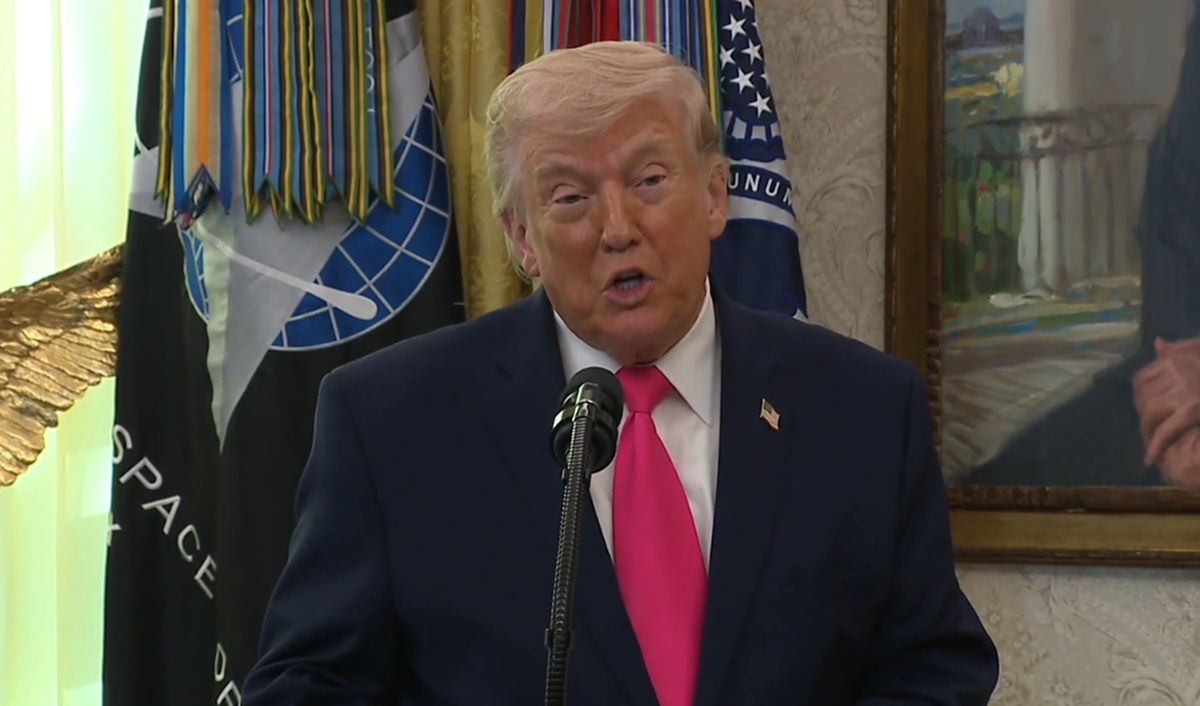
During a meeting in the Oval Office at the swearing-in ceremony for the new Secretary of Homeland Security, Markwayne Mullin, Trump described the “gift” as something very significant and of fantastic value.
“They did something extraordinary yesterday. They gave us a gift and that gift arrived today. It is a very big gift worth a lot of money,” Trump told reporters.
Furthermore, Trump confirmed that this is closely related to his demand for Iran to reopen the Strait of Hormuz to global oil shipping traffic, which has been disrupted for the past four weeks. “Yes, it’s related to the flow (of oil) and related to that strait,” he added.
Although reluctant to detail the identity of his interlocutor, Trump believes there has been a shift in the power map within Iran following the death of the supreme leader Ali Khamenei on the first day of the joint US-Israel air campaign.
Trump revealed several big names involved in this diplomatic effort, including Vice President JD Vance, Secretary of State Marco Rubio, global envoy Steve Witkoff, and his son-in-law, Jared Kushner. There are reports that the team may be heading to Pakistan to continue talks.
On the other hand, Pakistan’s Prime Minister Shehbaz Sharif has publicly offered himself as a mediator. Sharif claims to have communicated with Iranian President Masoud Pezeshkian to help bring peace to the region.
Although diplomatic channels are beginning to open, military tensions remain high. US Secretary of Defense Pete Hegseth gave a firm statement when called to the podium by Trump. Hegseth indicated that the military remains in a combat-ready position if negotiations fail.
“We consider ourselves part of these negotiations as well. We negotiate with bombs,” Hegseth stated firmly.
To date, the international community is still awaiting further details regarding the agreement, given the importance of the Strait of Hormuz as the lifeline of the world’s energy supply.
Iran’s allowance for non-US or Israeli-affiliated transit ships to pass through the Strait of Hormuz is seen as an opportunity for Indonesia according to Indef.
Pakistan has expressed its readiness to facilitate negotiations between the US and Iran to achieve a resolution to the conflict through diplomatic channels, if both parties desire.
The war between Iran, the United States, and Israel is impacting the global energy crisis, including Indonesia. However, the energy crisis does not always take the form of fuel shortages.
Iran’s gas facilities were reportedly targeted in attacks during the Iran-US-Israel war, amid a change in stance by US President Donald Trump.
The Japanese government has affirmed it will deploy all diplomatic efforts together with the international community to ease tensions in the Strait of Hormuz amid escalating conflict.
The Philippine government under President Ferdinand Marcos Jr. has declared a national energy emergency status following serious threats to domestic fuel supplies.
Japan is intensifying diplomatic efforts to maintain stability in the Strait of Hormuz, a vital route for crude oil imports that supports the nation’s primary energy needs.
The global energy crisis due to the war involving the United States, Israel, and Iran is increasingly concerning after the disruption of oil distribution routes in the Strait of Hormuz.