
Trenggono: Red and White Fishing Villages Programme in NTT and NTB to Boost Regional Economy by Rp29.2 Billion Annually
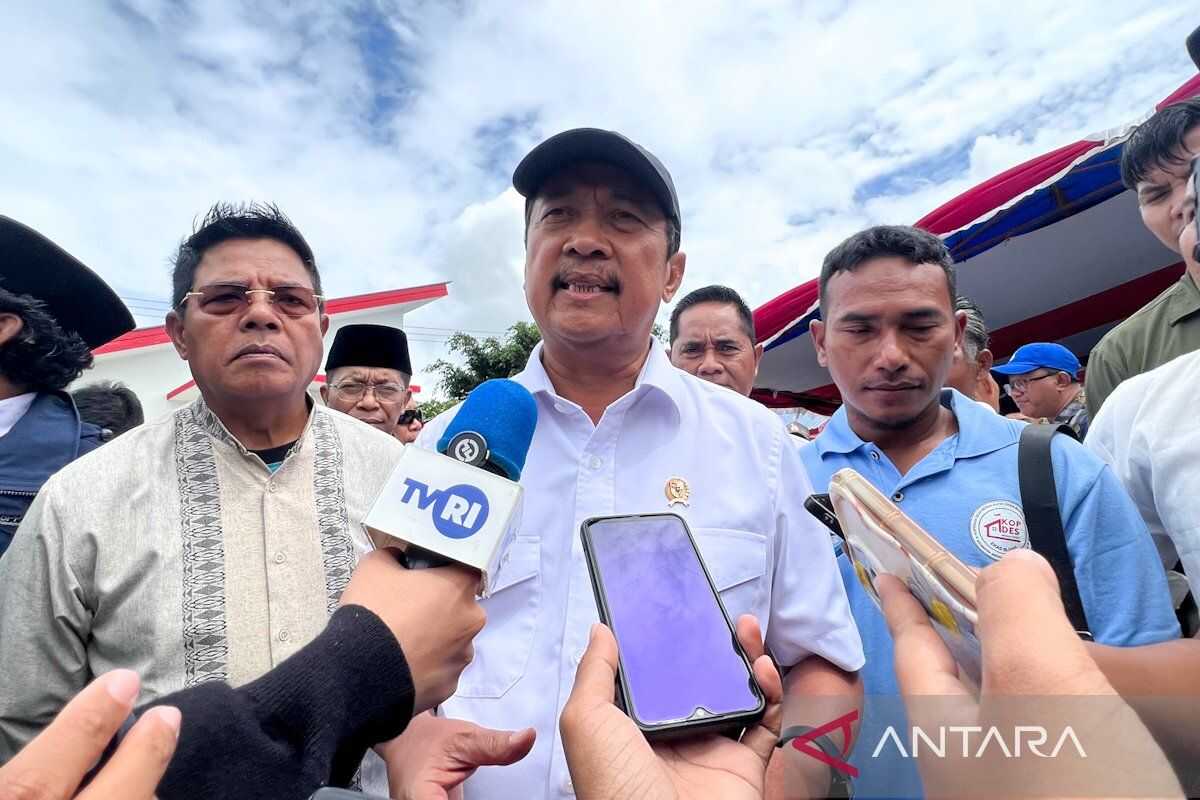
Lombok Timur, Nusa Tenggara Barat — Minister of Marine Affairs and Fisheries Sakti Wahyu Trenggono has projected that the Red and White Fishing Villages Programme (KNMP) in Nusa Tenggara Timur (NTT) and Nusa Tenggara Barat (NTB) can boost regional economic growth to Rp29.2 billion annually.
“Our hope is that once KNMP productivity increases, the welfare of fishing communities will automatically improve,” Trenggono stated whilst inspecting the KNMP Ekas Buana facility in Lombok Timur, NTB, on Friday.
Trenggono disclosed that he had visited multiple KNMP locations across eastern Indonesia. During his inspection tour, Trenggono visited KNMP sites in Sikka Regency, Sulamu Village, Kamanlaputi in East Sumba, Warloka in NTT, as well as Bungin Island and Ekas Buana Village in NTB.
“That is why I came here to Lombok Timur. I conducted inspections starting from Kupang, Sikka, Waingapu, then East Sumba, and here,” he said.
He emphasised that the inspection was part of the government’s commitment to ensure development progresses optimally and delivers direct benefits to fishing communities.
Trenggono stressed that the primary objective of KNMP development is to combat poverty in coastal villages. In Lombok Timur, specifically Ekas Buana Village, the poverty rate stands at 13 per cent.
“What is the goal? Fighting that 13 per cent poverty rate. Within two years there should be no poverty left. Everyone should be prosperous,” he stated.
According to Trenggono, increasing fisher productivity is the key. With the availability of production facilities and supporting infrastructure, fishing catches are expected to rise significantly, which will ultimately boost community incomes.
“The objective is for the community in Lombok Timur, in Ekas Buana, which is predominantly fishing-based, to increase their productivity. Once productivity increases, their welfare will automatically improve. That is why I came here,” he said.
The KNMP programme is designed as an integrated system from upstream to downstream. The government is not only building physical infrastructure but also conducting social engineering through coastal community empowerment, including human resource capacity building, cooperative strengthening, entrepreneurship development, and business certification and standardisation.
Through these interventions, each KNMP location is targeted to increase fish production by up to 800 tonnes annually, employ approximately 700 workers including both fishers and non-fishers, and boost the zone’s economic value by Rp29.2 billion annually in accordance with programme design.
The Ministry of Marine Affairs and Fisheries is constructing 100 KNMP sites across Indonesia since late 2025. One that has been physically completed is KNMP Ekas Buana Village, Jerowaru District, Lombok Timur Regency.
Ekas Buana Village was selected due to its significant fishing potential with primary commodities including skipjack tuna, mackerel, bullet tuna, and shrimp. Of 1,226 households, 854 work as fishers with 396 active fishing vessels in operation.
Various facilities have been constructed to support fishing activities, including portable cold storage, ice factories, fish landing shelters, ship docking facilities, fisher workshops, fisher halls, and fish marketing kiosks with wastewater treatment installations.
The government has also distributed 10 ship engine units, 1,620 fishing tools, one refrigerated vehicle, and 50 cool boxes.
Beyond physical construction, the Ministry of Marine Affairs and Fisheries is strengthening managing institutions through capacity building for village cooperative officials, expert-led community empowerment mentoring, and skills development for fisheries extension workers.
Trenggono emphasised that all fishing villages in NTB and NTT have the opportunity to be developed as KNMP sites provided they meet the criteria of a fishing village.
“As long as it is a fishing village, we will develop it. We must create all the economic potential that exists here,” he said.
Through supply chain strengthening, the implementation of cold chain systems, and enhanced competitiveness of fisheries products in regional and global markets, the government hopes KNMP will not merely serve as an infrastructure project but rather become a catalyst for economic transformation in eastern Indonesia’s coastal areas.