
Transport Minister Prepares Strategy to Handle Return Flow Across Sumatra-Java Crossing
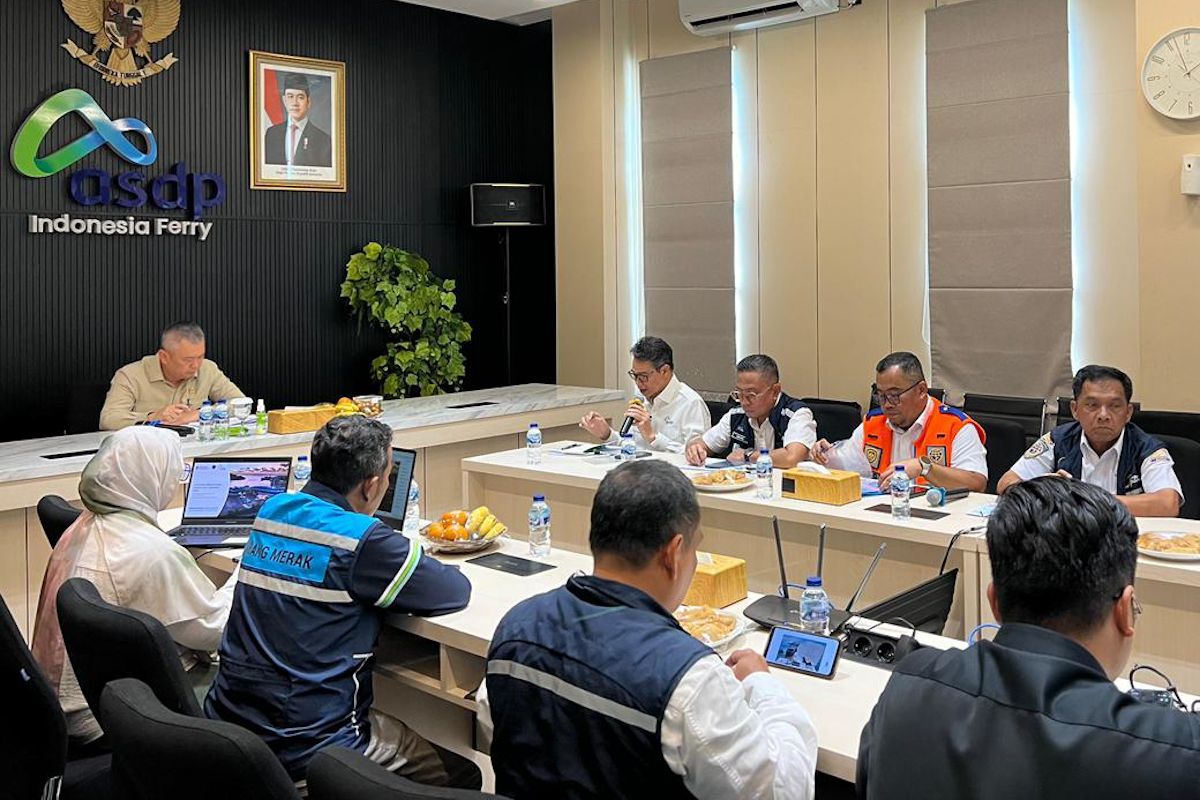
Transport Minister (Menhub) Dudy Purwagandhi is preparing strategies to handle the return flow for Eid al-Fitr 1447 Hijriah across the Sumatra-Java ferry crossings to ensure the journey home proceeds in a controlled, safe, secure, and smooth manner.
Dudy stated that his ministry has moved swiftly to evaluate several critical points during the peak outbound mudik for Eid 2026, while preparing anticipatory steps to ensure the return flow across the Sumatra-Java crossings runs safely and smoothly.
“The peak outbound mudik has passed. Currently, our focus is on ensuring the return flow can be managed better, with faster responses and more mature strategies,” said the Transport Minister in a statement in Jakarta on Sunday.
He conveyed that his team had held an evaluation and coordination meeting at the office of PT ASDP Indonesia Ferry (Persero) in Merak on Sunday, involving all stakeholders.
To face the return flow, the Transport Minister instructed all stakeholders to enhance readiness through more adaptive and responsive scenarios to field dynamics.
Several strategies have been prepared, including accelerating the activation of the arrival-unloading-departure (TBB) process when vehicle volumes increase, accompanied by simulations of service capacity under the 5- and 6-dock schemes to ensure optimal capacity.
Anticipation is also being made for potential crossing points at Bakauheni to avoid hindering loading and unloading flows, as well as optimising rest areas through intensive coordination with the Police in regulating vehicle distribution and traffic flow.
Additionally, evaluations are being conducted on the use of non-TBB docks and the regulation of vessel numbers to maintain efficiency, as well as preparing options for alternative routes such as the Pelabuhan Panjang–Krakatau Bandar Samudra (KBS) crossing if vehicle build-ups occur.
The use of technology is also being strengthened through drones for real-time monitoring, particularly in the Bakauheni area, to quickly and accurately identify potential queues.
Upstream, optimisation of buffer zones and rest areas in implementing the delaying system on Sumatra Island is being carried out through coordination with the National Traffic Corps of the Indonesian National Police to hold vehicles before entering the port.
Moreover, heightened vigilance is being applied at vulnerable points, such as souvenir sales areas on flyover descents that could cause traffic obstructions.
The Transport Minister emphasised that the results of the outbound mudik evaluation form the basis for refining the return flow strategies, given the still high potential for public movement in the coming days.
“Every note from the outbound mudik must be addressed immediately. Do not wait for problems to escalate. The key lies in the speed of response and accuracy of decision-making in the field,” said the Transport Minister.
Based on the evaluation results, the peak outbound mudik occurred on 18 March 2026. Overall, the organisation ran quite well, but there were still several important notes, one of which concerned the implementation of the new arrival-unloading-departure (TBB) mechanism that was only optimal at 3–4 docks.
Going forward, the Transport Minister requested that the TBB mechanism be applied more quickly and expanded to 5–6 docks to increase service capacity and reduce potential queues.
“The implementation of TBB must be more responsive to field dynamics. If there is a surge, it must be able to be applied optimally immediately,” said Transport Minister Dudy.
The Transport Minister also highlighted the importance of controlling vehicle flow within the port area to prevent queues from spilling outside the port premises.
Arrangements in supporting areas were also spotlighted, such as in the Indah Kiat area, which requires operational engineering in the form of adding or widening loading and unloading access to avoid vehicle flow intersections.
Meanwhile, ticket purchasing activities were also evaluated, with the need to expand the ticket purchase zone radius beyond 4 km to minimise build-ups at critical points leading to the port.
The Transport Minister stressed the importance of implementing the Ferizy ticketing system with the principle of one National ID Number (NIK) for one ticket to prevent scalping practices and improve service orderliness.
“There must be no room for scalping practices. The system must guarantee fairness, order, and convenience for the public,” he asserted.
The Transport Minister emphasised that safety remains the top priority in organising Eid transportation. Smoothness is important, but safety is paramount.
“We ensure all services run safely, securely, and orderly so that the public can undertake their return journey comfortably,” said the Transport Minister.