
Transport Minister modifies WFH policy to ensure maximum transportation services Monday-Friday
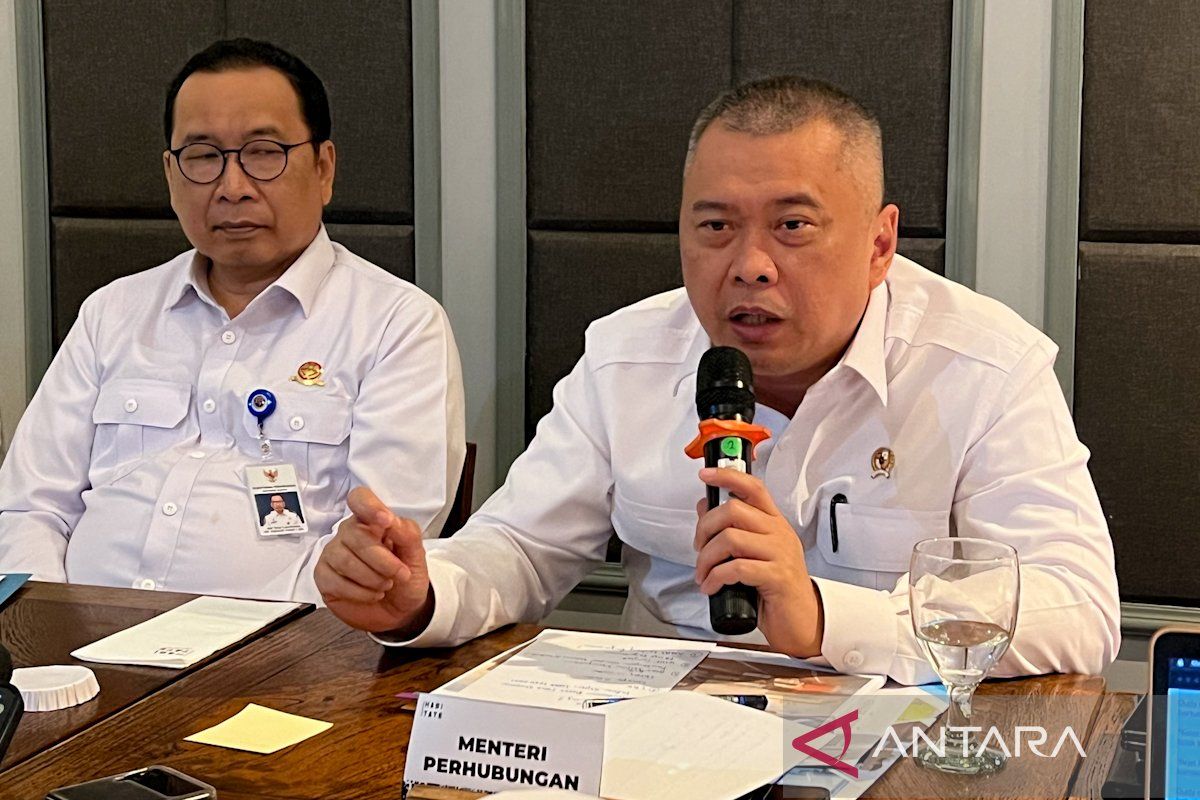
The implementation of the work-from-home (WFH) policy within the Ministry of Transportation is carried out flexibly in line with directives from the Ministry of Administrative and Bureaucratic Reform.
Jakarta (ANTARA) - Transport Minister Dudy Purwagandhi has modified the work-from-home (WFH) policy with a scheme of 40 percent of staff entering the office each day, to ensure transportation services continue to operate normally from Monday to Friday, in support of national energy efficiency.
Dudy explained that the implementation of the WFH policy within the Ministry of Transportation is conducted flexibly following directives from the Ministry of Administrative and Bureaucratic Reform regarding the regulation of civil servants (ASN).
“Well, we’ve modified it slightly because we serve public transportation, so we don’t take Fridays off. But we reduce the number entering each day. We go up to 40 percent each day,” said the Transport Minister during a discussion with the media in Jakarta on Thursday evening.
According to him, the policy generally provides leeway for each ministry and agency to regulate their respective work patterns, even though Fridays have been designated as WFH days.
However, the Ministry of Transportation is making adjustments because it has responsibilities in public transportation services that do not allow for halting services merely due to the work-from-home policy.
As a form of adjustment, the Ministry of Transportation does not implement full WFH on Fridays, but instead reduces the number of staff entering the office each working day with a certain proportion system.
Dudy revealed that they are implementing a staff attendance policy of 40 percent each day, so public service activities continue to run without disrupting vital transportation operations.
He gave an example: if the number of staff at the central office reaches around 5,000 people, then with the 40 percent policy, only about 2,000 staff enter each day on a rotating basis.
With this system, the total staff rotation continues through a replacement or shifting mechanism, ensuring all staff receive a fair and even share of work.
“Because we serve transportation, we can’t possibly take Fridays off either. So, in the end, we implement a reduction (in staff entering) each day,” he explained.
He hopes this policy will assist the government, particularly in Jakarta, in reducing fuel oil (BBM) consumption and curbing air pollution levels due to daily staff mobility.
He emphasised that the work schedule modification adjusts to the policy from the Ministry of Administrative and Bureaucratic Reform, which provides flexibility to each ministry and agency as long as they follow the broad outlines of government regulations.
“So we implement it, so that today, for example, 40 percent (enter). Rotating. But at minimum, we reduce it each day,” said the Transport Minister.
Previously, the government officially implemented a work-from-home (WFH) policy for civil servants (ASN) every Friday.
Coordinating Minister for Economic Affairs Airlangga Hartarto stated that the policy will apply starting from 1 April 2026 and will be evaluated after two months of implementation.
“The implementation of work-from-home for ASN in central and regional agencies, carried out for one working day per week, namely every Friday, regulated through a circular letter (SE) from the Minister of PANRB and SE from the Minister of Home Affairs,” said Airlangga.