
Transport Minister: Goods Vehicle Restrictions Imposed for Lebaran Travel Safety
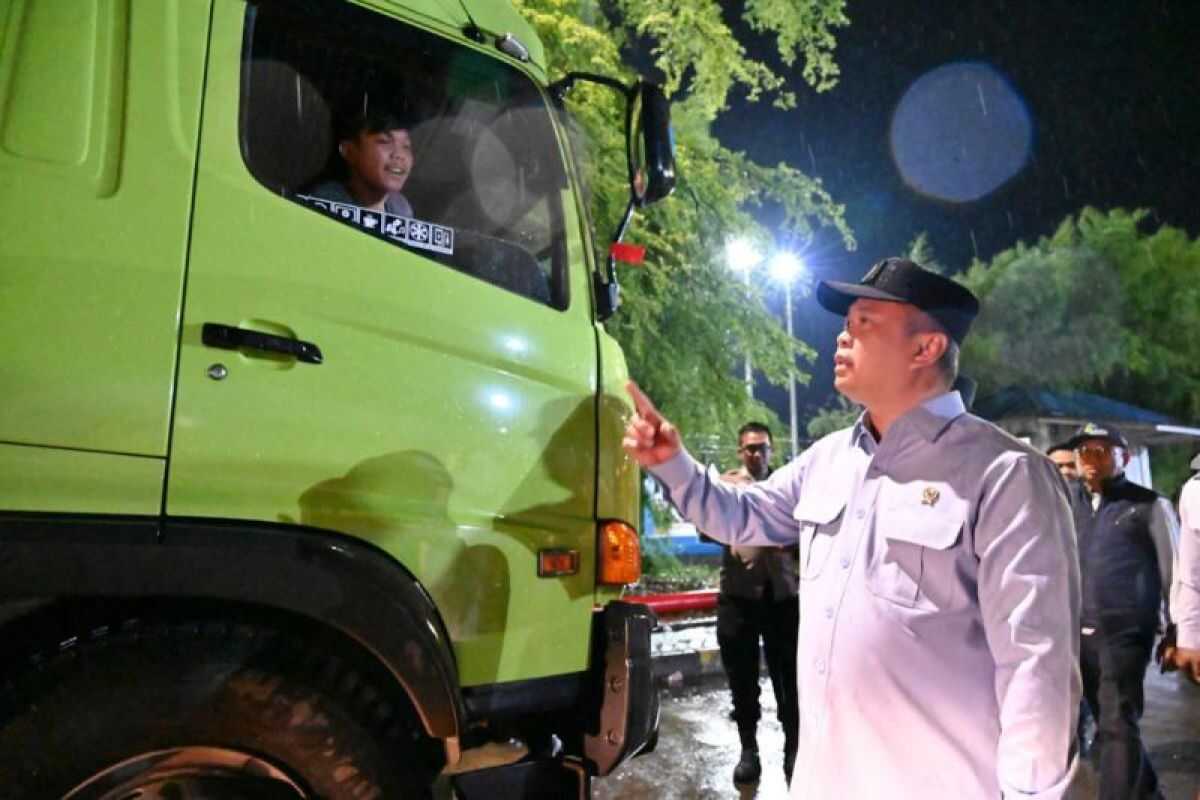
Jakarta (ANTARA) - Transport Minister Dudy Purwagandhi has announced that the government’s policy restricting goods vehicle operations is aimed at ensuring the safety and smooth flow of mudik (homecoming) and return travel during the 2026 Lebaran Transport period.
“The safety of the public and the smooth flow of mudik and return travel during the 2026 Lebaran Transport period is the government’s top priority,” the Minister said in a statement in Jakarta on Monday.
He made the remarks in connection with the implementation of a Joint Decree (SKB) on Road Traffic and Ferry Crossing Regulation During the Mudik and Return Flow of the 2026 Lebaran Transport period, signed by the Ministry of Transport, the Ministry of Public Works, and the National Traffic Police Corps (Korlantas Polri).
The Minister noted that one of the provisions set out in the joint decree concerns the restriction of goods vehicle operations from 13 March 2026 to 29 March 2026, applicable to both toll roads and arterial roads.
“We are taking this step solely to protect the safety of millions of people and to ensure that journeys can be undertaken safely, smoothly and comfortably,” he said.
Dudy explained that the government’s decision to impose a 16-day restriction on goods transport was based on evaluations of congestion and accidents during previous Lebaran transport periods, as well as traffic modelling analysis conducted in collaboration with various stakeholders.
According to 2024 data from Korlantas Polri, traffic accidents involving goods vehicles reached 27,337 incidents, or 10.4 per cent of the total number of accidents nationwide. In the same year, over-dimension over-loading (ODOL) trucks were the second leading cause of accidents, resulting in 6,390 fatalities.
The Minister stressed that the policy is not intended to restrict business activities, but rather to regulate traffic so that both public mobility and goods distribution can proceed safely and smoothly.
However, the restrictions do not apply to goods vehicles carrying fuel (BBM/BBG), livestock, fertiliser, disaster relief supplies, or basic necessities, provided the vehicles used are not overloaded or over-dimensioned.
The Minister also stated that every one per cent increase in heavy vehicle volume during peak mudik and return periods has a significant impact on average speeds and the potential for congestion on major roads.
He warned that without traffic regulation and goods transport restrictions, severe congestion would occur, resulting in far greater economic losses, including distribution delays.
“This policy can therefore be described as a pragmatic middle-ground solution for all parties,” the Minister explained.
Furthermore, Dudy revealed that the government had deliberately issued the policy well in advance to give goods transport operators sufficient time to adjust their operations and complete logistics deliveries before the restriction period begins.
The Minister urged goods transport operators to plan their deliveries carefully and expressed hope that all shipments could be completed before 13 March 2026.
He also advised members of the public planning mudik journeys to prepare themselves thoroughly and anticipate unpredictable weather conditions.
“Maintain your health and always monitor the official BMKG website for weather conditions. One equally important thing is to always obey traffic signs and follow the directions of officers in the field,” the Minister said.