
TransJakarta Reveals One Electric Bus Saves Government Fuel Subsidy of Rp302 Million Annually
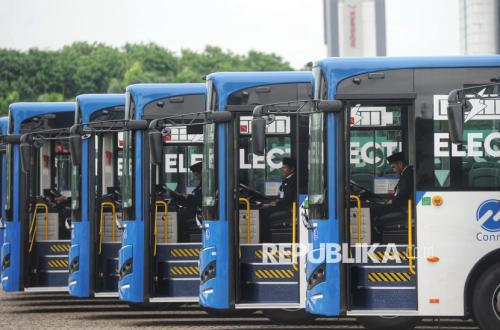
One unit of TransJakarta’s electric bus has the potential to save the government up to Rp302 million in fuel subsidies (BBM) per year. When factoring in various other aspects, the cost savings over 5.5 years of operation per unit could reach Rp3.9 billion, equivalent to the price of one 12-metre electric bus.
These figures are calculated based on the difference between the price of subsidised diesel and commercial fuel prices, as well as the operational efficiency of electric buses compared to internal combustion engine (ICE) buses.
“Indeed, the price of an electric bus can be up to twice as expensive as an ICE bus, but this increase is offset by energy costs that are four times cheaper than ICE, including maintenance costs that are twice as low,” said Gatot Indra Koswara, Principal Specialist for Transformation and Change Management at TransJakarta, during a Focus Group Discussion (FGD) with the Strategic Transport Initiative (Instran) and PT Kalista Nusa Armada in Jakarta on Wednesday (15/4/2026).
Gatot explained that the calculation uses an assumption of subsidised diesel at Rp6,800 per litre, while the commercial fuel price (Dexlite) is around Rp14,500 per litre.
With a difference of about Rp7,700 per litre, Gatot noted that one TransJakarta ICE bus typically covers 78,475 kilometres per year with an efficiency of 2 kilometres per litre, requiring about 39,238 litres of diesel annually. From this requirement, the potential subsidy savings amount to around Rp302 million per unit each year.
“If we convert the difference between the subsidised cost and the non-subsidised Dexlite diesel cost, it’s approximately Rp302 million per year per unit in government subsidies that would otherwise be spent on diesel for public or goods transport,” said Gatot.
In addition to savings at the central government level, TransJakarta also records potential cost efficiencies at the provincial government level.
From an energy perspective, the operational cost of an ICE bus is around Rp3,400 per kilometre, while for an electric bus it is about Rp800 per kilometre, based on electricity prices of Rp731 per kWh and the energy efficiency of each vehicle. This difference results in savings of around Rp204 million per unit per year, according to Gatot.
From a maintenance perspective, an ICE bus requires about Rp5,400 per kilometre, while an electric bus requires around Rp2,600 per kilometre. This difference provides additional savings of about Rp219.7 million per unit per year.
If all these savings components are combined—fuel subsidies, energy costs, and maintenance costs—TransJakarta estimates significant total efficiency over the long term.
Over a period of about 5.5 years, the accumulated savings are said to reach around Rp3.99 billion per unit, equivalent to the current price of one 12-metre electric bus.
“If we talk about maintenance savings and energy savings, and combine them, multiplying by 5.5 years, we get cost savings of approximately Rp3.9 billion, which is almost the price of one 12-metre electric bus today,” explained Gatot.
Gatot emphasised that although the initial investment in electric buses is still about twice as expensive as diesel buses, the savings from operational and energy subsidy aspects are deemed sufficient to compensate for this cost.
In addition to fiscal efficiency, the use of electric buses also provides additional benefits in the form of reduced emissions and improved urban air quality.