
Train Accident and the State's Evasion of Responsibility
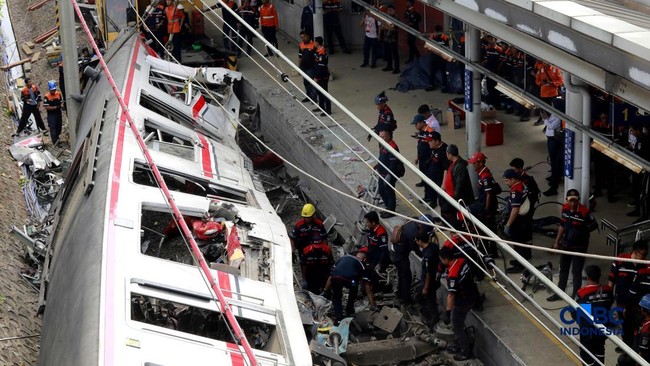
Following the train accident at Bekasi Timur Station in West Java, the public has once again questioned who is truly responsible for railway safety in Indonesia. Although the collision was triggered by a taxi being struck at a level crossing, the discussion has not stopped at the initial cause of the incident.
The debate has since broadened to issues of signalling, train scheduling, and the quality of rail infrastructure management. In such situations, the state-owned railway company is immediately positioned as the party deemed most responsible.
However, the matter is not as simple as pointing to one institution as bearing all the blame. The Indonesian railway sector is actually managed through a structure of authority dispersed across multiple institutions. When an accident occurs, determining who is responsible becomes far more complicated than simply blaming the train operator.
The public has long tended to perceive the railway system as a single entity. Everything related to tracks, stations, signals, and trains is considered under the same management. Yet in practice, railway management involves at least four major institutions: the Ministry of Finance, the Ministry of Transportation, Danantara or the Ministry of State-Owned Enterprises, and PT Kereta Api Indonesia.
Each institution has different portions of authority. The Ministry of Finance acts as the manager of state assets, including railway infrastructure such as tracks, signalling, stations, and communication networks. The use of these assets is then delegated to the Ministry of Transportation as the user of the goods as well as the implementer of construction and maintenance of infrastructure.
The Ministry of Transportation naturally has significant responsibility for the construction and maintenance of railway infrastructure. This includes safety issues such as sterilising routes that intersect with roads.
The construction and guarding of level crossings are part of this responsibility, although at certain points it also involves local governments according to the status of the roads intersecting the railway tracks. Meanwhile, Danantara and PT KAI should focus more on rail-based transport operations.
In the railway world itself, there are two main terms: sarana and prasarana. Sarana refers to vehicles running on the tracks, such as locomotives, passenger carriages, and goods wagons. Prasarana encompasses all the infrastructure that enables trains to operate, from tracks, signalling systems, stations, bridges, to communication systems.
The problem is that the separation between sarana and prasarana still appears blurred in the field to this day. The public has never truly received an explanation regarding who holds authority over what. Even within the institutional system itself, the separation between sarana operators and prasarana managers still leaves many overlaps.
The government, on one hand, is responsible for building a safety system through the provision of adequate infrastructure. However, at the same time, the railway company is still burdened with the responsibility of building or maintaining certain infrastructure through assignment schemes. It is this overlapping authority that makes the boundaries of responsibility not entirely clear.
When an accident occurs, the public ultimately has to first trace whether the source of the problem lies in the government’s infrastructure area, the operator’s assignment area, or other parts. In such situations, determining the party that must be held responsible becomes far more complicated than simply pointing to the train operator as the guilty party.
This is evident from the persistence of infrastructure functions within the state railway operator company. In daily practice, the public still views all railway matters as the sole responsibility of PT KAI. When there are travel disruptions, signal damage, or accidents, the train operator becomes the first party spotlighted by the public.
Yet if the state truly wants to place infrastructure under government authority, its management should be carried out through an integrated institution with clear boundaries of authority. Infrastructure management cannot be seen merely as an administrative function because it directly relates to travel safety, network regulation, and the continuity of public services.
Based on these considerations, there are several alternative institutional models that can be chosen. The first alternative is to make the infrastructure manager a regular government work unit. This model does place all budgeting under the control of the ministry. However, the overly rigid bureaucratic pattern often makes operational responses slow.
The public can see how replacing simple facilities like escalators at several stations can take a long time due to government budgeting mechanisms. Yet railway operations demand quick responses because they directly relate to the mobility of millions of users every day.
The second alternative is to form a special state-owned enterprise for infrastructure management. This model provides flexibility in financial management, human resources, and daily operations. The infrastructure manager can be more free in making purchases, recruiting employees, or maintaining networks.
However, this choice also has weaknesses because it will introduce a profit element in the management of public infrastructure. As a business entity, the infrastructure manager will certainly incorporate profit factors in every assignment or service provided.
This situation could ultimately lead to additional costs on two sides at once. On one side