
Tradition of Purchasing New Religious Supplies Revitalizes Seasonal Roadside Stalls
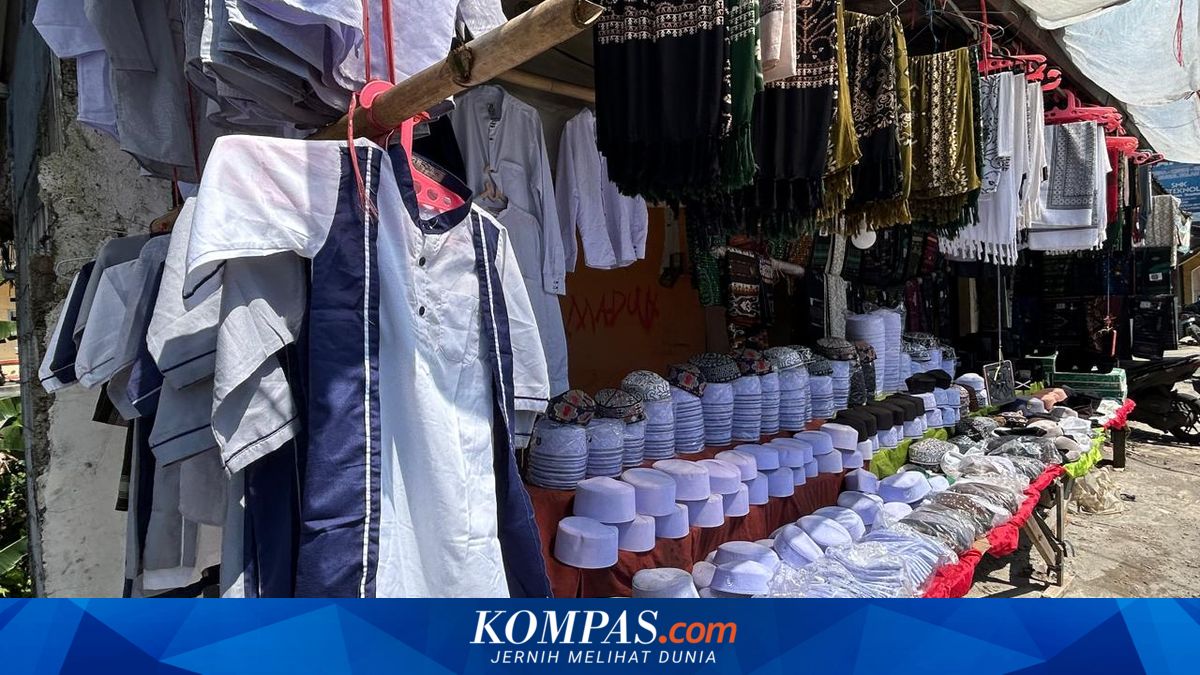
Depok — As Eid al-Fitr approaches, various street corners across several regions are once again populated by seasonal vendors hawking religious items and prayer equipment.
Simple stalls selling prayer robes (mukena), sarongs, prayer mats, and skullcaps (peci) are a sight that emerges almost without fail each Ramadan. Vendors typically set up stalls on pavements, roadsides, and around traditional markets and busy public areas, capitalising on increased demand for new religious items ahead of Lebaran (the celebration marking the end of Ramadan).
At the front of stalls, long tables covered with red cloth serve as display surfaces for merchandise. Dozens of white skullcaps are stacked in tiers forming neat rows. Beside them, black and patterned skullcaps are arranged in line to catch buyers’ eyes. Beyond skullcaps, vendors also display neatly folded sarongs stacked at the front of the table.
Various religious items hang from the upper portion of the stall using raffia string. White headscarves, sarongs, and small prayer mats dangle lengthwise beneath the tarpaulin roof. Some brightly coloured headscarves in gold and green are also displayed to attract the attention of passing customers.
Rizal Taufikurahman, an economic observer and head of the Macroeconomic and Finance Centre at the Institute for Development of Economics and Finance, noted that the emergence of these seasonal vendors demonstrates the informal sector’s ability to respond swiftly to shifts in market demand.
According to Rizal, Ramadan and Eid create seasonal demand spikes. The increase in household consumption is driven by several factors, including shopping traditions, increased mobility, and the disbursement of Eid bonuses (Tunjangan Hari Raya, or THR).
“Macroeconomically, household consumption accounts for approximately 53–55% of Indonesia’s GDP, so seasonal momentum such as Ramadan becomes an important catalyst for small retail sector activity,” he explained.
Beyond economic factors, community traditions also shape the seasonal market for religious equipment vendors. Many families have the custom of purchasing new prayer robes, sarongs, or prayer mats before Eid. Rizal noted that such habits create an annual demand cycle that vendors can exploit.
“Economically, culturally-based consumer preferences create an annual demand cycle that is leveraged by both small traders and modern retailers,” he said.
A considerable number of households use this opportunity to trade in religious equipment along the roadside. According to Rizal, this phenomenon demonstrates how the informal sector functions as a pillar of household economies.
“Ramadan opens opportunities for income diversification among communities, particularly in the informal sector such as sellers of fast-breaking refreshments, Islamic clothing, and religious equipment,” he remarked.
Although modern shopping centres also sell religious items, roadside vendors retain distinct appeal for many consumers. According to Rizal, small traders enjoy competitive advantages in terms of price and proximity to customers.
“Roadside vendors maintain competitive advantage because they offer lower prices, locations close to consumers, and transaction flexibility,” he said.
Alwan, one of seasonal prayer equipment vendor along the roadside, stated that he only sells during the Ramadan period leading up to Eid. “Usually I sell by moving around. Sometimes I participate in religious events too, like Mawlid celebrations. People usually sell there as well, so I bring my merchandise. It’s only during Ramadan like this that I try setting up a permanent stall,” he said when met by Kompas.com on Thursday.