
Trade Minister Confident Indonesia Can Seize Opportunities Amid Iran War, Here's the Key
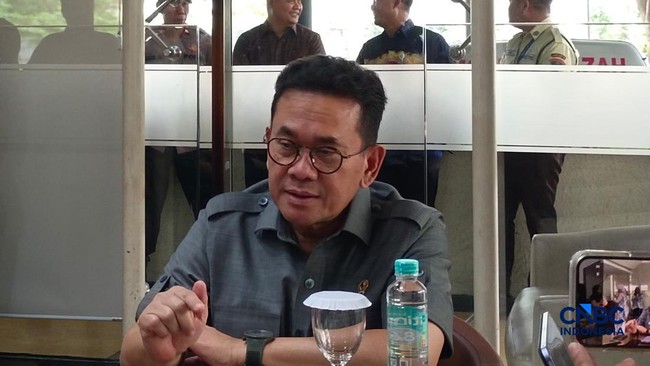
Jakarta, CNBC Indonesia - Trade Minister Budi Santoso is optimistic that Indonesia’s export performance will continue to grow positively despite increasing geopolitical tensions in the Middle East. The government views the crisis situation as opening new opportunities, particularly through strategies to diversify export markets.
Budi explained that this optimism is supported by the trend of rising prices for Indonesia’s main commodities such as crude palm oil (CPO) and coal.
“Last year, commodity prices for CPO fell by around 16%, and coal by about 19%. Now, prices for both commodities are starting to rise this year. That means our export value will certainly increase,” Budi told reporters at his office in Jakarta on Friday (27/3/2026).
Although logistics costs may potentially rise due to the global situation, the increase in commodity prices is seen as a support for export value.
“We can compensate for the costs later. But countries exporting CPO to the Middle East aren’t that many anyway,” he said.
However, he stressed that the main key to maintaining export growth is not just commodities, but strategies to open new markets amid changes in the global trade landscape.
“Secondly, one solution is diversifying export markets. Because diversifying export markets is sometimes long-term. But actually, when there’s a geopolitical crisis, the market map changes quickly,” he explained.
Budi cited the experience during the Covid-19 pandemic, when many countries faced supply disruptions, opening opportunities for other countries to enter those markets.
“Remember during Covid-19, things changed quickly. Because some countries suddenly had trouble getting goods, as their supplying countries were affected,” he said.
In such conditions, Indonesia is seen as able to exploit emerging market gaps in various non-traditional regions.
“So, if we have opportunities there, it means we can take advantage of them well; we can actually enter those markets, like South American markets or RCEP (Regional Comprehensive Economic Partnership) countries, Southeast Asia, and also Latin America,” Budi said.
To accelerate market penetration, the government is relying on business matching schemes, which are considered effective in producing export contracts in a short time.
“If we look at last year’s experience, for example, the results of business matching became contracts. This year, in January, we already had contracts worth US$4.57 million for UMKM Bisa Ekspor. That means it can happen quickly,” he said.
In addition to opening new markets, the government also sees this situation as a momentum to improve national competitiveness, particularly in the logistics sector.
“Of course, this is actually an opportunity for us to have competitiveness and be efficient, especially in logistics,” Budi stated.
He mentioned that the government is coordinating with the Indonesian Transport Users Council (Depalindo) to reduce various distribution barriers that have burdened export costs so far.
“This is being done together with Depalindo, eliminating barriers that hinder facilitating our exports,” he said.
Amid global uncertainty, the government still hopes the conflict can end soon. However, on the other hand, this condition also opens opportunities for Indonesia to expand markets and increase exports.
“I think so, hopefully it ends quickly (the war). And I’m sure everyone (countries also hope) it ends quickly, because the impact is on everyone,” Budi concluded.