
Top 10 Largest Companies in Asia: Who Dares to Challenge China's Giants?
Jakarta, CNBC Indonesia - Asia’s largest companies are predominantly dominated by the technology sector, primarily originating from China.
The power map of Asia has undergone a significant transformation, shifting from traditional natural resources and banking to advanced technological sovereignty, particularly in AI.
Here is the list compiled up to 24 March 2026:
- TSMC, the Global Chip King
Taiwan Semiconductor Manufacturing Company, or TSMC, is not just an ordinary semiconductor firm. It serves as the “heart” of nearly all modern technology devices worldwide, from smartphones to AI infrastructure.
TSMC is now Asia’s most valuable company with a market capitalisation of approximately US$1.783 trillion, equivalent to Rp30.26 quadrillion.
The company plays a vital role in the global technology supply chain as the primary chip manufacturer for tech giants such as Nvidia, Apple, and AMD.
The surge in demand for AI chips has further solidified TSMC’s dominant position in the global semiconductor industry.
- The Energy Giant, Saudi Aramco
In second place is the Saudi government-owned energy behemoth, Saudi Aramco, with a valuation of around US$1.718 trillion, or approximately Rp29.16 quadrillion.
Although the world is moving towards renewable energy, Aramco’s extremely low oil production costs keep it highly competitive.
Additionally, Aramco is undertaking massive diversification into the petrochemical sector to maintain its long-term dominance.
- Samsung Electronics
Next is this South Korean technology giant, with a market capitalisation of about US$848.20 billion, or roughly Rp14.40 quadrillion.
Samsung has a vast business spanning smartphones, televisions, and semiconductors. The company is also a major player in developing memory for data centres and AI.
- China’s Digital Ecosystem, Tencent Holdings
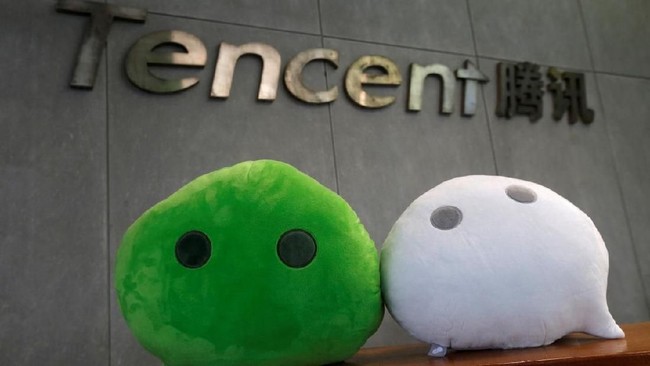
As the owner of the WeChat platform and one of the largest players in the global gaming industry, Tencent remains the ruler of China’s digital economy, with a valuation of around US$594.71 billion, or approximately Rp10.09 quadrillion.
After facing pressure from stringent Chinese government regulations in recent years, Tencent has made a strong comeback through cost efficiencies and the integration of AI technology into its various digital services.
- The AI Dark Horse, SK Hynix
SK Hynix from South Korea has been one of the companies with the fastest-rising valuations in recent years. It excels in High Bandwidth Memory (HBM) technology, a crucial component for supercomputers and modern AI chips.
This South Korean semiconductor manufacturer has a market capitalisation of around US$455.27 billion, or approximately Rp7.73 quadrillion.
- Industrial and Commercial Bank of China (ICBC)
ICBC remains Asia’s largest bank with a market value of about US$371.65 billion, equivalent to Rp6.31 quadrillion.
The bank holds enormous assets and serves as one of the main pillars of China’s financial system.
- China Construction Bank
This state-owned Chinese bank has a market capitalisation of around US$353.61 billion, or approximately Rp6.00 quadrillion.
It plays a crucial role in financing infrastructure projects and economic development in China.
- Agricultural Bank of China
With a valuation of about US$329.93 billion, or roughly Rp5.60 quadrillion, this bank is one of the pillars of China’s financial system, particularly in financing the agricultural sector and regional development.
- Alibaba Group
This Chinese e-commerce giant has a market capitalisation of around US$297.54 billion, or approximately Rp5.05 quadrillion.
Alibaba remains a major player in digital trade and cloud services in Asia, although it now faces increasingly fierce competition from new e-commerce platforms in China.
- The Manufacturing Legend, Toyota Motor Corporation
Toyota is the sole Japanese representative on this list, with a valuation of around US$273.89 billion, or approximately Rp4.65 quadrillion.
Amid intensifying global electric vehicle competition, Toyota maintains its position through its hybrid vehicle strategy and global reputation for production quality.
In conclusion, examining the composition, half of Asia’s largest companies come from the technology sector, such as TSMC, Samsung, Tencent, SK Hynix, and Alibaba.
This indicates a major shift in the regional economic power map. Whereas Asia’s wealth was once synonymous with oil and banking, the new centres of power now lie in semiconductors, artificial intelligence, and digital platforms.
In other words, in the current era, economic strength is no longer determined by the amount of oil possessed or the size of bank buildings, but by the sophistication of chips and algorithms they can create.