
Top 10 Districts Receiving the Largest Palm Oil Revenue Sharing Funds Are All Outside Java
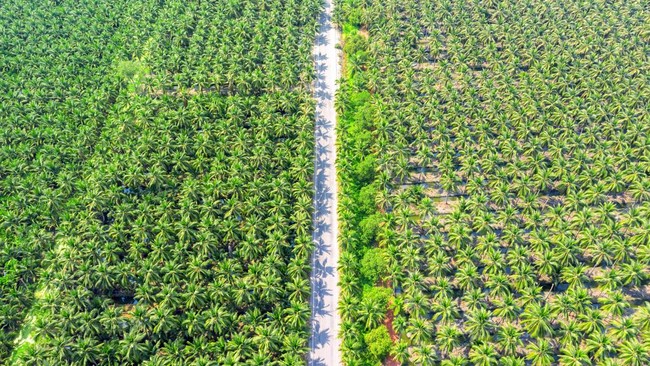
Based on the 2025 Fiscal Year Natural Resource Revenue Sharing Fund Transfer Realisation Report, districts in Kalimantan and Sumatra dominate the receipt of Natural Resource Revenue Sharing Funds (DBH) from palm oil commodities. Ketapang Regency is the largest recipient, with a realisation of palm oil DBH reaching approximately Rp18.13 billion. It is followed by Kampar Regency (Riau Province) with Rp17.43 billion, East Kotawaringin Regency (Central Kalimantan) with Rp16.67 billion, Rokan Hulu Regency (Riau Province) with Rp15.64 billion, and East Kutai Regency with Rp15.16 billion. This dominance shows that the flow of palm oil DBH is still concentrated in regions long known as the centres of national palm oil production. The list of largest recipients reveals a pattern that is difficult to ignore. Almost all districts with the largest palm oil DBH realisation are located on the two islands that have historically been the centre of Indonesia’s palm oil production. Kalimantan indeed dominates through Ketapang, East Kotawaringin, East Kutai, Berau, Kutai Kartanegara, North Barito, and Tanah Bumbu. However, Riau also places several districts in the group of largest recipients, such as Kampar, Rokan Hulu, Pelalawan, Siak, and Bengkalis. Aceh also appears through Nagan Raya Regency, which is included in the group of largest recipients. This pattern shows that the distribution of palm oil DBH follows the spread of long-established palm oil plantation areas, not merely provincial administrative boundaries. Palm oil DBH is part of the Transfer to Regions under the Natural Resource Revenue Sharing Fund scheme. These funds originate from state revenues related to palm oil commodities, which are then distributed to regions in accordance with the provisions applicable in the State Budget (APBN). Palm oil DBH is calculated based on state revenues from the palm oil sector, which are then distributed to producing regions and other related areas. According to applicable regulations, the source of Palm Oil DBH comes from levies on palm oil exports and their derivatives managed by the central government. Therefore, this figure does not represent the production or export value of palm oil from a particular region. What is shown is the realisation of government transfers to regions through the palm oil natural resource DBH mechanism. The contribution of the palm oil industry does not stop at activities in plantations or processing plants. A portion of state revenue from this sector flows back to the regions through a fiscal transfer scheme. Consequently, palm oil-producing districts are not only production sites but also beneficiaries in the state revenue-sharing mechanism.