
Tolerance Amidst the Parangkusumo Sand Dunes
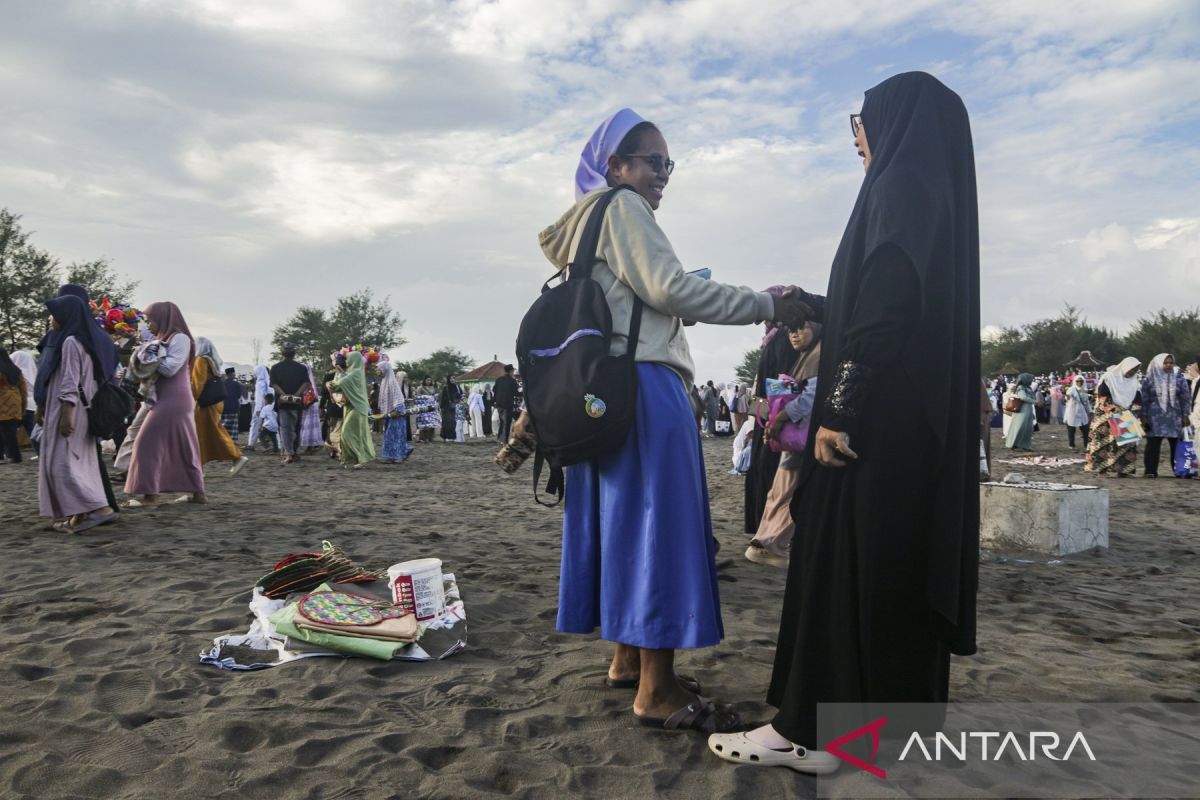
“Happy Eid al-Adha, Ma’am,” Sister Joyce said to a Muslim woman after the Eid al-Adha prayer at Gumuk Pasir Parangkusumo in Bantul Regency, Special Region of Yogyakarta, that morning.
The brief greeting was met with warm smiles from the women nearby. After the prayer, Sister Joyce engaged in light conversation with those tidying up their mukenas and prayer mats.
No visible distance between Sister Joyce and the other worshippers, despite her nun’s habit contrasting against hundreds of women in white and pastel-coloured mukenas.
The warm reception from the worshippers instantly dissolved the barriers she had felt.
“Feelings of shyness or unfamiliarity melted away, allowing me to feel part of everyone present in the field,” said Sister Joyce.
Sister Joyce, a nun from the Congregation of the Daughters of the Queen of the Holy Rosary and a Master’s student in Nusantara Islam Studies at UIN Sunan Kalijaga Yogyakarta, came to Gumuk Pasir Parangkusumo to research the Eid al-Adha prayer practices there.
“I am researching how the Eid prayer at Gumuk Pasir serves as a meeting point for interfaith dialogue, local culture, natural spaces, and digital media,” she said.
Sand Dunes as Prayer Mats
Early that morning, the Gumuk Pasir Parangkusumo area was filled with thousands gathered for the 1447 Hijriah Eid al-Adha prayer. The cool air gradually faded as the sun rose over the eastern horizon. The previously grey sky brightened, while the sand dunes slowly caught the dawn’s light.
At the same time, takbirs echoed from loudspeakers, breaking the usual silence of the sand dunes, typically known as a tourist attraction and off-road vehicle playground.
The sand surface gradually filled with worshippers’ footprints, their marks quickly erased by the wind. Meanwhile, the roar of motorcycles, cars, and tourist jeeps alternated as they entered the area, slowly transforming the once-deserted space into a sea of people.
Amidst the crowd, colourful prayer mats were spread across the sand dunes. To prevent sand from seeping through, some worshippers laid down plastic or bamboo mats as an additional layer before praying.
As worshippers stood and aligned their rows, a serene quiet enveloped the dunes. Takbirs, prayers, and sacred verses blended harmoniously with the wind’s roar and southern ocean waves.
Beneath the warming sky, children eagerly joined their parents in the prayer rows. The atmosphere here felt distinctly different, offering a unique solemnity compared to Eid al-Adha prayers held in mosques or general fields.