
To Secure Wheat – Beef Worth Rp300 Trillion, Xi Jinping and Trump Reconcile
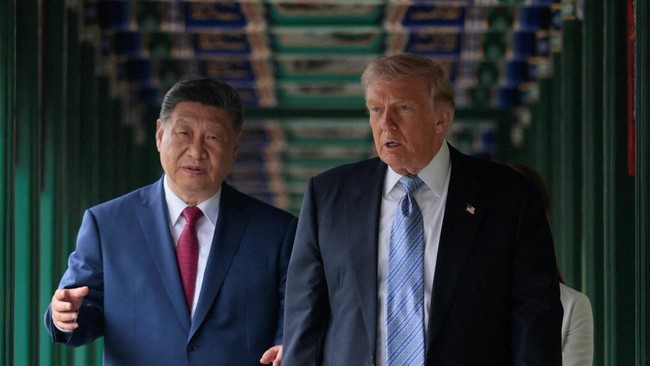
US-China trade tensions have not fully faded. Yet the supply of food has become the new terrain for compromise. Beijing has agreed to purchase US agricultural products worth at least US$17 billion per year, excluding soybeans, for the next three years, following a meeting between US President Donald Trump and Chinese President Xi Jinping in Beijing last week.
The White House said total US agricultural imports by China could reach US$28-30 billion per year if the new commitment is fully implemented. The figure is still below the record US$38 billion in 2022, but the gap to last year’s performance—around US$8 billion—is wide.
To hit that target, China would need to open its taps wider for imports of wheat, feed corn, sorghum, cotton, timber, and beef products. Reuters reported that Beijing had previously fulfilled a commitment to buy 12 million tonnes of US soybeans after the October agreement. Washington also says China will buy at least 25 million tonnes of US soybeans per year.
This shift in import direction has made other suppliers wary. Brazil, which has dominated China’s soybean imports for years, held a 73.6% share in 2025, and has also become a major supplier of corn to China.
According to Cheang Kang Wei, Vice President at StoneX Singapore, the surge in US purchases is unlikely to be driven purely by price. China is thought to be re-routing purchases for strategic and political reasons.
Australia has also come under scrutiny. It was China’s largest wheat supplier in 2023 and a leading sorghum exporter in 2025. If US products flood back into the Chinese market, demand for Australian wheat and sorghum could ease. Premium Australian beef is also under pressure as Beijing and Washington reopened discussions on meat trade barriers.
Canada, France, and Argentina are facing similar circumstances. When China changes its import direction, older suppliers will scramble to defend the market shares that have powered their export engines.
On the soybean front, the market sees good opportunities for the US. The price of US soybeans for the new harvest is seen as competitive against Brazilian supply. Oilseeds traders in Asia say buying 25 million tonnes of US soybeans is not an unrealistic target given current prices for milling and government stockpiling needs.
However, the role of Chinese state-owned enterprises is expected to remain dominant. COFCO and Sinograin are cited as the main buyers of US soybeans while the 10% tariff remains in place. China’s reliance on US soybeans has already fallen sharply in recent years. In 2016, US soybeans accounted for 41% of China’s total imports; by 2024 it was about one-fifth.
For corn and wheat, China’s import volumes are still subject to low-tariff quotas. It has a wheat quota of 9.64 million tonnes and a corn quota of 7.2 million tonnes at a 1% tariff. Imports outside the quotas face very high duties of up to 65%.
Customs data show US corn purchases in 2025 at only US$5 million, a drastic drop from US$561.5 million the previous year. Wheat imports were almost zero after US$600 million in 2024.
Sorghum has proved more flexible, as it faces no quota limits. After heavy rains damaged crops in northern China in 2025, Beijing bought at least 2.5 million tonnes of US sorghum since November to plug domestic corn shortfalls.
In the meat sector, China remains important for American farmers. Products such as chicken feet, pork ears, and offal have strong demand in China, even though domestic consumption is small in the United States. Beijing also extended registration for 425 US beef facilities and approved another 77 facilities over the next five years.
China nonetheless maintains protections for its domestic industry. A meat-import quota system introduced since December imposes a 55% tariff on imports above the quota from major supplier countries, including the United States.
Beyond foodstuffs, China’s import list is expected to widen to cotton and timber. China’s cotton imports from the US fell sharply last year to US$225.7 million from US$1.85 billion in 2024. The new deal opens opportunities for trade to move higher again.
CNBC Indonesia Research