
TNI Public Information Center Chief Explains What Alert Status 1 Means Amid Middle East Developments
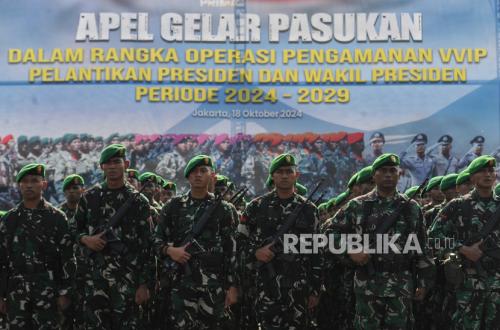
Jakarta — The Siaga-1 status of the Indonesian National Armed Forces (TNI) is a form of anticipation regarding international, regional, and national situations. The Head of the TNI Information Center (Kapuspen), Brigadier General Aulia Dwi Nasrullah, explained that the TNI has a primary duty to protect the entire Indonesian archipelago if threats or disturbances occur. Therefore, the TNI is ordered to remain on standby and ready for any operation.
‘Through the mandate of the TNI Law, one of the TNI’s primary duties is to protect the nation and its territory from threats and disturbances to the nation’s unity and state sovereignty,’ said Brig Gen Aulia in a message to Republika on Saturday (7 March 2026).
He added that the TNI is required to maintain professionalism and responsiveness in carrying out its core duties. Therefore, via the Siaga-1 status, the TNI is instructed to continuously maintain its capabilities and to be ready for any operation, and to stay on guard to anticipate developments in the international, regional, and national strategic environment.
‘The TNI must work professionally and responsively, which is realised by consistently maintaining its capabilities and strength so that it remains operationally ready and on standby to anticipate changes in the strategic international, regional, and national environment,’ he said. He noted that the TNI must have a high level of operational readiness, including by regularly conducting readiness checks.
The Commander-in-Chief of the TNI, Agus Subiyanto, reportedly issued Telegram TR/283/2026 containing orders for Siaga-1. The telegram, dated 1 March 2026, lists seven directives for all TNI ranks following the conflict between the United States‑Zionist Israel and the Islamic Republic of Iran.
The war began on Saturday, 28 February 2026, the day before the Commander’s Telegram was issued. The telegram states that Siaga-1 is to be observed from 1 March 2026 until the situation is resolved.
Seven directives in the telegram include, among others: directing the Chief of Operational Commands (Pangkotamaops) to mobilise personnel and equipment under his command and to carry out routine patrols of vital strategic assets (obvit) and economic hubs; including airports, seaports, river ports, railway stations, and bus terminals, as well as the state electricity company PLN. Second, ordering the National Air Defence Command (Kohanudnas) to perform continuous early warning and air surveillance. Third, instructing the Strategic Intelligence Agency (BAIS) to activate Indonesian defence attaches in countries affected by the Middle East conflict, map the situation, and plan the evacuation of Indonesian citizens if needed. Fourth, directing the Jayakarta Military District (Kodam Jaya) to patrol vital strategic assets and embassies, and to maintain consis-tency in Jakarta. Fifth, instructing TNI intelligence units to conduct early detection and preventive measures against groups at vital assets and embassies, and to anticipate developments to maintain Jakarta’s stability. Sixth, Balakpus (Central Implementation Agency) to maintain readiness in their respective units. Seventh, to ensure continuous reporting of any developments to the TNI Commander-in-Chief. ‘This Telegram constitutes an instruction,’ the telegram states.