
TKIM-INKP Shares Suddenly Surge, What's Going On?
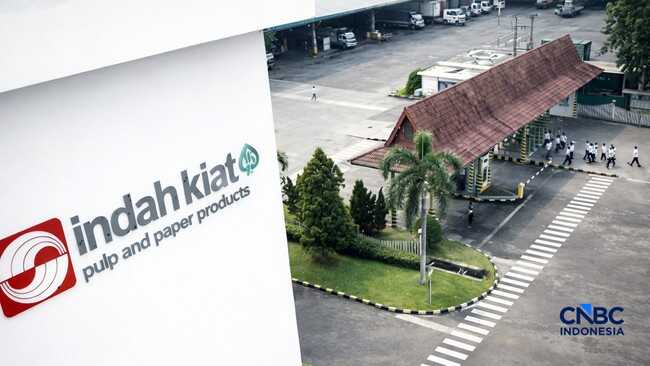
Jakarta, CNBC Indonesia - Shares of TKIM and INKP, both part of the Sinarmas paper group, surged on Wednesday (February 25, 2026). What is driving this positive sentiment?
TKIM shares led the gains, hitting the daily upper limit (Auto Reject Atas/ARA) with a 20% increase to Rp9,150 per share, while INKP shares rose 16.50% to Rp12,000 per share.
The surge in both stocks is attributed to revised analyst targets for TKIM and INKP, which are expected to see significant profit growth this year.
According to research from Trimegah Sekuritas, released on Tuesday (February 24, 2026), INKP is entering a monetization phase after completing a major capital expenditure cycle over the past four years.
Based on this assumption, analysts have raised their projections for INKP’s net profit (NPAT) for 2026 and 2027 by 65% and 36%, respectively.
The revision is driven by increased utilization of the new plant in Karawang and the potential for improved financial structure through a deleveraging strategy. The Karawang plant completed its trial phase at the end of December 2025, with positive initial results.
Management plans to open the facility to investors in early Q2 2026 to increase transparency regarding operational performance, efficiency, and potential margin expansion.
After meeting with management, analysts estimate that the Karawang plant’s utilization will reach around 30% in 2026, increasing to 75% in 2027, and approaching 90% from 2028 for both brown and white paper lines.
With these assumptions, revenue projections for 2026 and 2027 have been revised up by 13% and 2%, respectively.
Although the new facility features more modern and efficient technology, Trimegah is using a conservative assumption with an estimated EBITDA margin of around 23%, lower than the 26% at the old facility.
The completion of the Karawang project marks a shift in the company’s focus from aggressive expansion to strengthening cash flow.
With most of the major investments completed, INKP now has three options for capital allocation: reducing debt, increasing dividends, or continuing the second phase of expansion in Karawang.
Analysts also see the deleveraging strategy as the most optimal option with relatively low risk.
Currently, INKP has outstanding debt of around US$4.9 billion, consisting of 50% bonds and 47% bank loans. Annual interest expense is around US$310 million, with 12% in US dollars and 88% in rupiah.
Approximately US$1.9 billion of debt will mature in the next six months. If the company repays bank loans and refinances bonds with a 1% lower interest rate, interest expense is expected to decrease by about 11%, which could directly increase net profit.
For the second phase of expansion, which could add 1.5 million tons of capacity per year with an estimated capital expenditure of US$750 million, analysts believe that the likelihood of its realization in the near term is limited.
Management is expected to monitor the performance of the first phase for two to three years before making further decisions.
An increase in dividends is also seen as possible as capital expenditures normalize, with a potential dividend payout ratio (DPR) of up to 40%, equivalent to a dividend yield of around 4.8-7%. However, management is expected to prioritize strengthening the balance sheet before increasing distributions to shareholders.
Meanwhile, from external factors, the surge in TKIM and INKP shares is influenced by optimism in the paper sector as prices recover in the global market.
Since the end of last year, global pulp prices have risen due to supply chain disruptions in Vietnam. In addition, the planned revocation of licenses for Industrial Forest Plantations (HTI) in the country is expected to further tighten supply, which will ultimately cause prices to rise again.
With a total of about 300,000 hectares of forest area whose licenses have been revoked, the impact is considered significant on market balance.
This policy has the potential to reduce wood production by up to 7 million tons per year, equivalent to about 2 million tons of pulp. This amount represents about 3-4% of the global market share of bleached hardwood kraft (BHK) pulp.
Meanwhile, demand for paper for the packaging industry remains relatively strong, especially orders from China.
Disclaimer: This article is a journalistic product in the form of CNBC Indonesia Research’s views. This analysis is not intended to encourage readers to buy, hold, or sell related investor products or sectors. The decision is entirely up to the reader, so we are not responsible for any losses or profits arising from that decision.
CNBC INDONESIA RESEARCH
(saw/saw) Add as a preferred source on Google