
Tjokroaminoto: The Boarding House Landlord Who Led Sarekat Islam and Mentored National Heroes
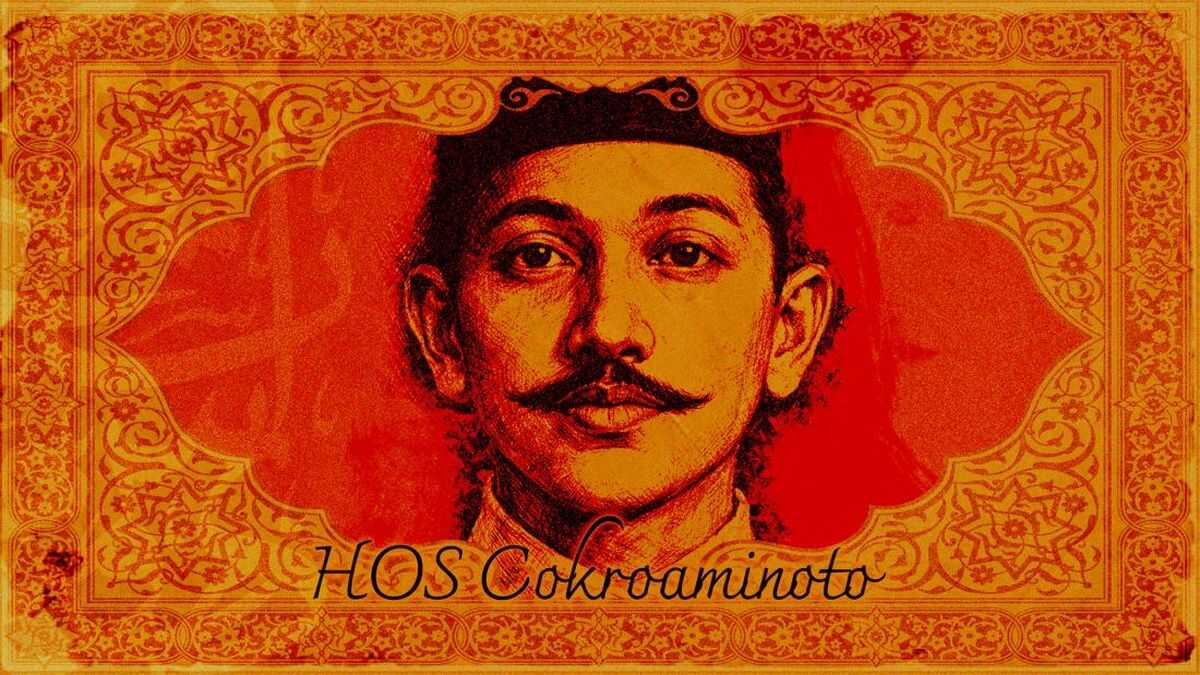
Who would have guessed that a boarding house owner in Surabaya, Haji Oemar Said (HOS) Tjokroaminoto, would become one of the foundations of the national movement during the era of Dutch colonialism.
He was even dubbed the ‘Uncrowned King of Java’ by the Dutch for his influence in awakening the political and spiritual consciousness of Muslims through Sarekat Islam.
The Republic of Indonesia subsequently bestowed upon HOS Tjokroaminoto the title of National Hero through Presidential Decree No. 590 of 1961, issued on 9 November 1961.
The private residence of HOS Tjokroaminoto, located in an alleyway off Jalan Peneleh, Surabaya, was converted into a boarding house by his wife, Soeharsikin. The lodgings were subsequently occupied by young men who would go on to become leading figures of the national movement during the colonial era, including Sukarno, Musso, Kartosoewirjo, and Alimin.
The house, which has since been turned into a museum, bore witness to the political discussions that gave birth to ideas of nationhood, and where Sukarno practised his oratory.
HOS Tjokroaminoto’s role in the national movement became increasingly prominent after he led the transformation of Sarekat Dagang Islam into Sarekat Islam (SI). His reputation grew further following his successful organisation of the first SDI congress in Surabaya on 26 January 1913.
The congress was one of the most historically significant decisions, as it saw the renaming of Sarekat Dagang Islam (SDI) to Sarekat Islam (SI) and a shift in the movement’s orientation towards socio-political concerns.
Following the congress, H Samanhudi handed the leadership of SI to HOS Tjokroaminoto.
HOS Tjokroaminoto led SI from 1912 to 1934. During this period, he succeeded in developing SI into a formidable organisation that caused considerable unease within the Dutch colonial government.
Its members and sympathisers were numerous and drawn from all strata of society.
Not only in its place of origin, SI expanded rapidly into other regions. By 1934, SI membership had reached 490,000 people spread across the entirety of Indonesia.
Sarekat Islam advanced the economic welfare of the Muslim community, improved understanding of Islam, and demanded social justice against colonialism.
Tjokroaminoto’s speeches stirred a spirit of religious nationalism. His trilogy — ‘The highest knowledge, the purest monotheism, the cleverest strategy’ — ultimately became the embryo of the patriotic national movement led by its key figures.
In the development of Islam across the archipelago, in 1922, HOS Tjokroaminoto together with Haji Agus Salim initiated the Al-Islam Congress in Cirebon to unite Muslims in the face of colonialism.
Following the congress, HOS Tjokroaminoto and KH Mas Mansur of Muhammadiyah accepted an invitation from Ibn Saud to attend the Caliphate Congress held in Mecca, Saudi Arabia, in 1926.
Upon returning to the archipelago, HOS Tjokroaminoto and Haji Agus Salim established the Muktamar Alam Islami Far’ul Hindis Syarqiyyah (MAIHS), a branch of the Muktamar Alam Islami in Mecca. He became chairman of MAIHS, with Agus Salim serving as its secretary.
Another notable contribution was HOS Tjokroaminoto’s founding, together with Haji Agus Salim, of the Organisasi Haji Hindia (Indies Hajj Organisation). This body aimed to provide guidance on the hajj pilgrimage for Muslims intending to perform the journey.
According to the National Heroes Encyclopaedia in the Ministry of Primary and Secondary Education repository, on 25 November 1918, Tjokroaminoto together with Abdul Muis, representing the Volksraad (People’s Council), submitted a motion.
In his speeches, Tjokroaminoto consistently condemned the actions of the Dutch East Indies Government. Subsequently, in 1920, Tjokroaminoto was accused of incitement and of preparing an insurrection against the Dutch, and was consequently imprisoned.
The man known as the ‘Teacher of the Nation’, born on 16 August 1882 in Ponorogo, was descended from a prominent line of Islamic scholars and aristocrats. His grandfather was RM Adipati Tjokronegoro, who served as regent of Ponorogo. Furthermore, his great-grandfather was Kiai Bagoes Kasan Basari, a renowned Islamic scholar who ran a pesantren (Islamic boarding school) in the Tegalsari area.
HOS Tjokroaminoto passed away in Yogyakarta on 17 December 1934. He was buried at the Pekuncen Heroes’ Cemetery, where his gravestone bears the inscription: “The foremost Islamic hero H.O.S Tjokroaminoto, 10 Ramadan 1353”.