
Time for the Textile Industry to Adopt Circular Economy
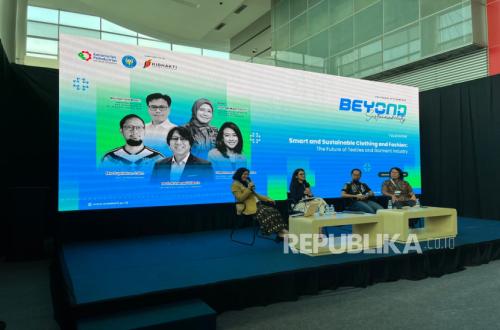
The textile industry is being encouraged to transform towards a more comprehensive circular system. This change no longer focuses solely on recycling but encompasses strategies of reduce, reuse, and rethink throughout the production chain.
The concept emphasises reducing waste from the outset (reduce), reusing materials to prevent them from becoming waste (reuse), and redesigning products and production processes to be more efficient and sustainable (rethink).
Global pressure on environmental issues and supply chain efficiency is the main driver of this shift. The industry is required to be more adaptive while maintaining business sustainability.
This call was delivered by Politeknik STTT Bandung through the Applied Master’s Programme in Textile and Apparel Engineering (RTA) at a seminar during the Indo Intertex 2026 event, themed “Beyond Sustainability”. The Indo Intertex textile exhibition itself will be held from 15 to 18 April 2026.
This theme emphasises transformation towards a smarter, more efficient, and sustainable system. Innovations from lecturers and students were also showcased, ranging from advanced textiles and environmentally friendly materials to sustainable production processes.
Head of the Applied Master’s RTA Programme, Prof Ida Nuramdhani, stated that industrial transformation cannot stop at mere discourse. “In an increasingly dynamic world, innovation is the main key, and workforce readiness is one of its important pillars,” said Ida.
According to Ida, the role of higher education is key in preparing skilled personnel while promoting research as a driver of change in the national textile industry.
From the industry side, Director of Marketing and Operations II at PT Tribhakti Inspektama, Muhamad Ihsan, assessed that the transformation also targets aspects of inspection and product compliance.
“Inspection transformation in the textile industry, which previously focused only on physical checks, now develops towards ensuring that the resulting products meet compliance standards from the production process,” said Ihsan.
Academic Prof Mohamad Widodo emphasised that the shift towards a circular economy must be more ambitious. “Our homework towards circularity must move from mere recycling to higher strategies such as reuse, reduce, rethink, and refuse,” he said.
National Coordinator of UNEP InTex Indonesia, Diah Ratna Pratiwi, added that the environmental impact of the textile industry occurs across the entire value chain. Therefore, a circular textile value chain approach is essential.
Industry players assess that sustainability is now entering systemic transformation, especially in the supply chain. The next challenge is to ensure implementation proceeds without disrupting business continuity.
“This transition not only reduces environmental impacts but also creates economic opportunities and increases the competitiveness of the textile sector,” she said.