
Timah Karya Strengthens Development of Integrated Green Areas
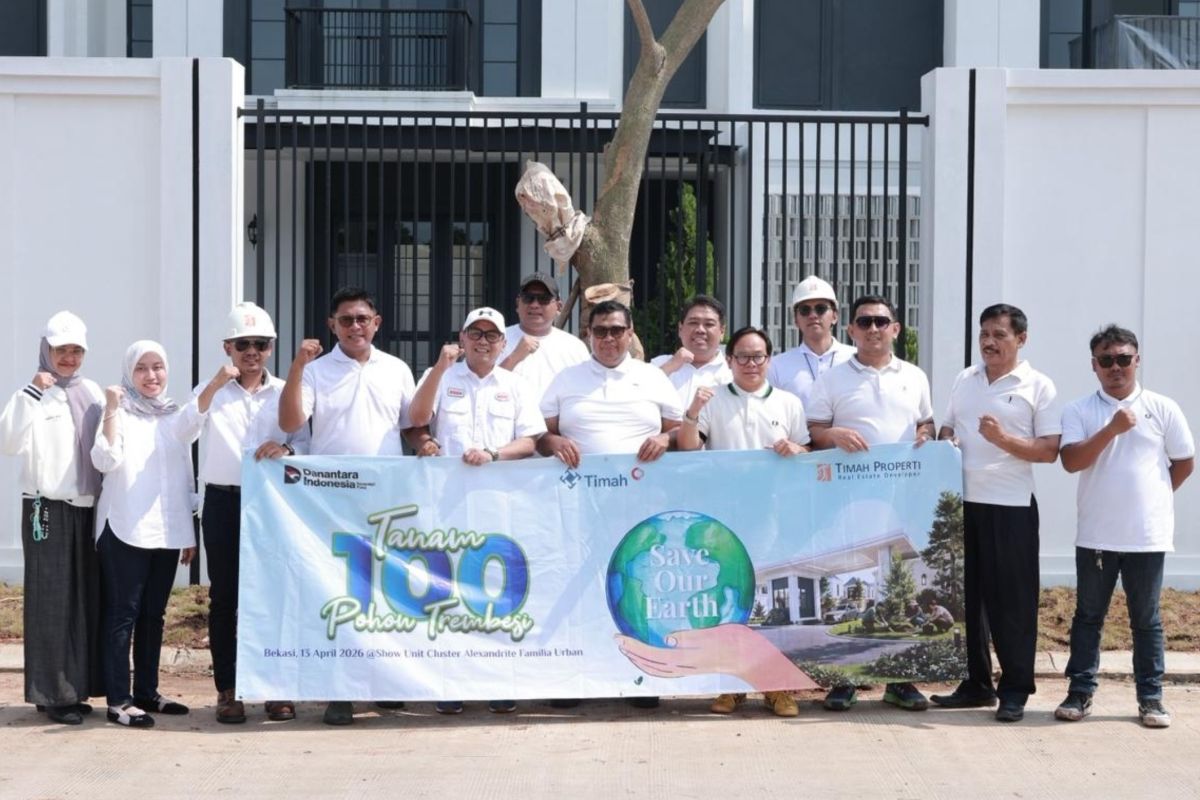
Jakarta (ANTARA) - PT Timah Karya Persada Properti, a subsidiary of PT Timah (Persero) Tbk, is strengthening the development of integrated green areas through various sustainable initiatives.
Director of PT Timah Karya Persada Properti, Candra Hadiqadriman, confirmed in a statement in Jakarta on Thursday that the company is committed to implementing tangible actions in line with Environmental, Social, and Governance (ESG) principles, particularly in environmental conservation.
He stated that one of the initiatives is the planting of 100 trembesi trees in the residential area currently being developed by this state-owned company in Bekasi City, West Java.
“This is part of the company’s long-term commitment to creating sustainable residential areas,” he said.
He explained that the tree planting was chosen due to its ability to absorb carbon dioxide and create a shady atmosphere, thereby making a significant contribution to improving the quality of living environment in the area.
In agreement, Iriyanto, Staff Advisor to the Director of PT Timah Karya Persada Properti, stated that this commitment is part of the area planning that balances development with nature conservation, which is being developed by the company.
“We ensure that every development carried out is not only oriented towards aesthetic and comfort aspects but also considers long-term environmental sustainability,” he clarified.
Head of Marketing and Promotion Division of PT Timah Karya, Suhendra Sanusi, assessed that the green living concept is now an important factor in society’s decision to choose housing.
Meanwhile, the company is developing the Familia Urban area as a self-sufficient city (township) with an environmentally friendly concept that encourages walking activities in green open spaces.
Previously, the Ministry of National Development Planning/National Development Planning Agency (PPN/Bappenas) revealed that the government now views environmentally oriented economic activities or the green economy as the core of the national development strategy, in line with increasing challenges from climate change and hydrometeorological disaster risks.
“The government is shifting the development paradigm by viewing the green economy as the heart of national planning. This commitment has been evident since the RPJMN 2020-2024 and is further strengthened in the RPJMN 2025-2029 through Astacita 2 and 8. In short, the green economy has become the mainstream of every development policy we formulate,” said Deputy for Food, Natural Resources, and Living Environment of the Ministry of PPN/Bappenas, Leonardo A.A. Teguh Sambodo, at the Dialogue on the Journey and Reflection of the Green Growth Program Phase III (GGP III) held by Bappenas together with the Global Green Growth Institute Indonesia (GGGI).
He explained that increasingly evident climate pattern changes and the rising frequency of hydrometeorological disasters demand stronger and more integrated development strategies.
Without adequate mitigation and adaptation measures, he continued, the potential economic losses due to climate change are estimated to reach nearly Rp500 trillion in 2025 and could exceed Rp2 quadrillion in 2029.