
Tight US Dollar Liquidity: Yuan Could Become a New Funding Source Option for Indonesia
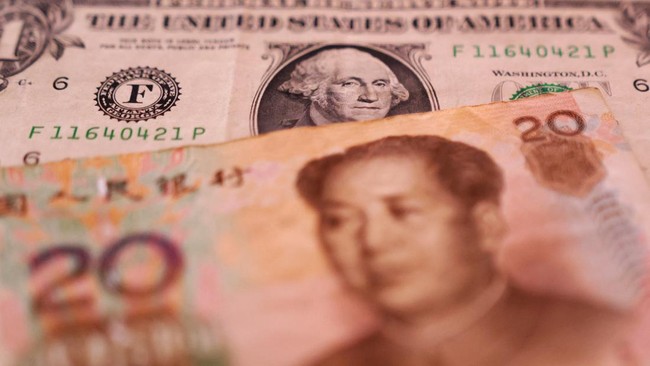
Head of Economics at Trimegah Sekuritas Indonesia, Fakhrul Fulvian, has revealed that US dollar liquidity is currently tightening, making funding sourced from the greenback expensive for many countries, including Indonesia.
In recent years, he noted a trend of declining global dollar supply, accompanied by liquidity tightening, increasing domestic financing needs in the United States, and changes in global investor behaviour.
On the other hand, a new dynamic is emerging from the internationalisation of China’s currency, particularly the Chinese yuan or CNH (offshore renminbi), which is beginning to play a larger role in cross-border trade and financing.
“We see two major opposing flows: the increasingly limited global dollar supply, while CNH is expanding its use in trade and financing. This creates a new imbalance, but also opens strategic opportunities,” Fakhrul said in a written statement on Monday (20/4/2026).
Fakhrul views this situation not merely as a market phenomenon, but as the beginning of a change in the global financial architecture. However, these opportunities will not automatically benefit all countries if they are not well utilised.
“This is not a passive change. It is a change that demands execution. Countries that are not prepared will be trapped in increasingly expensive funding costs and higher volatility,” he emphasised.
In the context of Indonesia, he believes future policy approaches must be far more progressive and precise, particularly in building an alternative funding architecture beyond dependence on the US dollar.
He considers that Indonesia must strengthen policies to respond to this global phenomenon, such as enhancing local currency settlement (LCT) schemes in bilateral trade, exploring the use of currencies with lower funding costs like CNH in financing, deepening the domestic financial market based on the rupiah, especially long-term instruments, and diversifying the investor base and liquidity sources.
“Indonesia can no longer just be a price taker in the global financial system. We must start becoming architects, or at least co-architects, of our own funding sources,” Fakhrul stated.
He also warned that the current global fragmentation is not a temporary disruption, but a transitional phase towards a more multipolar system. In such a system, access to liquidity and financing will increasingly be determined by bilateral and regional networks, as well as each country’s policy flexibility.
“If we still view the world through old lenses, that global liquidity will always be available and cheap, as it has been for the past decade or so, we will be left behind. The future world is one where liquidity must be fought for, not assumed,” he said.
Furthermore, Fakhrul emphasised the urgency for the government and authorities to communicate policy directions more explicitly and strategically, especially in responding to these global structural changes.
“Markets today not only assess stability, but also direction. Without clear communication on how Indonesia will adapt to global fragmentation and these liquidity changes, we risk losing momentum,” he added.
According to Fakhrul, the opportunities from this change are very significant, but they also come with non-negligible risks if not responded to appropriately. He considers this a highly determining moment for Indonesia in strengthening new funding.
“The imbalance between the declining global dollar supply and the increasing role of CNH is a strategic opportunity, but only for those who are ready. If we do not move quickly and precisely, what is at stake is not just growth, but the future of our economic structure itself. If we want to grow the economy to 8%, we must solve the funding issues that have been problematic for years, and in this case, opening up CNH financing is the solution,” he concluded.
Based on notes from the CNBC Indonesia research team, the share of the Chinese yuan in global foreign exchange reserves rose slightly to 1.95% in Q4-2025, from 1.92% in Q3-2025. The increase is still small and its portion far below the dollar or euro, but the direction of movement remains important as it shows the yuan is slowly gaining space in the composition of central banks’ foreign exchange reserves worldwide.
Meanwhile, the share of global foreign exchange reserves denominated in the US dollar fell to 56.77% in Q4-2025, lower than 56.93% in Q3-2025.
If traced throughout 2025, the direction is the same. In Q1-2025, the dollar’s portion was still around 57.79%, then fell to 56.32% in Q2-2025, before moving around 56.9% in the second half of last year and closing the year at 56.77%. At this level, the dollar’s share is at its lowest point since the mid-1990s. This means the dollar’s dominance is still large, but it is gradually eroding.
Nevertheless, the US dollar’s position will not be easily displaced in the near term. One reason is that Gulf countries are still very tied to the dollar, both through their exchange rate systems and the large holdings of their assets in the US currency. This condition makes shifting away from the dollar not possible quickly. If forced, such steps could instead risk pressuring the exchange rate stability of countries in the Gulf region.
On the other hand, the dollar also still has the opportunity to maintain its dominance in oil trade if the United States continues to hold a strong position in global energy supply. As long as the influence of the US and Western countries in the global energy supply chain remains large, the dollar still has room to remain the primary currency in oil trade.
That is why, although pressure on the petrodollar is starting to appear, the dollar has not yet been truly rivalled. The old system is indeed beginning to…