
‘Tidying the strategic landscape’: How China is strengthening its hand before Trump-Xi summit
analysis East Asia
‘Tidying the strategic landscape’: How China is strengthening its hand before Trump-Xi summit
The convergence in timing of China’s recent flurry of diplomatic efforts with neighbours, as well as outreach towards Taiwan, has reinforced its broader effort to shape the ground ahead of the Trump-Xi summit, say analysts.
BEIJING: China has stepped up diplomatic engagement across multiple fronts ahead of an anticipated meeting between President Xi Jinping and US counterpart Donald Trump next month, in what analysts say is a calculated bid to strengthen its negotiating hand for the summit.
In about a week, China has hosted senior officials and leaders from Vietnam, the United Arab Emirates and Spain, and dispatched its foreign minister to North Korea.
At the same time, Beijing has stepped up outreach across the Taiwan Strait by welcoming the leader of Taiwan’s main opposition party.
Observers say the burst of activity points to a broader effort to shape the conditions around the summit to ensure China enters the talks from a position of strength rather than on the defensive.
They say Beijing is pursuing three objectives at once - reducing the risk of sudden shocks on its doorstep, reinforcing ties with key regional partners and projecting itself as the steadier power in contrast to a Washington distracted by the conflict in the Middle East.
“Beijing appears to be tidying the strategic landscape before the Trump-Xi meeting, not by removing all tension, but by making sure any tension is on terms it can manage,” Nathan Attrill, a senior analyst at the Australian Strategic Policy Institute, told CNA.
FLURRY OF DIPLOMACY
China has hosted a string of high-level visitors in recent days.
On Wednesday (Apr 15), Xi met with Russian Foreign Minister Sergei Lavrov at the Great Hall of the People in the heart of Beijing, where Xi called the stability of China-Russia ties “precious” and urged closer strategic coordination, while Lavrov praised the resilience of bilateral ties and said Moscow was ready to deepen cooperation.
Xi also met with Vietnam’s President To Lam. Both leaders used the meeting to underscore the importance of stable party-to-party and state ties, while signalling continued efforts to manage differences and deepen economic cooperation.
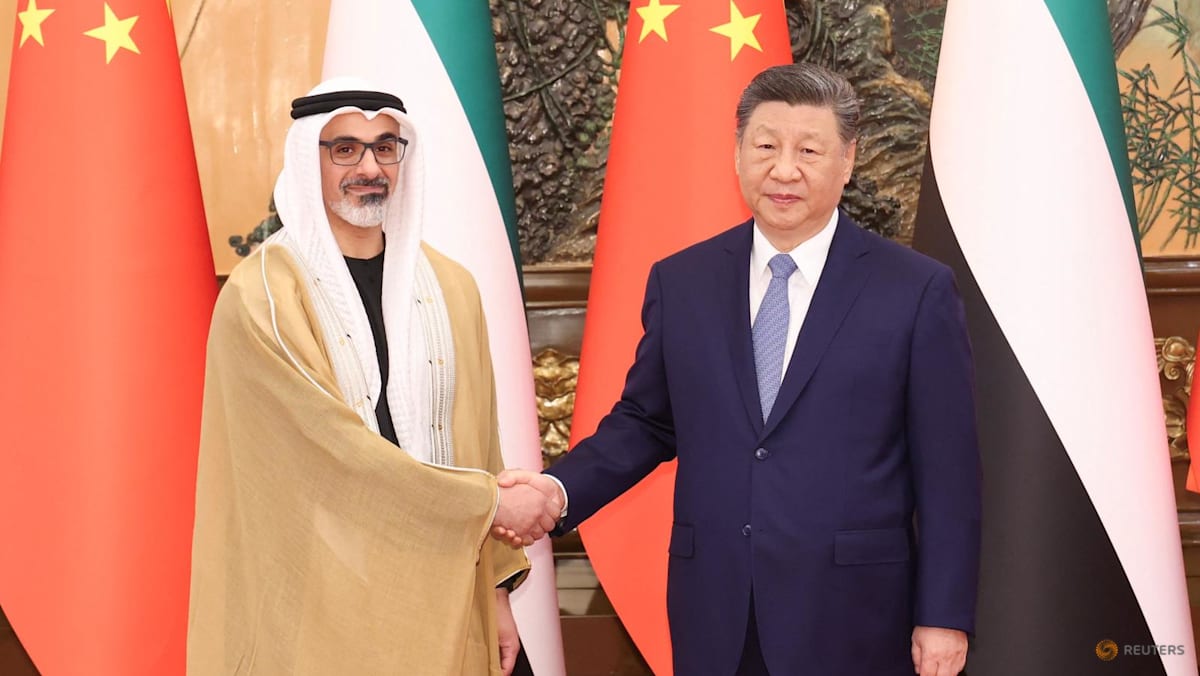
The previous day, Xi met with Abu Dhabi Crown Prince Sheikh Khaled bin Mohamed bin Zayed Al Nahyan and Spanish Prime Minister Pedro Sanchez in separate meetings.
With Abu Dhabi’s crown prince, Xi paired calls for closer bilateral cooperation with a four-point proposal on Middle East peace, in his first public remarks on the conflict since it began in late February.
With Sanchez, Xi emphasised multilateralism and closer China-Spain cooperation amid global turbulence, while Spain also sought to deepen economic ties.
On the cross-strait front, on Apr 10, the Chinese supremo met with Cheng Li-wun, the chairperson of Taiwan’s opposition Kuomintang (KMT) and the party’s first leader to visit China in a decade. During their meeting, Xi expressed willingness to work with all political parties in Taiwan to advance ties.
That same day, Chinese Foreign Minister Wang Yi met North Korean leader Kim Jong Un in Pyongyang - marking his first visit to the country in seven years. Both sides pledged to strengthen strategic communication and coordination.
Analysts said these engagements were not necessarily part of a single coordinated strategy. But their convergence in timing has reinforced Beijing’s broader effort to shape the environment ahead of the Trump-Xi summit, which Trump said is now set for May 14 to 15 after he delayed the trip because of the Iran war.
“The overall pattern is strategic: shore up vulnerable relationships, signal diplomatic reach and avoid entering the Trump-Xi meeting looking isolated or reactive,” said Attrill from the Australian Strategic Policy Institute.
At the heart of Beijing’s pre-summit push is a clear priority - stabilising its immediate neighbourhood to prevent disruptions that could undercut its leverage with Washington, analysts told CNA, citing Wang’s visit to North Korea as a key example.
“Any sudden instability on the (Korean) Peninsula would inherently weaken Beijing’s negotiating hand with Washington, stripping China of its leverage as a ‘stabiliser’,” Lee Chan Hui, a Singapore-based China observer and geopolitical analyst, told CNA.
The concern is not abstract: North Korea this month showcased fresh weapons activity, including what state media said were missile tests involving cluster-bomb warheads, as well as cruise and anti-ship missiles launched from a newly unveiled destroyer.
Wang’s recent visit should thus be read as a move to “firmly re-establish Beijing’s regional authority”, Lee added.
Despite longstanding rhetoric of a socialist “brotherhood”, Lee said North Korea’s closer alignment with Russia since 2023 has complicated Beijing’s influence.
Pyongyang’s growing closeness with Moscow appeared to stem in part from Russia’s wartime demand for ammunition and North Korea’s interest in economic aid, energy and possible military support in return.
China is now seeking to rebuild that influence, not to resolve the nuclear issue outright - referring to North Korea’s nuclear weapons and missile standoff with the US and its allies - but to ensure it retains a decisive voice on developments on the Peninsula, said Lee.
“Beijing tends to maintain a sufficiently stable relationship with Pyongyang, enough to influence the Kim regime, without assuming responsibility for resolving the nuclear conflict.”
That balancing act could also carry a more forward-looking purpose, noted Lee.
With Trump having publicly signalled openness last October to meeting Kim again, he said Wang’s visit may help Beijing better gauge Pyongyang’s position and concerns, allowing Beijing to avoid being sidelined and to preserve influence ahead of any renewed diplomacy.
He added that the push to steady the Korean Peninsula also reflects a wider conc