
Through This Innovative Camera, Humans Can Now See the World as Animals See It
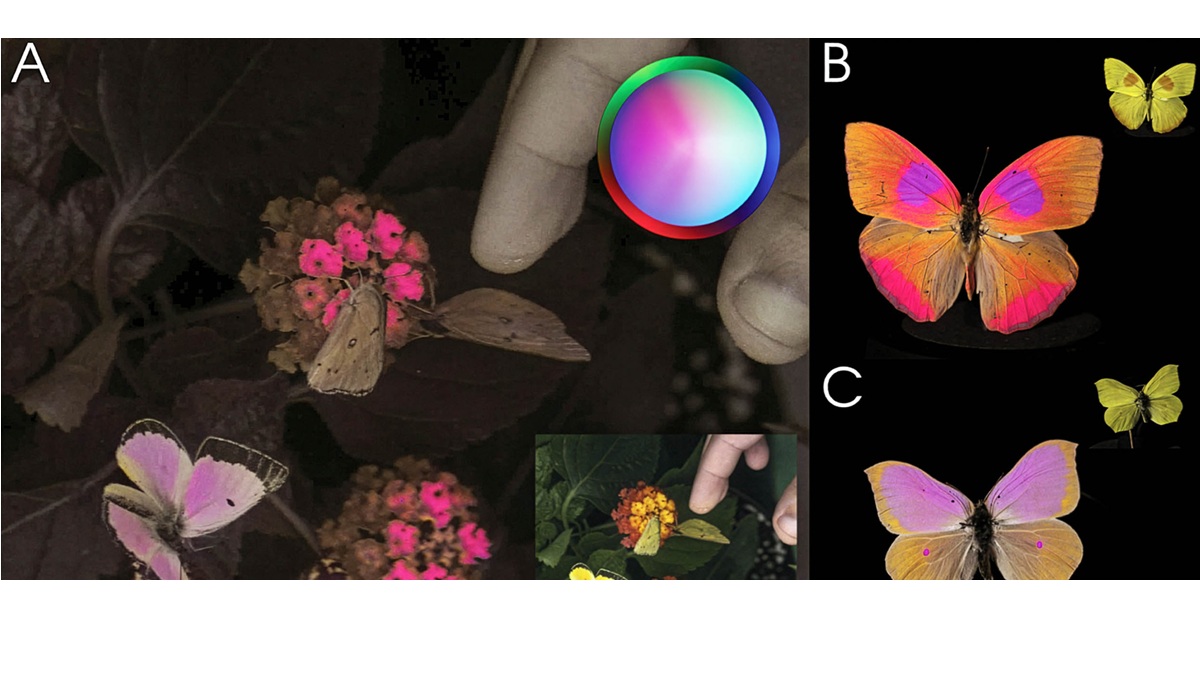
Have you ever imagined how a bee sees a flower or how a dog views your home garden? Until now, the way animals perceive colour has been a mystery that could only be guessed at through theory. However, a breakthrough in camera technology now allows humans to see the world exactly as it is seen by the various animal species. This innovation is led by Vera Vasas, a researcher who has dedicated years to studying fauna vision. In collaboration with the Hanley Color Lab at George Mason University, the team has created a device that can translate the spectrum of light into perceptual units corresponding to animal eyes.
The fundamental difference between humans and animals lies in the photoreceptor cells in the eye. While humans typically have trichromatic vision (sensitive to red, green, and blue), many animals have far more complex abilities.
Birds, for instance, have tetrachromatic vision that allows them to see ultraviolet (UV) light. This ability is crucial for them to forage or choose mates. On the other hand, mammals like dogs and cats have dichromatic vision, which makes them difficult to distinguish red and green, akin to human colour blindness.
The camera system developed by Vasas aims to overcome the limitations of the old method. Previously, visualisation of animal vision could only be achieved through false colour photography, which was time-consuming and unable to capture moving objects.
‘Our system records in four colour channels: blue, green, red, and UV,’ Vasas explained. ‘The data is then converted into “perceptual units”, essentially translating it into a format that replicates animal vision based on known photoreceptor data.’
One of the major advantages of this technology is its accuracy rate of more than 92% compared with traditional spectrophotometry methods. Even more, the device is designed to be practical. Rather than using expensive laboratory equipment, the system is built using commercially available cameras on the market with modular casings produced by 3D printing.
Its impact on the worlds of science and cinematography is enormous. Documentary filmmakers can now present visuals that are more accurate about how prey evade predators or how insects navigate flowers patterns that are invisible to humans.
Besides for education, understanding how animals see the world has practical implications for environmental conservation. Visual adaptations in animals have evolved over millions of years to help them survive in their respective habitats.
‘Thinking about how animals see the world helps us make better decisions about conservation and habitat management,’ Vasas said. ‘This can inform how we design buildings, roads, and even lighting to minimise negative impacts on wildlife.’
The full study on this revolutionary camera technology has been published in the journal PLoS Biology. With this new lens, humans will not only observe nature but also begin to understand the perspectives of other living beings that share the planet with us.